All species › Passerines › Tyrant flycatchers and allies › Smoky Bush Tyrant
Smoky Bush Tyrant | Myiotheretes fumigatus
Roetkleurige struiktiran | Alinaranja ahumada | Tirano-arbustivo-fuliginoso
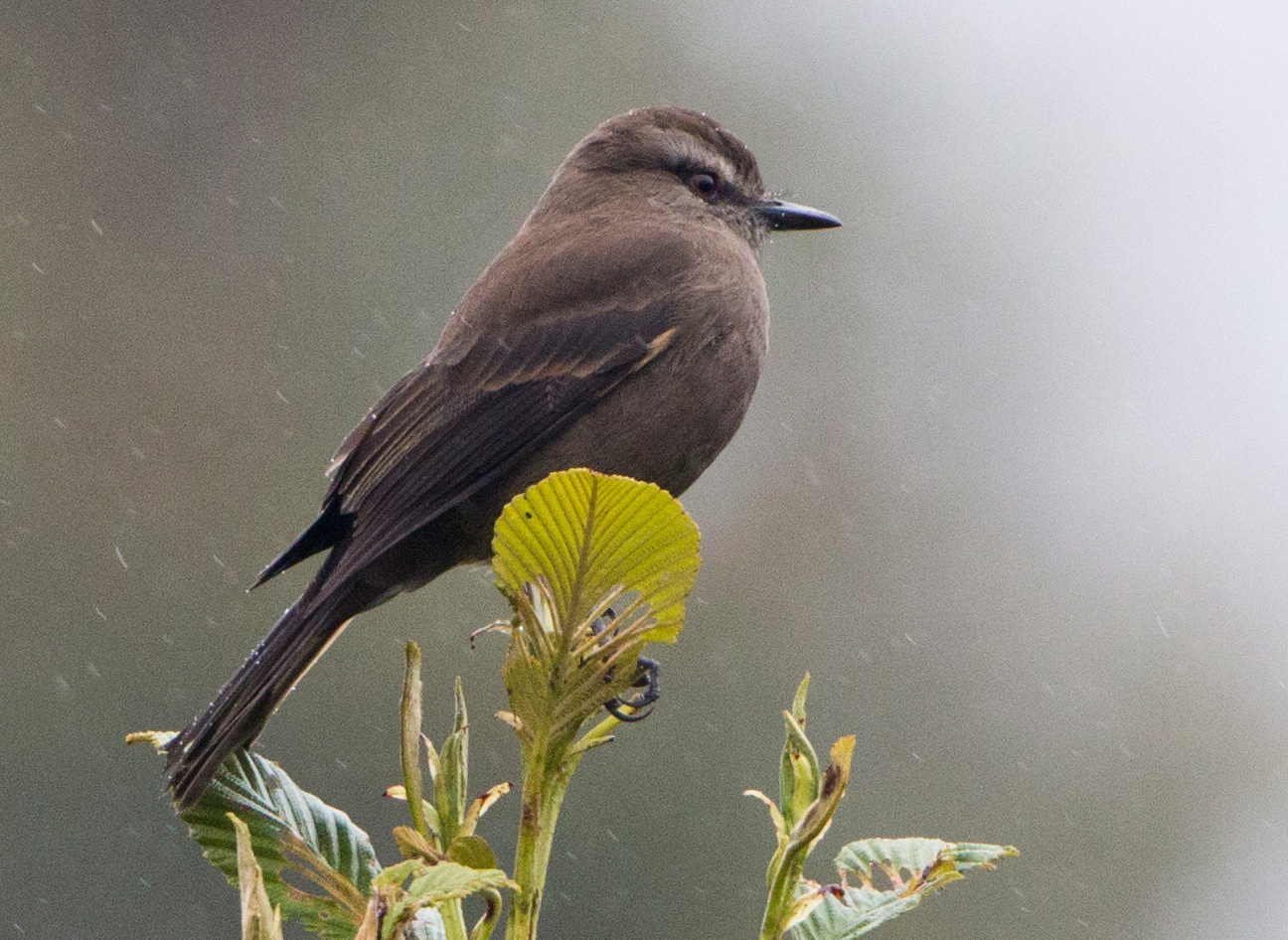
The Smoky Bush Tyrant is a fairly large, uniformly dark brown flycatcher of the upper montane forests of the northern and central Andes. It often perches upright on a bare branch or shrub top at a forest edge and sallies out for insects. In flight it shows cinnamon underwings, the key feature of the species.
Voice
A clear, descending whistle wheeeur, often repeated at intervals, mainly in the early morning; also a short tseep.
Recording: Brian Cox — CC BY-NC-SA 4.0 · xeno-canto
Identification
20 cm, with a fairly long tail and a straight, black bill. The entire plumage is sooty brown, the underparts slightly paler. A narrow, pale supercilium is sometimes visible, and the throat is finely streaked pale. The wings are dark; in flight the cinnamon underwing coverts and rufous inner webs of the primaries show. The sexes are alike; juveniles are slightly warmer brown.
Confusion species
Rufous-bellied Bush Tyrant Myiotheretes fuscorufus has a rufous belly and pale wingbars. Streak-throated Bush Tyrant Myiotheretes striaticollis is larger, with a clearly streaked throat and cinnamon underparts. Smoke-colored Pewee Contopus fumigatus is greyer, with a small crest, and lacks the cinnamon in the wing. Rufous-webbed Bush Tyrant Cnemarchus rufipennis is grey and lives higher, in open terrain.
Habitat
Edges and clearings of humid montane forest and cloud forest, the treeline and shrubby slopes with scattered trees, roughly between 2300 and 3600 m. It perches on a lookout and catches insects in the air or on the ground. The nest is a cup of moss and plant fibres in a tree or shrub.
Where the bird is most at home, classified by the vegetation units of the Andes and the west coast.


Range and movements
Colombia: in all three Andean ranges and in the Serranía de Perijá. Ecuador: on both slopes of the Andes. Peru: along the Andes from north to south, probably to about Cusco. Absent from Bolivia and the Galápagos. Outside the guide area in the Andes of western Venezuela.
- Resident
- dark = core range, pale = thinly spread
How and when to look
Search along roads and trails at the upper forest edge in the early morning; look for a dark brown flycatcher on a bare branch that shows cinnamon underwings when it sallies out.
Conservation status
Least Concern. The species usually occurs at low densities; clearing of forest on the upper slopes degrades its habitat locally.
Scientific name
Myiotheretes fumigatus | (Boissonneau, 1840)
Boissonneau described the species in 1840 as Tyrannula fumigata; because it was later moved to another genus, the author and year stand in brackets. The genus Myiotheretes was introduced in 1850 by Reichenbach. The genus name comes from Greek muia, 'fly', and thērētēs, 'hunter': a fly-hunter. Latin fumigatus, 'smoked', for the sooty-brown plumage. The specimen the first description was based on came from Bogotá, Colombia.