All species › Passerines › Tyrant flycatchers and allies › Snethlage's Tody-Tyrant
Snethlage's Tody-Tyrant | Hemitriccus minor
Snethlages todietiran | Titirijí de Snethlage | Maria-sebinha
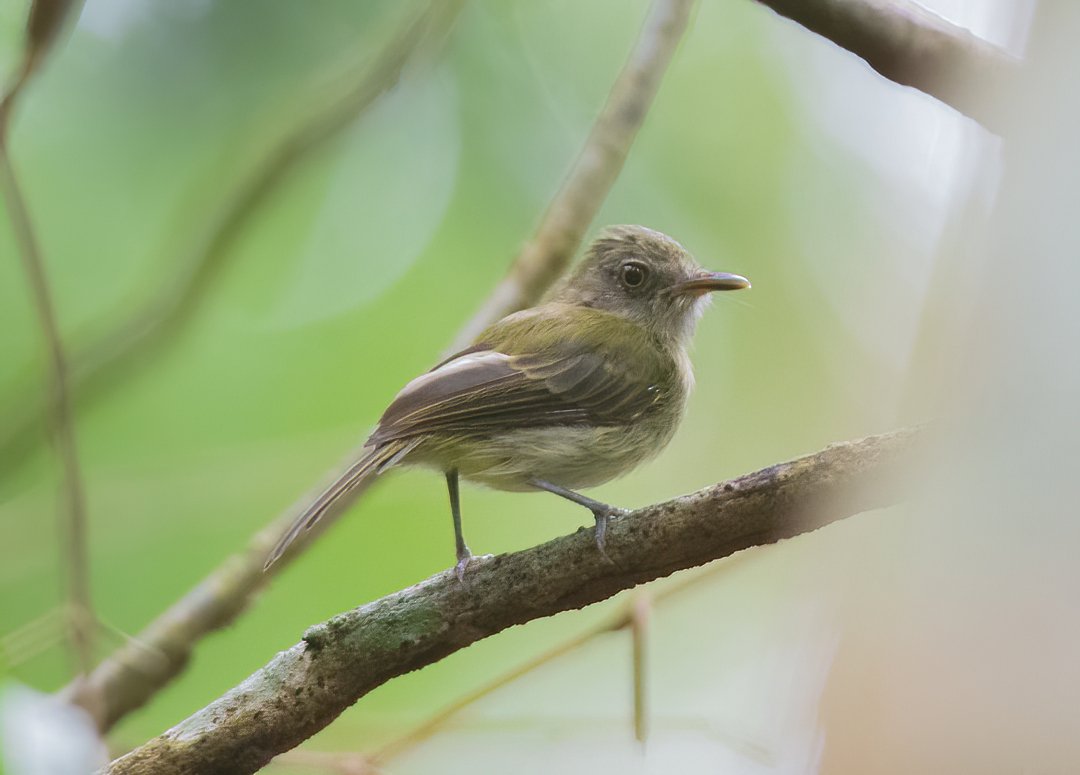
Snethlage's Tody-Tyrant is a small, olive-green tyrant with a pale iris, named after the German ornithologist Emilie Snethlage, who worked in Brazil. The core of its range lies in Brazilian Amazonia; in the guide area it occurs with certainty only in north-eastern Bolivia.
Voice
A short, gravelly, downslurred rattle drrru, which varies in pitch, speed and length between subspecies.
Recording: JAYRSON ARAUJO DE OLIVEIRA — CC BY-NC-SA 4.0 · xeno-canto
Identification
10 cm, with a flat bill and a short, bushy crest. The crown, face, back and rump are olive-green. The wings and tail are olive with greenish-yellow edgings and two indistinct wing bars. The throat and underparts are pale yellow with faint greyish-olive streaks, except the centre of the belly; some birds are mostly white below. The iris is white to pale yellow. The sexes are nearly alike; the female is slightly brighter.
Confusion species
Acre Tody-Tyrant Hemitriccus cohnhafti has a tawny wash on the lores and face and more distinct buff wing bars; it lives in secondary forest on poor sandy soils. White-eyed Tody-Tyrant Hemitriccus zosterops has a more distinct eye-ring and a greyer breast. White-bellied Tody-Tyrant Hemitriccus griseipectus has a white belly and a grey breast.
Habitat
Vine tangles and dense vegetation at forest edges and in treefall gaps in humid terra firme lowland forest and mature secondary forest; the subspecies pallens mainly in igapó. It forages for insects at about 3 to 8 m above the ground.
Where the bird is most at home, classified by the vegetation units of the Andes and the west coast.


Range and movements
Bolivia: the north-east, in Beni and Santa Cruz, locally fairly common. Peru: sight records only; the species is regarded as hypothetical there. Absent from Colombia, Ecuador and the Galápagos. Outside the guide area in Brazilian Amazonia and into Venezuela.
- Resident
- dark = core range, pale = thinly spread
How and when to look
Listen in north-eastern Bolivia, for example in protected areas in Santa Cruz, at forest edges and in treefall gaps for the short, gravelly rattle.
Conservation status
Least Concern. The range is very large; the population is thought to be declining through deforestation, but no immediate threats are known.
Scientific name
Hemitriccus minor | (Snethlage, HMMEE, 1907)
Snethlage, HMMEE described the species in 1907 as Euscarthmus zosterops minor; because it was later moved to another genus, the author and year stand in brackets. The genus Hemitriccus was introduced in 1860 by Cabanis & Heine. The genus name comes from Greek hēmi-, 'half, small', and trikkos, an unidentified small bird, used by ornithologists for tyrant flycatchers. The species name comes from Latin minor, 'smaller', as it was first described as a smaller subspecies of zosterops. The specimen the first description was based on came from Arumateua, Rio Tocantins, Pará, Brazil.