All species › Passerines › New World blackbirds, troupials and allies › Solitary Cacique
Solitary Cacique | Cacicus solitarius
Zwarte buidelspreeuw | Cacique solitario | Iraúna-de-bico-branco
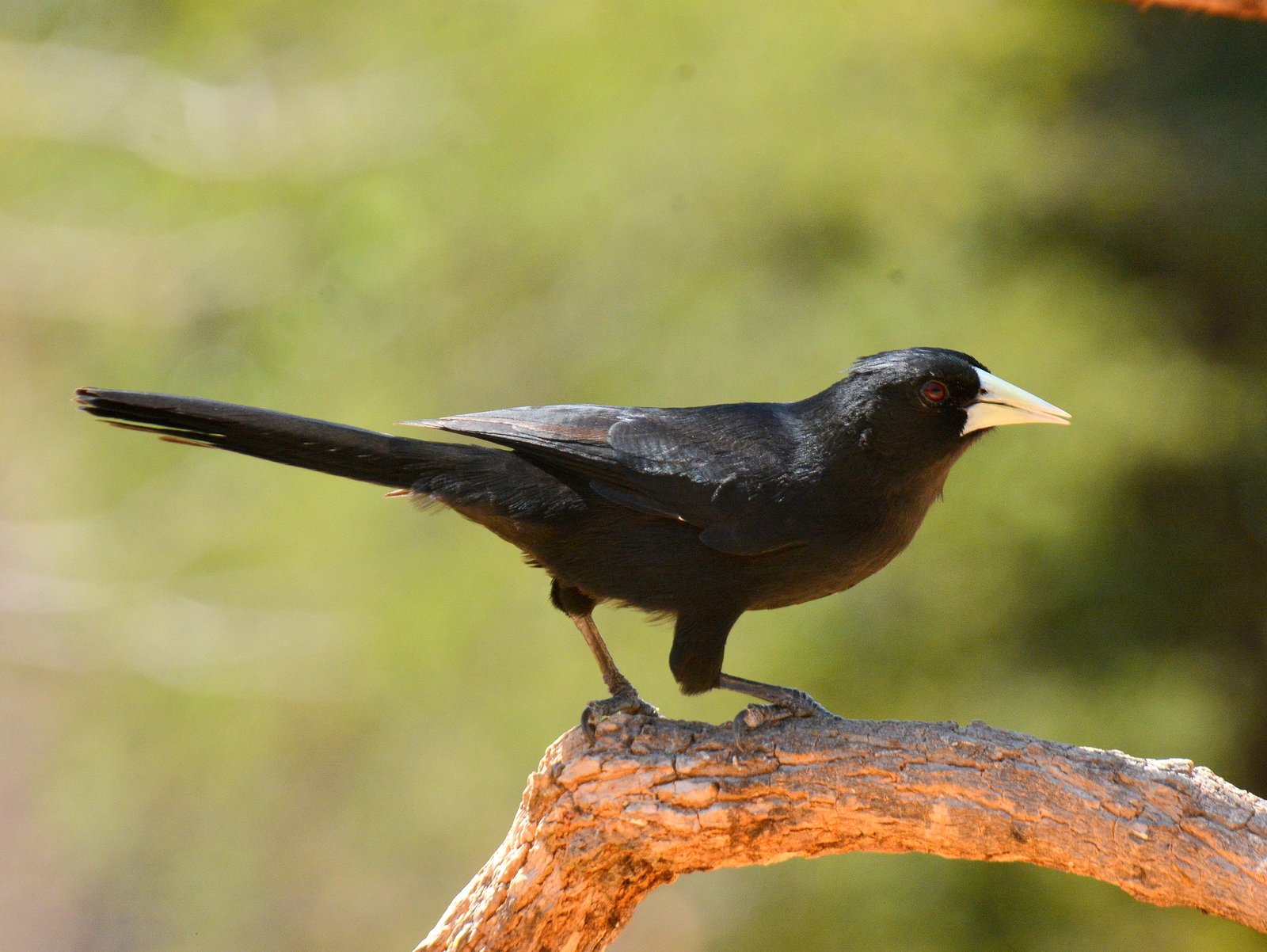
The Solitary Cacique is an all-black cacique of dense thickets and vine tangles along rivers in the lowlands east of the Andes. Unlike most of its relatives it lives alone or in pairs and does not nest in colonies. It usually keeps to low, dense vegetation and is mainly detected by its loud, varied calls.
Voice
Very varied: loud, nasal, mewing calls, a harsh kyah, clucking and grating sounds and clear whistles. It often calls from cover.
Recording: Mateus Gonçalves Santos — CC BY-NC-SA 4.0 · xeno-canto
Identification
23–28 cm; the male is clearly larger than the female. Entirely dull glossy black, with no yellow or red in the plumage. The bill is long and pointed and pale greenish white. The iris is dark. The tail is fairly long. The sexes are otherwise alike. Juveniles are duller black.
Confusion species
Ecuadorian Cacique Cacicus sclateri is smaller, has a pale blue iris and usually stays higher in várzea and river-edge forest. Giant Cowbird Molothrus oryzivorus has a black bill, a small head with a puffed-up neck ruff and often walks on open riverbanks. Shiny Cowbird Molothrus bonariensis is smaller, with a short, dark bill, and lives in open country. Velvet-fronted Grackle Lampropsar tanagrinus is smaller, with a short black bill, and lives in groups.
Habitat
Dense thickets, vine tangles and young forest along rivers and lakes, várzea, river islands, gallery forest and forest edges in the lowlands, mostly below 1000 m. It forages in low to middle levels for insects, spiders and other invertebrates, and also takes fruit and nectar. The nest is a long, hanging pouch, usually suspended singly over or close to water.
Where the bird is most at home, classified by the vegetation units of the Andes and the west coast.


Range and movements
In Colombia in the lowlands east of the Andes, mainly in Amazonia. In Ecuador and Peru in the Amazonian lowlands. In Bolivia in the lowlands of the north and east, including the Beni savannas and the south-east. Absent from the Galápagos. Outside the guide area in southern Venezuela, Amazonian and southern Brazil, Paraguay, Uruguay and northern Argentina.
- Resident
- dark = core range, pale = thinly spread
How and when to look
Listen along riverbanks and on river islands for the nasal calls from dense cover; the bird then sometimes shows briefly at the edge of the thicket. Boat trips along smaller tributaries and walks along lake shores in the Amazonian lowlands give the best chances.
Conservation status
Least Concern. A widespread species that also occurs in secondary growth along water.
Scientific name
Cacicus solitarius | Vieillot, 1816
Vieillot described the species in 1816 and placed it straight away in the genus where it still stands. The genus Cacicus was introduced in 1799 by De Lacépède. The genus name comes from Spanish cacique, 'chief', a word from the Taíno language of the Caribbean. The species name comes from Latin solitarius, 'solitary'. The specimen the first description was based on came from Paraguay.