All species › Parrots › African and New World parrots › Spectacled Parrotlet
Spectacled Parrotlet | Forpus conspicillatus
Gebrilde muspapegaai | Periquito de anteojos | Tuim-de-óculos
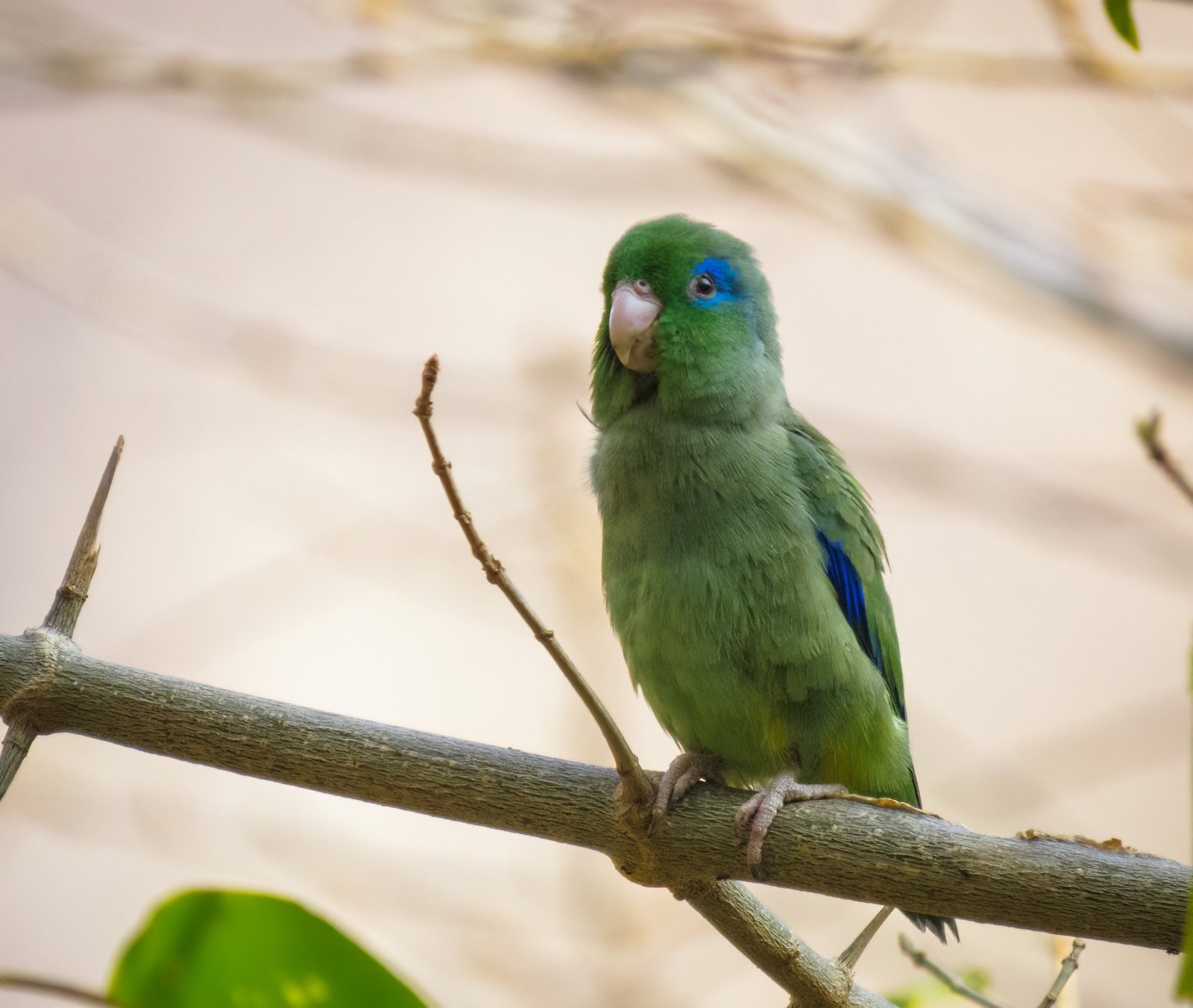
The Spectacled Parrotlet owes its name to the blue ring around the eye of the male. In large parts of Colombia it is one of the commonest small parrots of open, human-made landscapes. Groups move through gardens, plantations and forest edges with constant chattering.
Voice
A high, shrill chirping, often rapidly repeated, and continuous chattering from groups.
Recording: Germán Darío Gallego Chica — CC BY-NC-SA 4.0 · xeno-canto
Identification
12–13 cm, with a short, wedge-shaped tail and a pale bill. The plumage is green, more yellowish below. The male has a blue ring around the eye, a blue rump and blue wing coverts, secondaries and underwing. The female lacks the blue and has a brighter emerald-green ring around the eye. Juveniles resemble the female.
Confusion species
The male Green-rumped Parrotlet Forpus passerinus lacks the blue eye-ring and has a green rump; it lives in the Caribbean lowlands. The male Cobalt-rumped Parrotlet Forpus xanthopterygius lacks the blue eye-ring and has a turquoise-blue rump. Orange-chinned Parakeet Brotogeris jugularis is larger, with a longer, pointed tail, an orange chin spot and brown shoulders.
Habitat
Open and dry woodland, scrub, forest edges, savanna with groves of trees, pasture, plantations, gardens and parks, from the lowlands to about 1800 m. It eats seeds of grasses, herbs and trees, and fruit. It nests in a cavity in a tree or post.
Where the bird is most at home, classified by the vegetation units of the Andes and the west coast.


Range and movements
Widespread in Colombia: in the western Caribbean lowlands, in the Magdalena and Cauca valleys, on the lower Andean slopes and in the llanos east of the Andes. Absent from Ecuador, Peru, Bolivia and the Galápagos. Outside the guide area in eastern Panama and western Venezuela.
- Resident
- dark = core range, pale = thinly spread
How and when to look
Search gardens, parks and plantations in the Cauca and Magdalena valleys and in the llanos. Groups often land in grassland or bushes to feed on seeds, giving their shrill chirping.
Conservation status
Least Concern. Common and probably increased through forest clearance, which has created open landscapes.
Scientific name
Forpus conspicillatus | (de Lafresnaye, 1848)
De Lafresnaye described the species in 1848 as Psittacula conspicillata; because it was later moved to another genus, the author and year stand in brackets. The genus Forpus was introduced in 1858 by Boie. The genus name, introduced by Boie in 1858, is probably arbitrary. It may come from Greek phoreō, 'to possess', and pous, 'foot', for the dexterous toes; according to Prestwich (1963) it is an anagram of Latin profus, 'spread out', for the short, wedge-shaped tail. The species name comes from Latin conspicillum, 'spectacles', for the male's blue eye-ring. The specimen the first description was based on came from Honda, Tolima, Colombia.