All species › Passerines › Thrushes and allies › Spectacled Thrush
Spectacled Thrush | Turdus nudigenis
Naaktooglijster | Zorzal caripelado | Caraxué
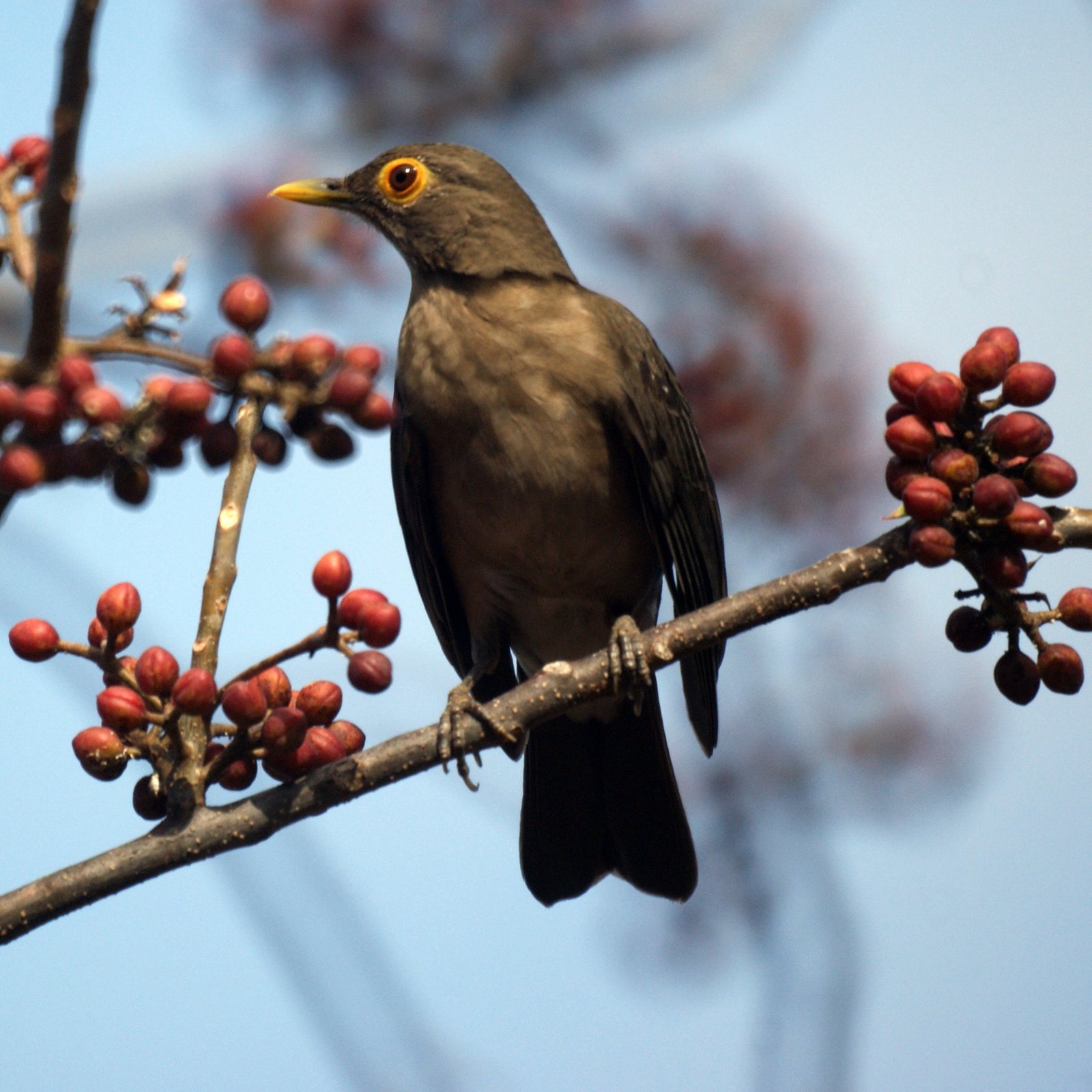
The Spectacled Thrush is an olive-brown thrush of semi-open country in northern South America, with a broad area of bare yellow skin around the eye. In the guide area it occurs only in Colombia, mainly in the Llanos. Ecuadorian Thrush west of the Andes was formerly treated as a subspecies of this species and is now regarded as a separate species.
Voice
The song is a series of clear, fluty phrases, fairly fast and varied, mainly in the early morning. The call is a plaintive, cat-like mee-ow.
Recording: Denis Dujardin — CC BY-NC-SA 4.0 · xeno-canto
Identification
23–24 cm. The upperparts are uniform olive-brown to grey-brown. The throat is white with brown streaks, the breast and flanks are pale grey-brown, and the belly and undertail coverts are white. Around the eye is a broad, bare yellow to yellow-orange ring; the bill is olive-yellow and the legs are grey-brown. The sexes are alike. Young birds have pale spots on the upperparts and dark spots on the breast.
Confusion species
Clay-colored Thrush Turdus grayi is warmer buff-brown below, without a white belly and without a broad bare eye-ring. Pale-breasted Thrush Turdus leucomelas has a grey head contrasting with the brown back, and no yellow eye-ring. Black-billed Thrush Turdus ignobilis has a dark bill and no yellow eye-ring. Ecuadorian Thrush Turdus maculirostris has a narrower eye-ring and lives only west of the Andes in Ecuador and Peru.
Habitat
Open woodland, gallery forest, forest edges, savanna with trees, plantations, farmyards, gardens and parks in the lowlands, mostly below 1000 m. It searches the ground and trees for invertebrates and fruit. The nest is a cup in a tree or shrub, sometimes on a building.
Where the bird is most at home, classified by the vegetation units of the Andes and the west coast.


Range and movements
In Colombia in the east, in the Llanos of Arauca, Casanare, Meta and Vichada and along the Orinoco, and locally in the north-east near the border with Venezuela. Absent from Ecuador, Peru, Bolivia and the Galápagos. Outside the guide area in Venezuela, the Guianas, northern Brazil, Trinidad and Tobago and the Lesser Antilles.
- Resident
- dark = core range, pale = thinly spread
How and when to look
Search in the Llanos around farms, in gallery forest and along roads lined with trees. Birds often perch in the open on branches or walk on lawns and open ground.
Conservation status
Least Concern. The species tolerates farmland, farmyards and villages well and is common over most of its range.
Scientific name
Turdus nudigenis | de Lafresnaye, 1848
De Lafresnaye described the species in 1848 and placed it straight away in the genus where it still stands. The genus Turdus was introduced in 1758 by Linnaeus. The genus name comes from Latin turdus, 'thrush'. The species name comes from Latin nudus, 'bare', and gena, 'cheek', referring to the bare yellow skin around the eye. The specimen the first description was based on came from Caracas, Venezuela.