All species › Passerines › Thrushes and allies › Cocoa Thrush
Cocoa Thrush | Turdus fumigatus
Cacaolijster | Zorzal cacao | Sabiá-da-mata
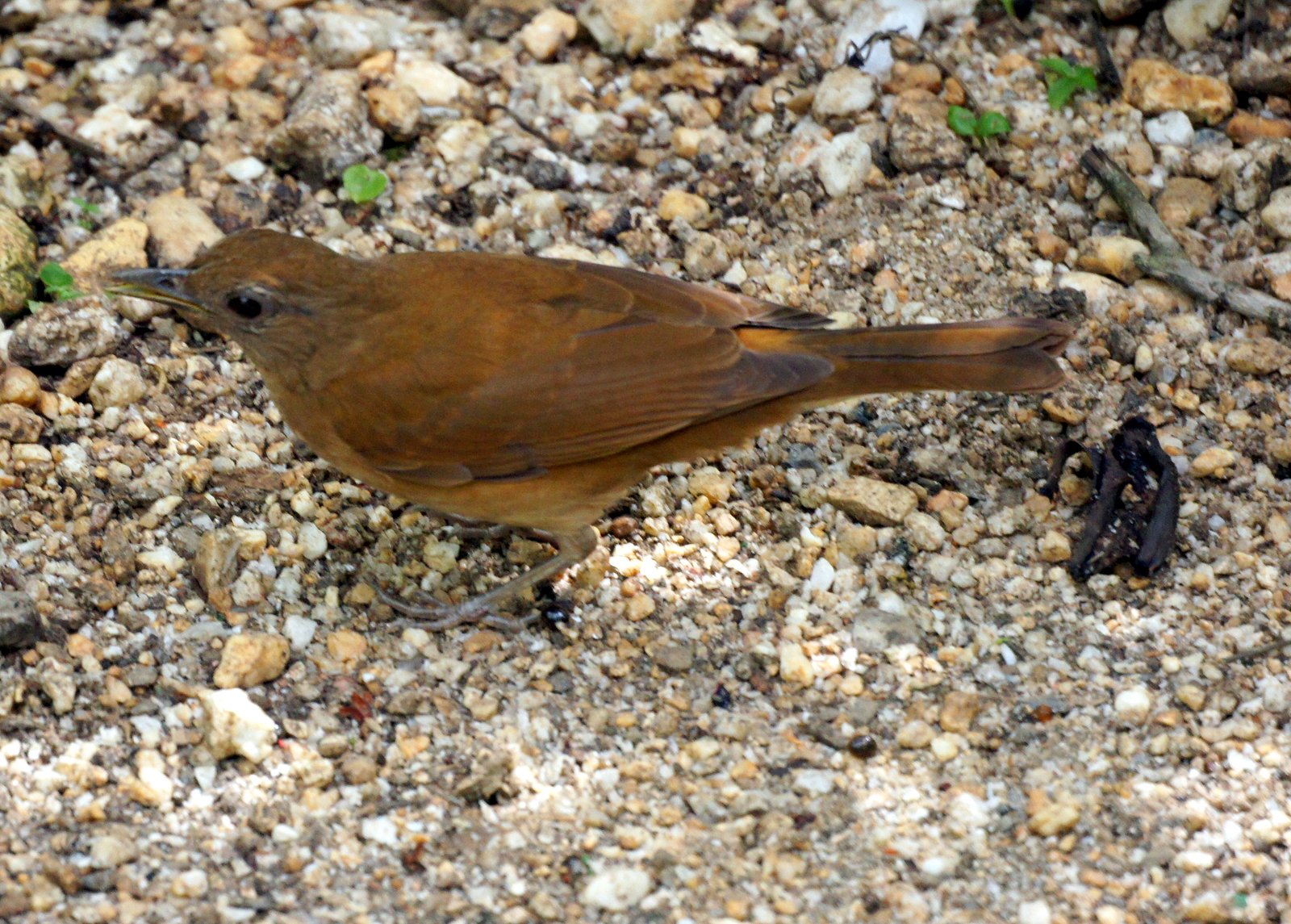
The Cocoa Thrush is a uniformly warm brown thrush of humid forest, gallery forest and plantations in northern South America and the Lesser Antilles. It owes its name to its cocoa-brown plumage and to its presence in cacao plantations. In the guide area it occurs only in Colombia.
Voice
The song is a long series of fluty phrases running into one another; birds in Colombia (orinocensis) sing more haltingly and less fluently than those in the east of the range. Calls are a short chack and a harsh alarm call.
Recording: Jelle Scharringa — CC BY-NC-SA 4.0 · xeno-canto
Identification
22–24 cm. The entire plumage is warm rufous-brown to cocoa-brown, the upperparts slightly darker than the underparts. The throat is paler, with faint dark streaks; the belly and undertail are slightly paler buff, without white. The bill is dark, the legs brown. The sexes are alike. Young birds have pale spots on the upperparts.
Confusion species
Hauxwell's Thrush Turdus hauxwelli is slightly less rufous, with a paler lower belly and undertail, and lives in Amazonia south of the range of Cocoa Thrush. Black-billed Thrush Turdus ignobilis and Clay-colored Thrush Turdus grayi are greyer or paler buff, with a pale belly. Pale-breasted Thrush Turdus leucomelas has a grey head and a white belly.
Habitat
Humid forest, forest edges, gallery forest and swamp forest, and also cacao and shade-coffee plantations, parks and gardens, in Colombia up to about 1500 m. It searches the ground for insects and eats fruit. The nest is a cup of mud and plant material in a tree, against a rock face or among tree roots.
Where the bird is most at home, classified by the vegetation units of the Andes and the west coast.


Range and movements
In Colombia in the east and centre: at the base of the Eastern Cordillera, in the gallery forests of the Llanos and in the Serranía de Perijá. There are no confirmed records from Ecuador and Peru, and occurrence in Bolivia is unconfirmed. Absent from the Galápagos. Outside the guide area in Venezuela, on Trinidad, Grenada and Saint Vincent, in the Guianas and in eastern Amazonian Brazil.
- Resident
- dark = core range, pale = thinly spread
How and when to look
Search along gallery forests and in shady plantations at the foot of the Andes in eastern Colombia; birds often forage on the ground along trails.
Conservation status
Least Concern. It tolerates plantations and secondary forest well.
Scientific name
Turdus fumigatus | Lichtenstein, 1823
Lichtenstein described the species in 1823 and placed it straight away in the genus where it still stands. The genus Turdus was introduced in 1758 by Linnaeus. The genus name comes from Latin turdus, 'thrush'. The species name comes from Latin fumigatus, 'smoked, smoky'. The specimen the first description was based on came from Rio Espírito Santo, Brazil.