All species › Passerines › Thrushes and allies › Hauxwell's Thrush
Hauxwell's Thrush | Turdus hauxwelli
Hauxwells lijster | Zorzal de Hauxwell | Sabiá-bicolor
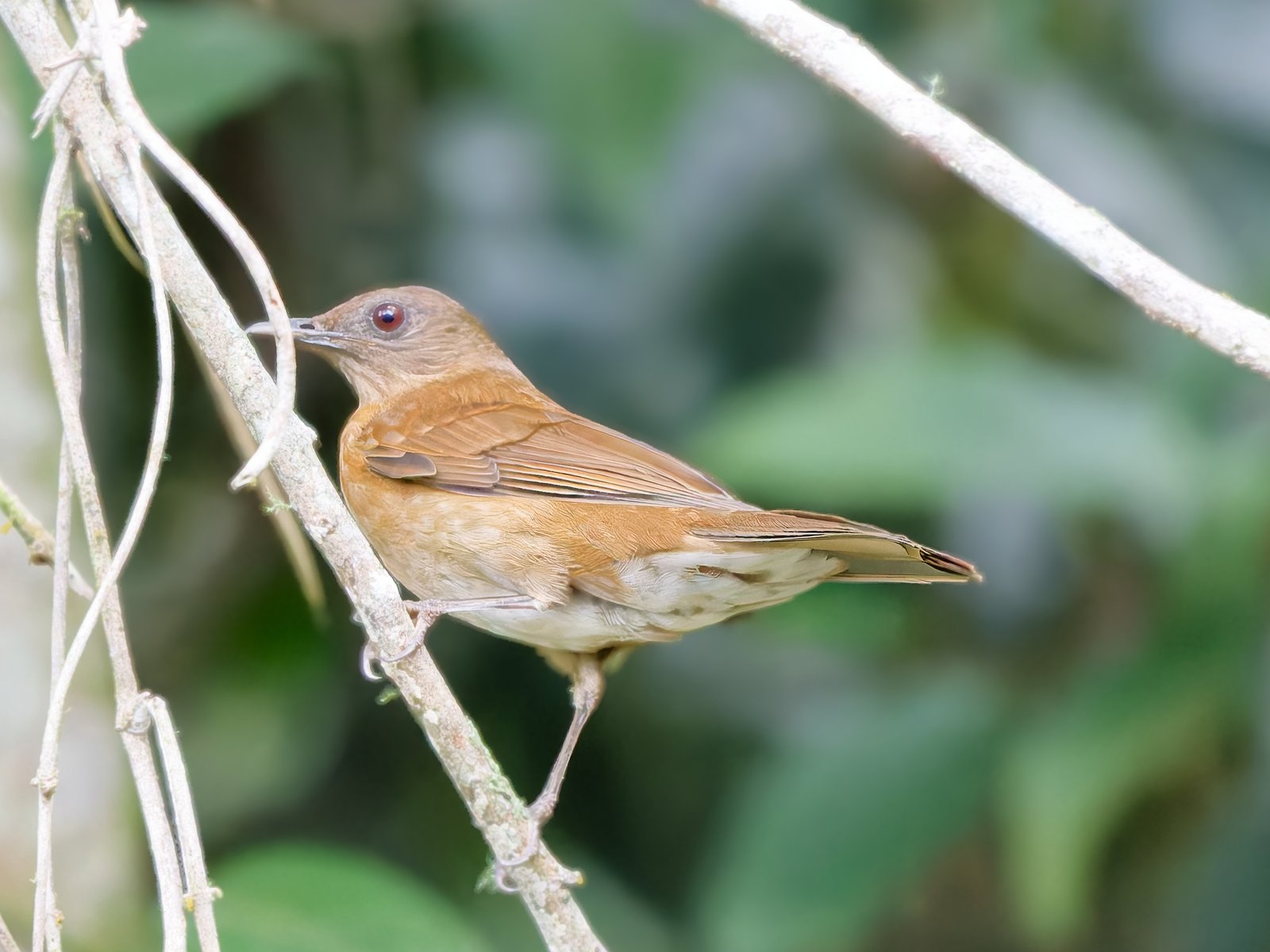
Hauxwell's Thrush is a warm brown thrush of western Amazonia, especially of forest along rivers. Its plumage has few distinctive features; often the song is noticed first. It is closely related to Cocoa Thrush Turdus fumigatus and was formerly treated as a subspecies of it; Varzea Thrush Turdus sanchezorum, described in 2011, is very similar.
Voice
The song is a long, slow series of simple, melodious phrases, sometimes including imitations of other birds. Calls include a rising drrreee? and an upslurred kweeeow?.
Recording: Rob Felix — CC BY-NC-SA 4.0 · xeno-canto
Identification
21–23 cm. The upperparts are olive-brown to warm brown. The throat is white with dark streaks, the breast and flanks are warm brown, the belly is paler and the undertail coverts are whitish to buff. The bill is dark; an eye-ring is absent or narrow. The sexes are alike. Young birds have pale spots on the upperparts.
Confusion species
Varzea Thrush Turdus sanchezorum is almost identical in plumage, slightly more rufous on the back and breast; the difference lies mainly in the song. Lawrence's Thrush Turdus lawrencii is darker, and the male has a yellow bill. Black-billed Thrush Turdus ignobilis is greyer, with a white belly. White-necked Thrush Turdus albicollis has a white half-collar and grey flanks.
Habitat
Humid lowland forest, especially várzea, river islands and riverside forest, but also terra firme, mostly below 500 m, in Peru locally to 1500 m. It searches the ground and the understorey for insects and eats fruit in the middle levels. The nest is a cup of moss and plant material in a tree.
Where the bird is most at home, classified by the vegetation units of the Andes and the west coast.


Range and movements
In Colombia in Amazonia in the south-east. In Ecuador in the eastern lowlands. In Peru in Amazonia, up into the foothills. In Bolivia in the north. Absent from the Galápagos. Outside the guide area in western Amazonian Brazil, possibly also in south-western Venezuela.
- Resident
- dark = core range, pale = thinly spread
How and when to look
Listen in the early morning along riverbanks and in várzea forest for the slow, melodious song; birds often sit low and forage on the ground.
Conservation status
Least Concern. Widespread in western Amazonia.
Scientific name
Turdus hauxwelli | Lawrence, 1869
Lawrence described the species in 1869 and placed it straight away in the genus where it still stands. The genus Turdus was introduced in 1758 by Linnaeus. The genus name comes from Latin turdus, 'thrush'. The species name honours John Hauxwell, English collector of birds and insects on the upper Amazon, who supplied the type material. The specimen the first description was based on came from Pebas, Peru.