All species › Passerines › Thrushes and allies › Pale-breasted Thrush
Pale-breasted Thrush | Turdus leucomelas
Vaalborstlijster | Zorzal sabiá | Sabiá-branco
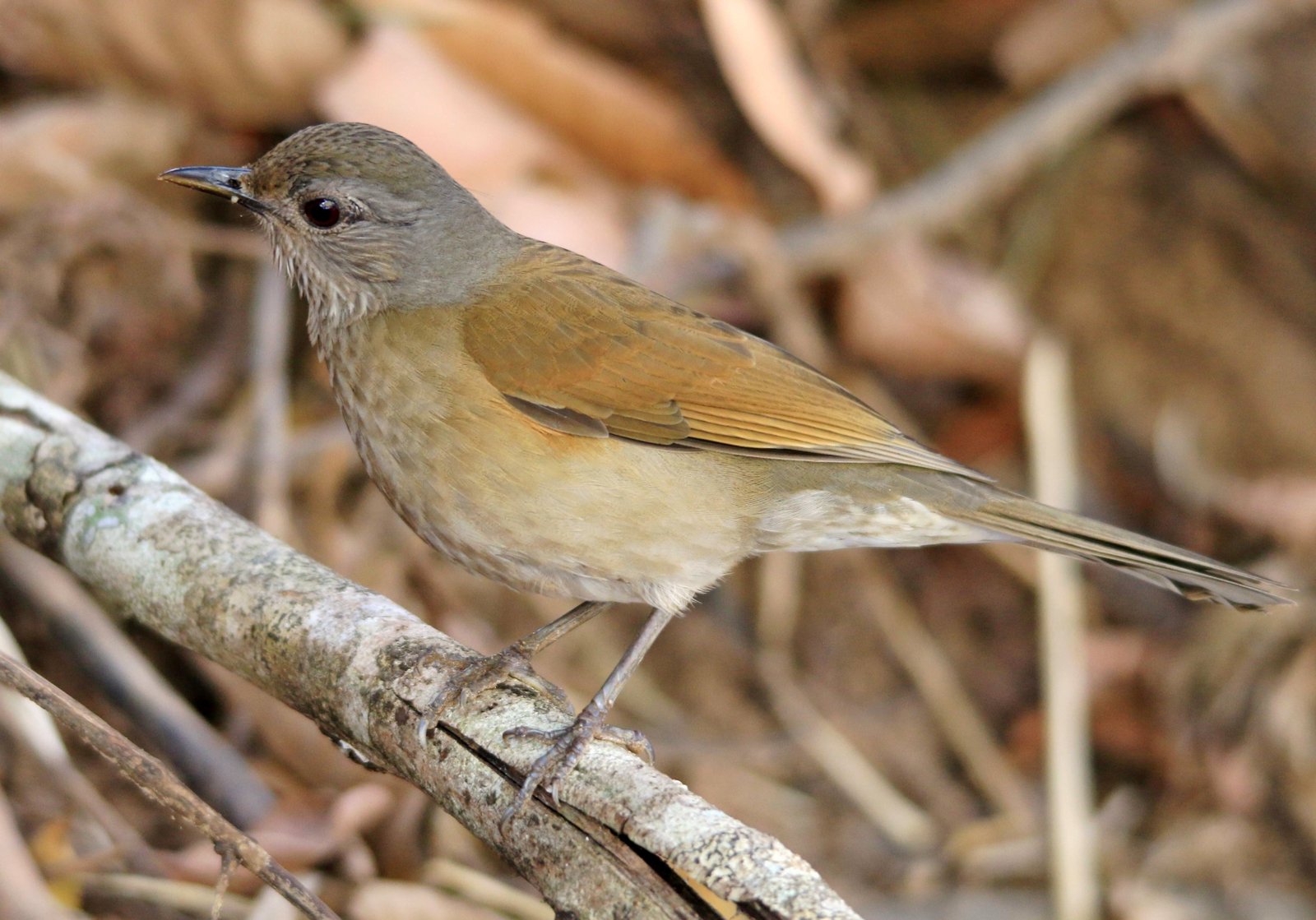
The Pale-breasted Thrush is a greyish-brown thrush of open woodland, forest edges and gardens in northern and eastern South America. A distinctive feature is the grey head, which contrasts with the browner back. It is common in man-made landscapes such as parks, plantations and villages.
Voice
The song is a rich, rambling series of fluty phrases, often long sustained. A characteristic call is a harsh, jay-like jeap; also a dry chook.
Recording: Christian Kerihuel — CC BY-NC-SA 4.0 · xeno-canto
Identification
22–24 cm. The head and nape are grey, the back and wings warmer olive-brown. The throat is white with brown streaks, the breast pale greyish brown and the belly white. The underwing is rufous. The bill is dark, with a yellowish lower mandible; there is no obvious eye-ring. The sexes are alike. Young birds are spotted on the breast and upperparts.
Confusion species
Creamy-bellied Thrush Turdus amaurochalinus is more uniform greyish brown, without a grey head, with dark lores and, in the breeding male, a yellow bill; it occurs mainly as a winter visitor from the south. Black-billed Thrush Turdus ignobilis has a black bill and a uniform greyish-brown head. Clay-colored Thrush Turdus grayi is warmer buff on the breast and belly.
Habitat
Open woodland, gallery forest, forest edges, savanna with trees, plantations, parks and gardens, from sea level to about 1800 m in Colombia. It searches lawns and open ground for insects and earthworms and eats much fruit. The nest is a cup of grass and mud in a tree or on a building.
Where the bird is most at home, classified by the vegetation units of the Andes and the west coast.


Range and movements
In Colombia widespread in the north, in the Magdalena and Cauca valleys and east of the Andes in the Llanos. In Peru only in the far south-east, in the savannas of the Pampas del Heath. In Bolivia in the lowlands of the north and east. Absent from Ecuador and the Galápagos. Outside the guide area in Venezuela, the Guianas, much of Brazil, Paraguay and north-eastern Argentina.
- Resident
- dark = core range, pale = thinly spread
How and when to look
Search parks, gardens and coffee plantations and along forest edges; birds often walk on open ground and give themselves away by their harsh call.
Conservation status
Least Concern. Common and well adapted to open, man-made landscapes.
Scientific name
Turdus leucomelas | Vieillot, 1818
Vieillot described the species in 1818 and placed it straight away in the genus where it still stands. The genus Turdus was introduced in 1758 by Linnaeus. The genus name comes from Latin turdus, 'thrush'. The species name comes from Greek leukos, 'white', and melas, 'black'. The specimen the first description was based on came from Paraguay.