All species › Passerines › Thrushes and allies › White-throated Thrush
White-throated Thrush | Turdus assimilis
Mexicaanse witneklijster | Mirlo garganta blanca | Sabiá-de-garganta-branca
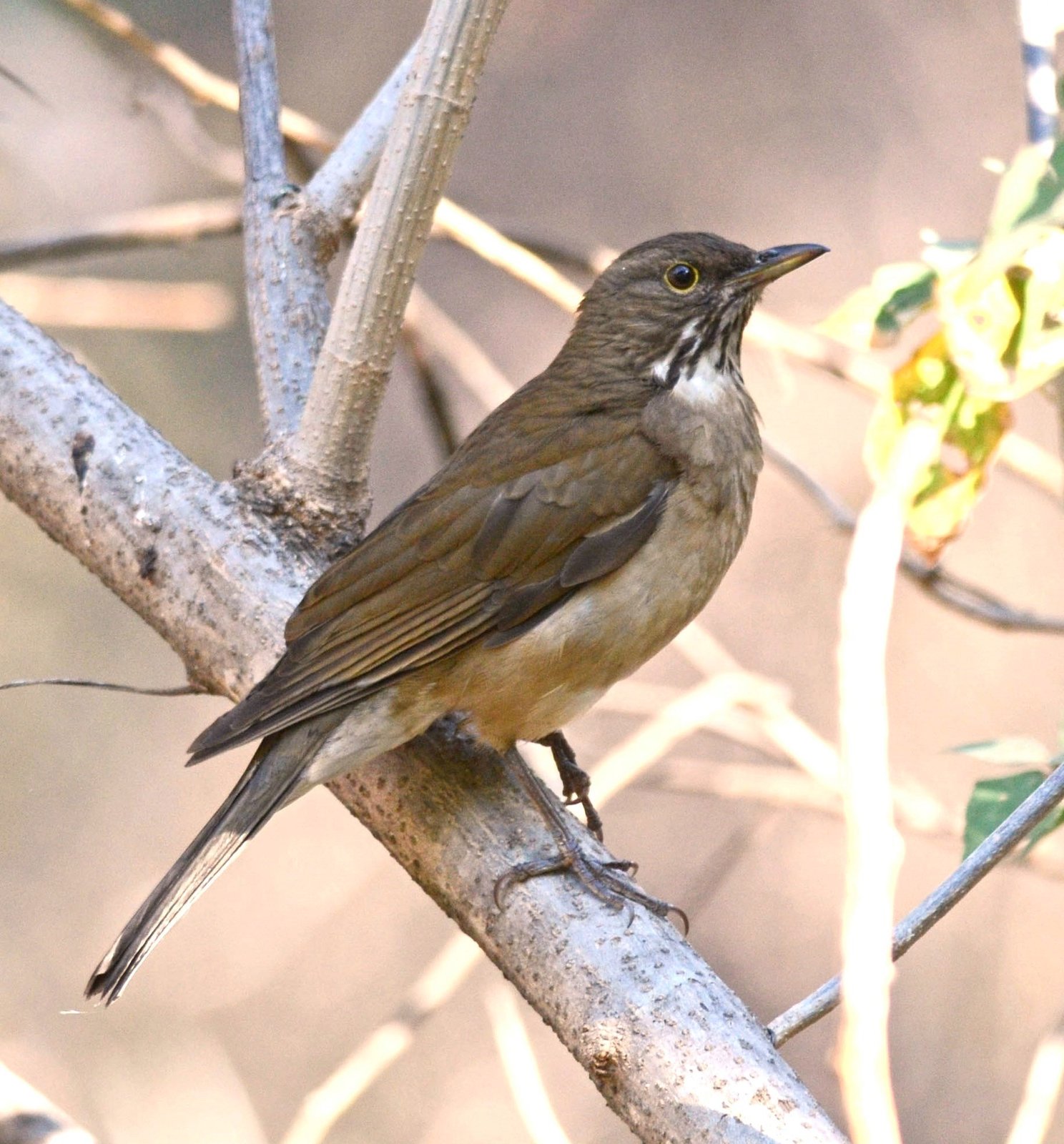
The White-throated Thrush is a thrush of montane forest in Mexico and Central America, with a streaked throat, a white half-collar and a yellow eye-ring. In current classification it does not reach South America: the birds of the Chocó in western Colombia and western Ecuador, formerly included in this species, belong to Dagua Thrush Turdus daguae. For the guide area the species is mainly relevant for comparison and for older literature.
Voice
The song is a long, varied series of rich, fluty phrases, each usually repeated two to four times, sometimes with imitations. The call is a nasal enk.
Recording: Manuel Grosselet — CC BY-NC-SA 4.0 · xeno-canto
Identification
22–24 cm. The upperparts are olive-brown to greyish brown. The throat is white with black streaks and is bordered below by a white crescent. The breast and flanks are greyish brown, the belly and undertail white. The bill is yellowish to greenish yellow with a dark tip, the eye-ring yellow to orange. The sexes are alike. Young birds have pale spots on the upperparts and a spotted breast.
Confusion species
Dagua Thrush Turdus daguae is smaller and darker, with a dark bill. White-necked Thrush Turdus albicollis lives east of the Andes and has greyer flanks and a dark bill. Pale-vented Thrush Turdus obsoletus lacks the white throat band.
Habitat
Humid and semi-humid montane and foothill forest, forest edges and shade-coffee plantations, in Mexico and Central America up to about 2500 m. It feeds on the ground and in trees on insects and fruit. Outside the breeding season part of the population moves down to lower forest.
Where the bird is most at home, classified by the vegetation units of the Andes and the west coast.


Range and movements
In current classification no confirmed occurrence in the guide area: birds from Colombia and Ecuador belong to Dagua Thrush, and records under this name from the guide area almost certainly refer to that species. Absent from Peru, Bolivia and the Galápagos. Outside the guide area from northern Mexico to central Panama.
- Resident
- dark = core range, pale = thinly spread
How and when to look
The species is not to be expected in the guide area; birds with a streaked throat and a white throat band in the Chocó are Dagua Thrushes.
Conservation status
Least Concern. Locally fairly common in Central America, but dependent on montane forest and shade coffee.
Scientific name
Turdus assimilis | Cabanis, 1851
Cabanis described the species in 1851 and placed it straight away in the genus where it still stands. The genus Turdus was introduced in 1758 by Linnaeus. The genus name comes from Latin turdus, 'thrush'. The species name comes from Latin assimilis, 'similar'. The specimen the first description was based on came from Xalapa, Veracruz, Mexico.