All species › Passerines › Thrushes and allies › Lawrence's Thrush
Lawrence's Thrush | Turdus lawrencii
Lawrence' lijster | Zorzal imitador | Caraxué-de-bico-amarelo
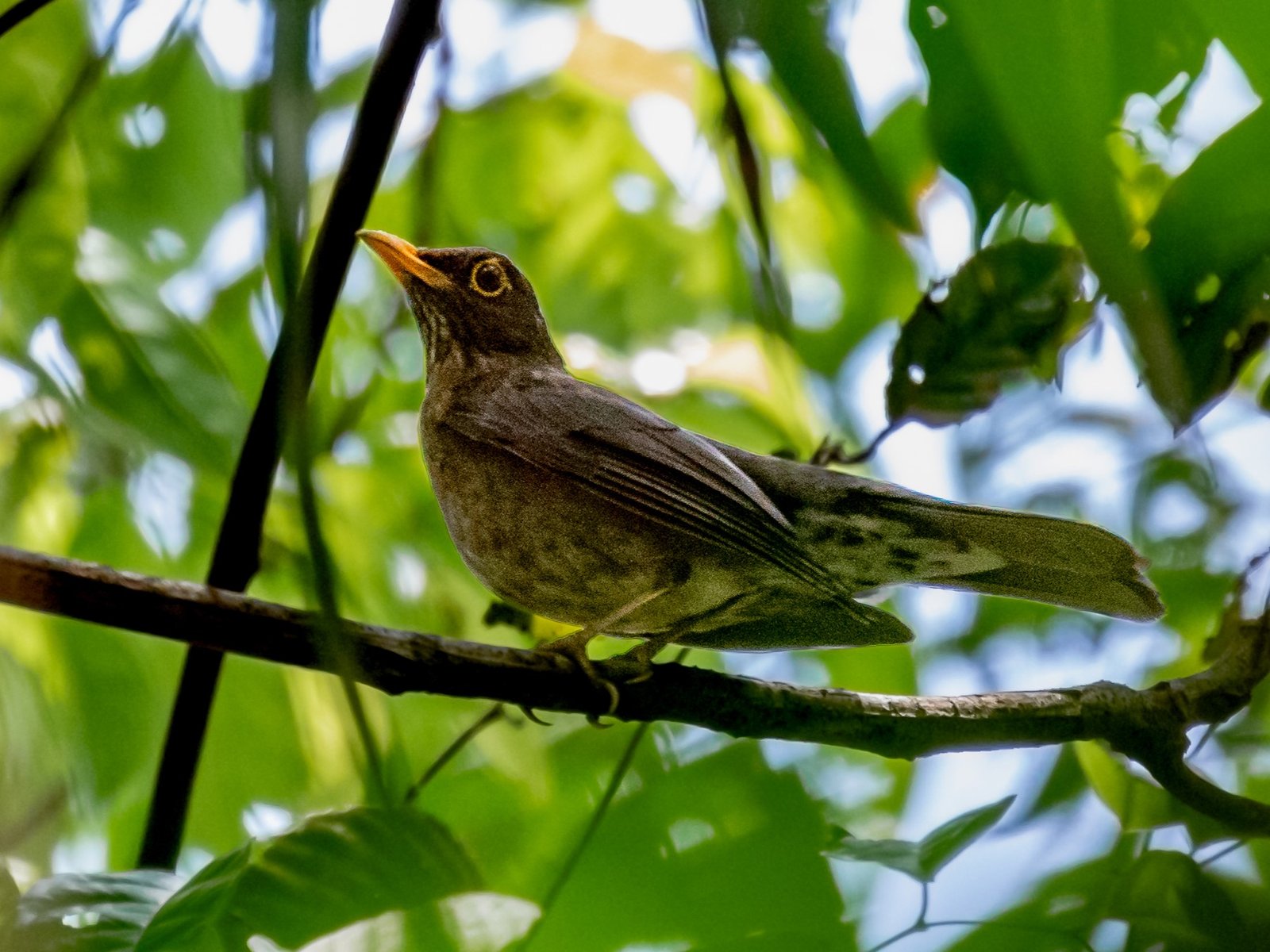
Lawrence's Thrush is a dark brown thrush of the canopy of Amazonian forest. Its song consists almost entirely of imitations of other birds, frogs and insects; dozens of mimicked species have been documented from single birds. It often sings for long periods from a hidden perch high in a tree.
Voice
The song is a long, continuous series of imitations of the calls of other birds, such as parrots, woodpeckers, woodcreepers and antshrikes, and of frogs, interspersed with short calls of its own. It often sings for long periods, also in the middle of the day. The call is a soft chook.
Recording: JAYRSON ARAUJO DE OLIVEIRA — CC BY-NC-SA 4.0 · xeno-canto
Identification
21–23 cm. The upperparts are dark chocolate-brown. The throat is white with broad black streaks, the breast dark brown, the belly and undertail white. The male has a bright yellow bill and a yellow eye-ring; in the female the bill is dark and the eye-ring less distinct. Young birds have rufous spots on the upperparts.
Confusion species
Hauxwell's Thrush Turdus hauxwelli is warmer and paler brown, with a dark bill in both sexes, and sings mainly its own phrases. Black-billed Thrush Turdus ignobilis is greyer, with a black bill, and lives in open country along rivers and near villages. White-necked Thrush Turdus albicollis has a white band below the streaked throat and grey flanks.
Habitat
The canopy and middle levels of humid terra firme and várzea lowland forest, mostly below 600 m. It feeds high in the trees on fruit and insects. The nest is a cup of moss and fibres in a tree.
Where the bird is most at home, classified by the vegetation units of the Andes and the west coast.


Range and movements
In Colombia in Amazonia in the south-east. In Ecuador in the eastern lowlands. In Peru in Amazonia. In Bolivia in the north. Absent from the Galápagos. Outside the guide area in western Amazonian Brazil and southern Venezuela.
- Resident
- dark = core range, pale = thinly spread
How and when to look
Listen from a canopy tower or a clearing in the forest for a singer that seems to switch from one species to another; then scan the dense canopy for the yellow bill of the male.
Conservation status
Least Concern. The Amazonian forest it inhabits is still largely continuous.
Scientific name
Turdus lawrencii | Coues, 1880
Coues described the species in 1880 and placed it straight away in the genus where it still stands. The genus Turdus was introduced in 1758 by Linnaeus. The genus name comes from Latin turdus, 'thrush'. The species name honours George Newbold Lawrence (1806–1895), American ornithologist who described the species in 1878 as Turdus brunneus; Coues renamed it because that name was preoccupied. The specimen the first description was based on came from (per the original description).