All species › Passerines › Thrushes and allies › Dagua Thrush
Dagua Thrush | Turdus daguae
Daguawitneklijster | Zorzal del Dagua | Sabiá-do-dagua
The Dagua Thrush is a small, dark thrush with a streaked throat and a white half-collar, restricted to the humid lowlands and foothills of the Chocó. It was formerly treated as a subspecies of White-throated Thrush Turdus assimilis; on the basis of plumage, song and DNA it is now regarded as a separate species. The name refers to the Dagua River in western Colombia.
Voice
The song is a series of varied, fluty phrases, often repeated and interspersed with higher notes. The call is a short, nasal enk.
Recording: Juan Freile — CC BY-NC-SA 4.0 · xeno-canto
Identification
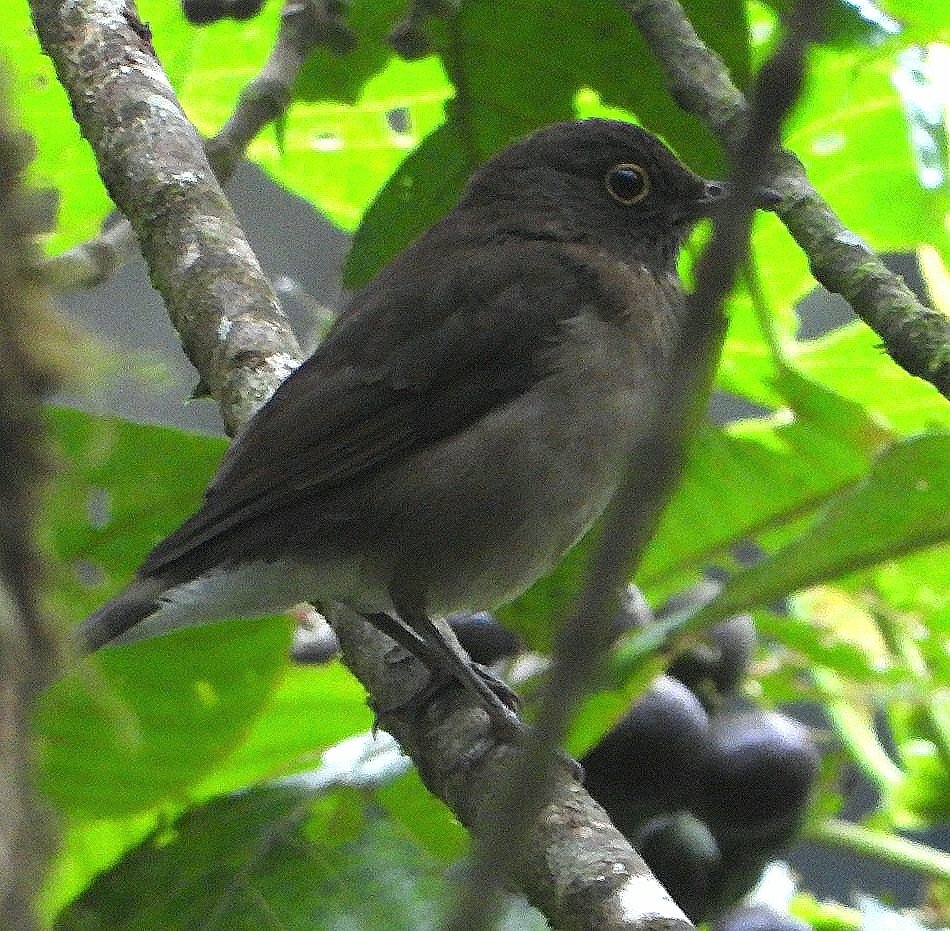
21–22 cm. The upperparts are dark olive-brown. The throat is white with blackish-brown streaks and is bordered below by a white crescent on the lower throat. The breast and flanks are brownish grey, the belly and undertail white. The bill is dark, the eye-ring yellowish orange. The sexes are alike. Young birds are spotted on the breast and upperparts.
Confusion species
White-necked Thrush Turdus albicollis has a similar throat pattern, but lives only east of the Andes. Pale-vented Thrush Turdus obsoletus lacks the white throat band and has a uniform brown breast with a white lower belly. Ecuadorian Thrush Turdus maculirostris is paler greyish brown, with a yellow bill and no white throat band.
Habitat
Understorey and middle levels of humid forest in the lowlands and foothills, roughly between 100 and 1200 m. It searches the ground and the understorey for insects and eats fruit in the trees. The nest is a cup of moss and fibres in a tree or shrub.
Where the bird is most at home, classified by the vegetation units of the Andes and the west coast.


Range and movements
In Colombia on the Pacific side, from the Chocó to Nariño. In Ecuador in the north-west and south along the western slope. Absent from Peru, Bolivia and the Galápagos. Outside the guide area in eastern Panama (Darién).
How and when to look
Listen in the early morning in the foothills of the Chocó, for example in north-western Ecuador, for the song from the understorey of closed forest.
Conservation status
Not Evaluated as a separate species. It is tied to humid lowland and foothill forest, which is heavily threatened by deforestation.
Scientific name
Turdus daguae | Berlepsch, 1897
Berlepsch described the species in 1897 and placed it straight away in the genus where it still stands. The genus Turdus was introduced in 1758 by Linnaeus. The genus name comes from Latin turdus, 'thrush'. The species name refers to the Río Dagua in western Colombia, not necessarily the type locality. The specimen the first description was based on came from San José, Río Dagua, Colombia.