All species › Passerines › Thrushes and allies › Pale-vented Thrush
Pale-vented Thrush | Turdus obsoletus
Bleekbuiklijster | Mirlo ventripálido | Sabiá-de-ventre-pálido
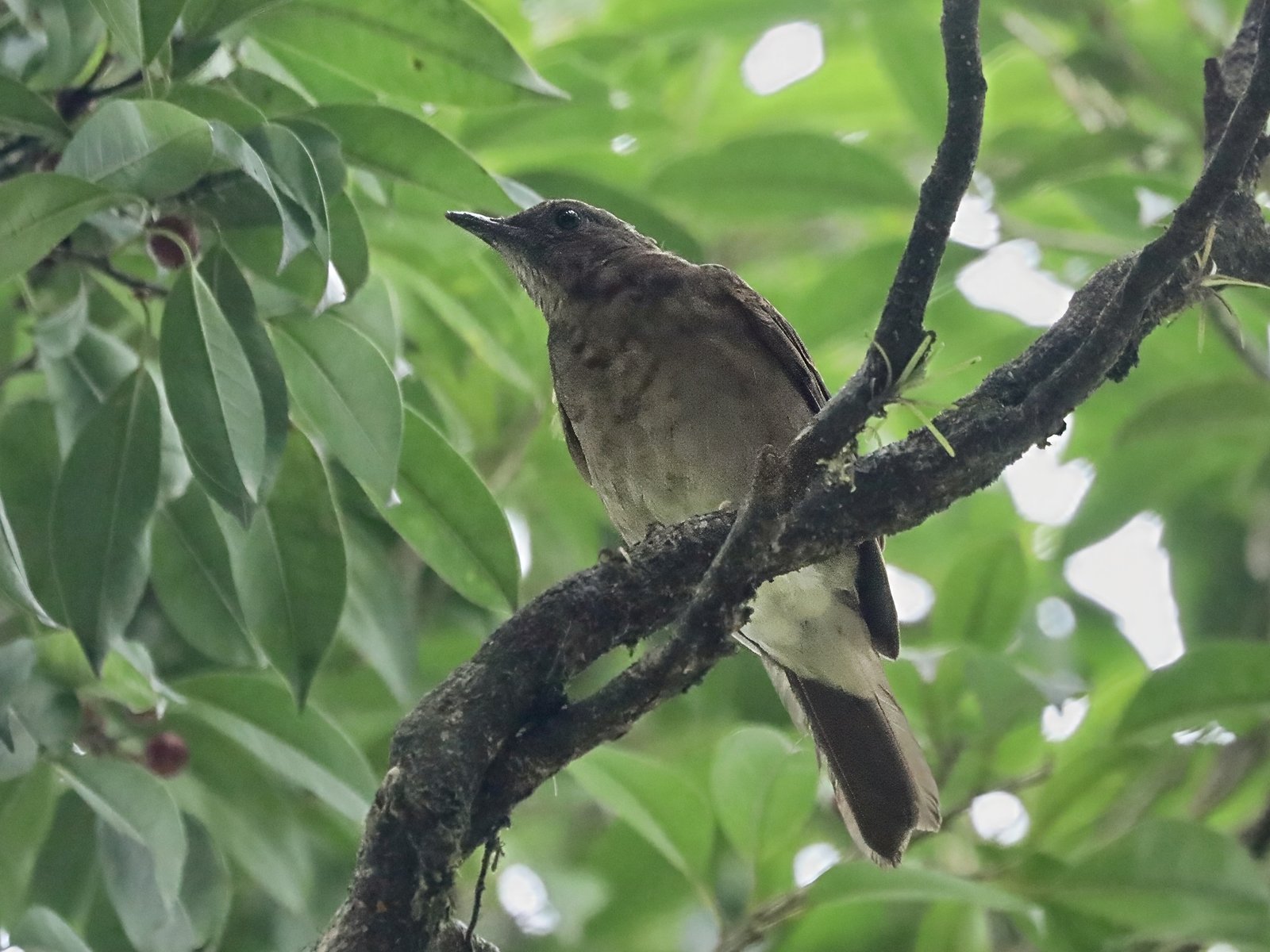
The Pale-vented Thrush is a uniformly dark brown thrush of humid foothill and lower montane forest on the Pacific side of the Andes. Its clearest feature is the white lower belly and undertail, which contrasts sharply with the otherwise brown plumage. It lives mainly in the canopy, where it searches for fruit.
Voice
The song is a series of rich, fluty phrases, similar to those of other Turdus thrushes, but fairly fast and little varied. Calls include a short chook and a rising wheee.
Recording: José María Loaiza B. — CC BY-NC-SA 4.0 · xeno-canto
Identification
22–23 cm. The upperparts, head and breast are uniform dark olive-brown to chocolate-brown. The throat is slightly paler, with faint dark streaks. The lower belly and undertail coverts are clean white. The bill is blackish and the legs dark greyish brown; there is no obvious eye-ring. The sexes are alike. Young birds have rufous spots on the upperparts and a spotted breast.
Confusion species
Ecuadorian Thrush Turdus maculirostris is paler greyish brown, with a yellow bill and a yellow eye-ring. Dagua Thrush Turdus daguae has a white band below the streaked throat. Hauxwell's Thrush Turdus hauxwelli is very similar, but lives only east of the Andes. The male Glossy-black Thrush Turdus serranus is glossy black with an orange bill and lives higher.
Habitat
Humid forest, forest edges and mature secondary forest in the lowlands and foothills, roughly between 200 and 1500 m, locally higher. It feeds mainly on fruit in the canopy and middle levels; outside the breeding season it wanders to fruiting trees and sometimes moves altitudinally. The nest is a cup of moss in a tree.
Where the bird is most at home, classified by the vegetation units of the Andes and the west coast.


Range and movements
In Colombia on the Pacific side, along the western slope of the Western Cordillera, and locally in the northern outliers of the Andes. In Ecuador in the north-west, in the foothills and lower montane forest of the western slope. Absent from Peru, Bolivia and the Galápagos. Outside the guide area in Costa Rica and Panama.
- Resident
- dark = core range, pale = thinly spread
How and when to look
Search fruiting trees along forest edges and roads in the foothills of north-western Ecuador and western Colombia; on birds flying off, note the white lower belly.
Conservation status
Least Concern. Foothill forest in the Chocó is being cleared on a large scale, but the species tolerates forest edges and mature secondary forest.
Scientific name
Turdus obsoletus | Lawrence, 1862
Lawrence described the species in 1862 and placed it straight away in the genus where it still stands. The genus Turdus was introduced in 1758 by Linnaeus. The genus name comes from Latin turdus, 'thrush'. The species name comes from Latin obsoletus, 'plain, indistinct (in markings)'. The specimen the first description was based on came from Caribbean side of the Isthmus, Panama.