All species › Passerines › Thrushes and allies › White-necked Thrush
White-necked Thrush | Turdus albicollis
Witneklijster | Zorzal cuelliblanco | Sabiá-coleira
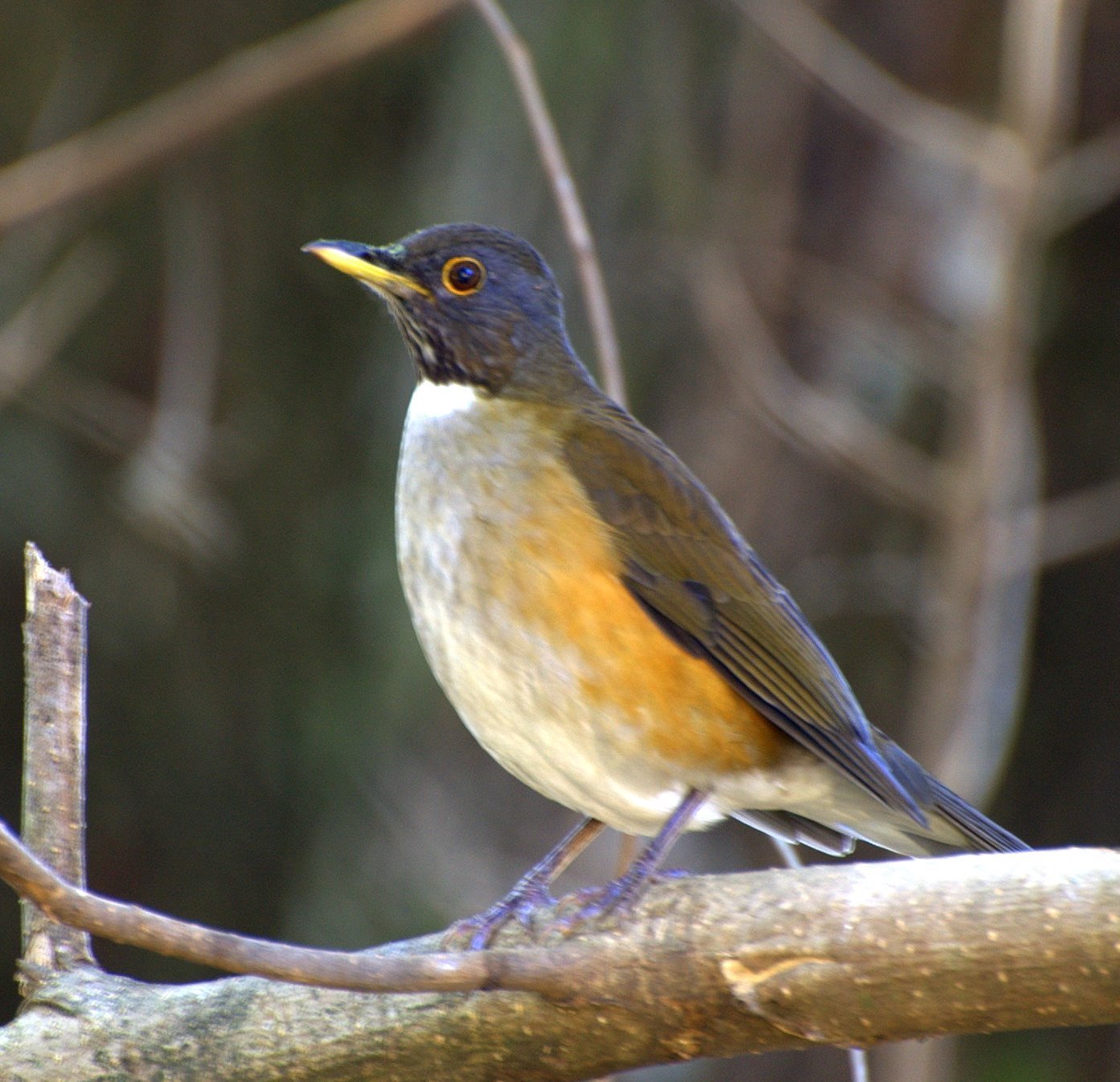
The White-necked Thrush is a brown thrush of the understorey of humid lowland and foothill forest, with a streaked throat and a white half-collar. It keeps to the shade of closed forest and mostly gives itself away by its slow song. As treated in this guide the species includes the Amazonian populations and an isolated form in the Yungas of Peru and Bolivia; some authors split the Amazonian birds as a separate species.
Voice
The song is a slow, monotonous series of short, fluty phrases of two to four notes, repeated at intervals from the middle level of the forest. The call is a nasal kwek.
Recording: Fabrício Grigolin — CC BY-NC-SA 4.0 · xeno-canto
Identification
21–22 cm. The upperparts are olive-brown to warm brown. The throat is white with dense blackish-brown streaks and is bordered below by a white crescent on the lower throat. The breast and flanks are grey to greyish brown, the centre of the belly and the undertail white. The bill is dark, in some forms with yellow at the base; there is a narrow orange-yellow eye-ring. The sexes are alike. Young birds have pale spots on the upperparts and a spotted breast.
Confusion species
Dagua Thrush Turdus daguae has a similar throat pattern, but lives only west of the Andes, in the Chocó. Black-billed Thrush Turdus ignobilis has a less contrasting throat, no orange eye-ring and lives at open forest edges and near villages. Hauxwell's Thrush Turdus hauxwelli and Lawrence's Thrush Turdus lawrencii lack the white band below the throat and are warmer brown on the breast.
Habitat
Humid terra firme lowland forest, foothill forest and lower montane forest on the eastern slope, mainly below 1500 m; the Yungas form lives higher, to about 2000 m. It searches the ground and the understorey for insects, earthworms and fruit and visits fruiting trees. The nest is a cup of moss and plant material, low in a tree or shrub.
Where the bird is most at home, classified by the vegetation units of the Andes and the west coast.


Range and movements
In Colombia east of the Andes, in Amazonia and at the base of the Eastern Cordillera, and isolated in the foothills of the Sierra Nevada de Santa Marta. In Ecuador in the eastern lowlands and foothills. In Peru in Amazonia and on the lower eastern slope; the form contemptus in the Yungas of the south-east. In Bolivia in the northern lowlands and in the Yungas. Absent from the Galápagos. Outside the guide area in Venezuela, the Guianas, Amazonian Brazil and the Atlantic Forest from south-eastern Brazil to north-eastern Argentina.
- Resident
- dark = core range, pale = thinly spread
How and when to look
Listen in the early morning for the slow, repeated song in the understorey of undisturbed lowland or foothill forest; the singer often sits still on a branch in the shade.
Conservation status
Not Evaluated in the circumscription used in this guide, because the classification of the complex has recently been revised. The species is widespread, but tied to closed forest and therefore locally sensitive to deforestation.
Scientific name
Turdus albicollis | Vieillot, 1818
Vieillot described the species in 1818 and placed it straight away in the genus where it still stands. The genus Turdus was introduced in 1758 by Linnaeus. The genus name comes from Latin turdus, 'thrush'. The species name comes from Latin albus, 'white', and collis (from collum), 'neck': 'white-necked'. The specimen the first description was based on came from Rio de Janeiro, Brazil.