All species › Passerines › Antbirds › Spot-backed Antwren
Spot-backed Antwren | Herpsilochmus dorsimaculatus
Vlekrugmiersluiper | Tiluchí dorsimanchado | Chorozinho-de-costas-manchadas
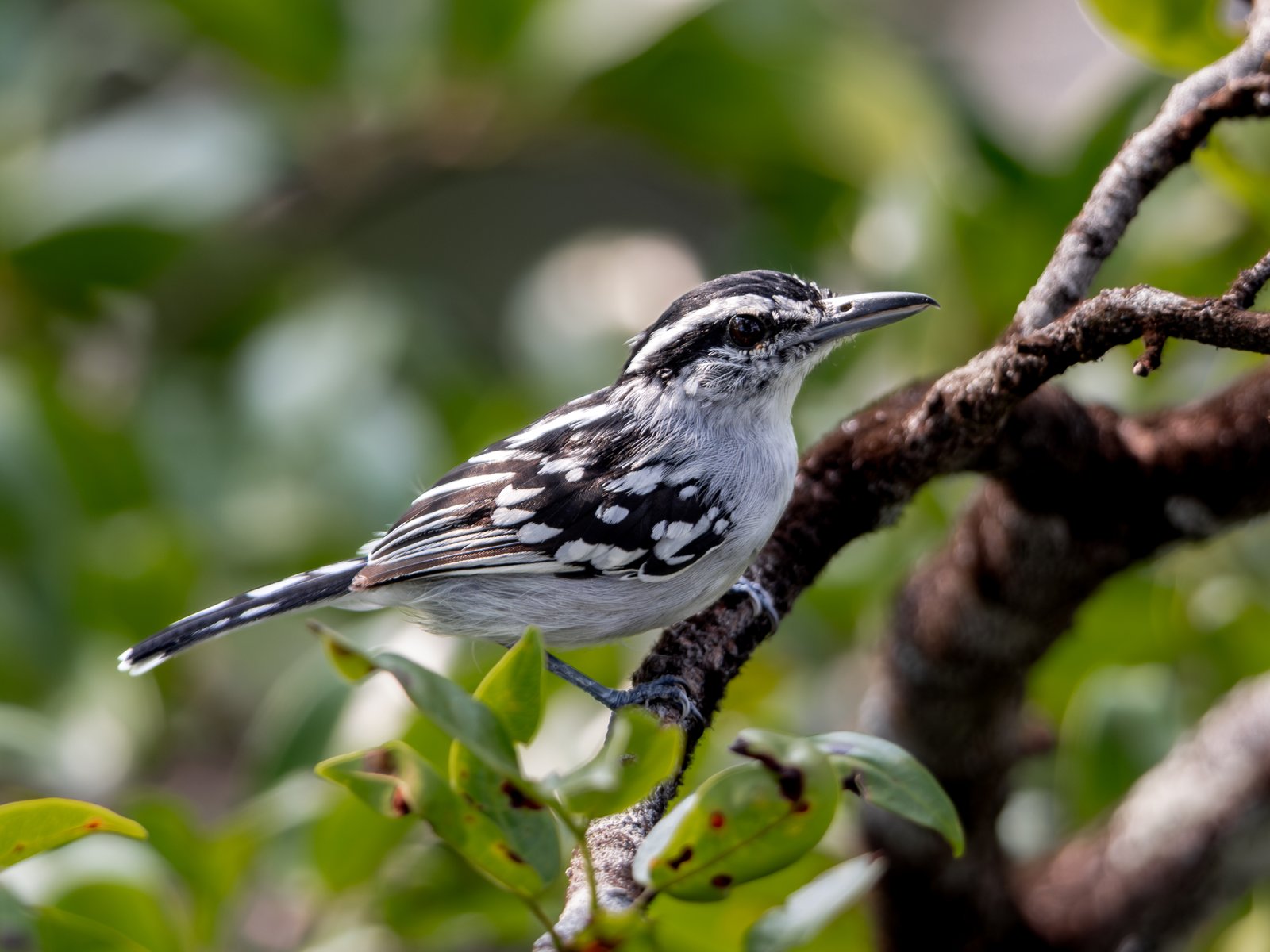
The Spot-backed Antwren is a small antwren of the northwestern Amazon, with a black back full of white spots. In the guide area it lives only in eastern Colombia. Pairs search high in the trees for insects, often in forest on poor sandy soils.
Voice
The song is a series of short notes that accelerates into a dry, rattling trill. Calls are short, nasal notes.
Recording: Rodrigo Dela Rosa — CC BY-NC-SA 4.0 · xeno-canto
Identification
11 cm, with a fairly short tail. The male has a black crown, a white supercilium and a black eyestripe. The back is black and grey with white spots; the wings are black with white wingbars. The tail is black with white spots and tips. The underparts are white, greyish on the sides. The female has a black crown with white or buff spots and a pale buff wash to the breast.
Confusion species
Dugand's Antwren Herpsilochmus dugandi has a grey back without clear white spots; the female has a rufous crown. Yellow-throated Antwren Myrmotherula ambigua has yellow underparts and a streaked back. Pygmy Antwren Myrmotherula brachyura is smaller, with a yellow belly and a shorter tail.
Habitat
Canopy and upper mid-levels of lowland terra firme rainforest and forest on poor sandy soils, also at forest edges. It searches in pairs for insects in foliage, often with mixed flocks. The nest is an open cup in a horizontal fork of a branch.
Where the bird is most at home, classified by the vegetation units of the Andes and the west coast.


Range and movements
Colombia: in the east, mainly in Vaupés and Guainía, also in Caquetá, Amazonas, Guaviare and locally Meta and Vichada. Absent from Ecuador, Peru, Bolivia and the Galápagos. Outside the guide area in southern Venezuela and northwestern Brazil, along the upper Rio Negro.
- Resident
- dark = core range, pale = thinly spread
How and when to look
Search forest on sandy soils around Mitú (Vaupés) or Inírida (Guainía); follow mixed flocks in the canopy and look for an antwren with a spotted back.
Conservation status
Least Concern. Fairly common within its range, which consists largely of undisturbed forest.
Scientific name
Herpsilochmus dorsimaculatus | Pelzeln, 1868
Pelzeln described the species in 1868 and placed it straight away in the genus where it still stands. The genus Herpsilochmus was introduced in 1847 by Cabanis. The genus name combines Greek herpō, 'to creep about', and lokhmē, 'thicket, copse'. The species name combines Latin dorsum, 'back', and maculatus, 'spotted'. The specimen the first description was based on came from Marabitanas, Amazonas, Brazil.