All species › Swifts › Hummingbirds › Straight-billed Hermit
Straight-billed Hermit | Phaethornis bourcieri
Priemsnavelheremietkolibrie | Ermitaño piquirrecto | Rabo-branco-de-bico-reto
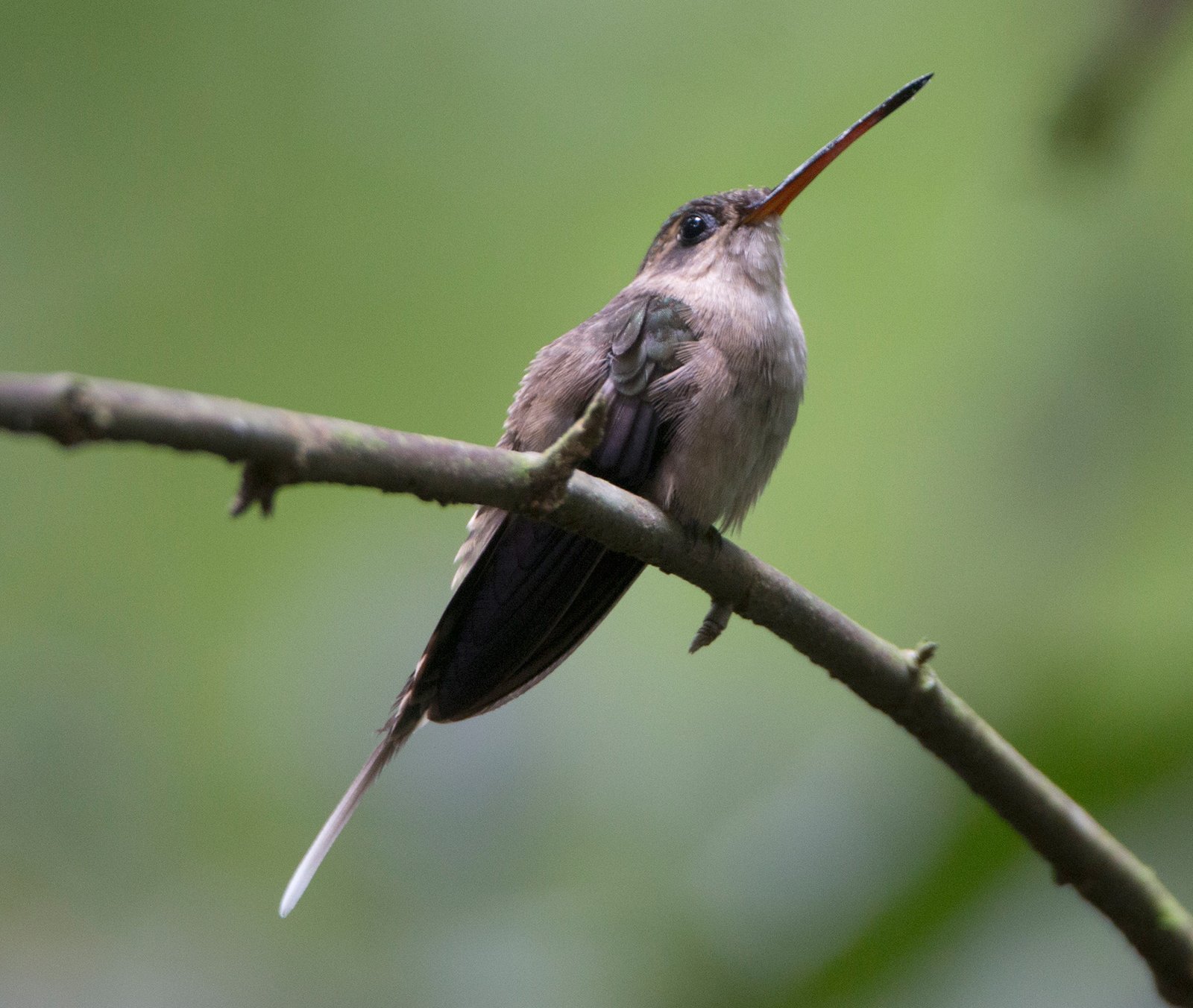
The Straight-billed Hermit is a hermit of north-western Amazonia, with an almost straight bill. It lives in the understorey of tall lowland forest and of foothill forest on the eastern slope of the Andes. It follows a fixed route past flowers and flies low and fast between the trunks.
Voice
The call is a sharp tsip, often in flight. Males sing at leks in the understorey with a repeated, high, squeaky note.
Recording: Jerome Fischer — CC BY-NC-SA 4.0 · xeno-canto
Identification
12–13 cm, with a long, almost straight bill; the lower mandible is yellow at the base. The upperparts are bronzy green, the underparts pale grey with a buff wash. The face shows a dark mask between narrow, pale supercilium and malar stripes. The central tail feathers are elongated and white-tipped. The sexes are almost alike.
Confusion species
White-bearded Hermit Phaethornis hispidus is greyer, with a decurved bill and a distinct white throat stripe. Great-billed Hermit Phaethornis malaris is larger, with a clearly decurved bill. Needle-billed Hermit Phaethornis philippii also has a straight bill, but orange-brown underparts, and lives south of the Amazon.
Habitat
Understorey of tall terra firme lowland forest and foothill forest, less in várzea and at forest edges, up to about 1100 m. It visits understorey flowers along a fixed route and also takes small insects and spiders. The nest hangs from the underside of a leaf.
Where the bird is most at home, classified by the vegetation units of the Andes and the west coast.


Range and movements
In Colombia east of the Andes, in Amazonia. In Ecuador in the Amazonian lowlands and on the lower eastern slope. In Peru in the north, mainly north of the Amazon and the Marañón. Absent from Bolivia and the Galápagos. Outside the guide area in southern Venezuela, the Guianas and northern Brazil.
- Resident
- dark = core range, pale = thinly spread
How and when to look
Along forest trails in tall lowland forest in northern Peru, such as at Allpahuayo-Mishana near Iquitos, and in the Amazonian lowlands of Ecuador. Watch for a hermit with a straight bill that flies past low and hovers briefly at a flower.
Conservation status
Not Evaluated. Widespread in lowland forest in the guide area; the species depends on forest and disappears with deforestation.
Scientific name
Phaethornis bourcieri | (Lesson, 1832)
Lesson described the species in 1832 as Trochilus Bourcieri; because it was later moved to another genus, the author and year stand in brackets. The genus Phaethornis was introduced in 1827 by Swainson. The genus name combines Ancient Greek phaethōn, 'sun', with ornis, 'bird'. The species name honours Jules Bourcier (1797–1873), a French naturalist who specialised in hummingbirds. The specimen the first description was based on came from Rio Tapajós, Brazil.