All species › Swifts › Hummingbirds › Long-billed Hermit
Long-billed Hermit | Phaethornis longirostris
Westelijke langstaartheremietkolibrie | Ermitaño piquilargo | Rabo-branco-de-bico-comprido
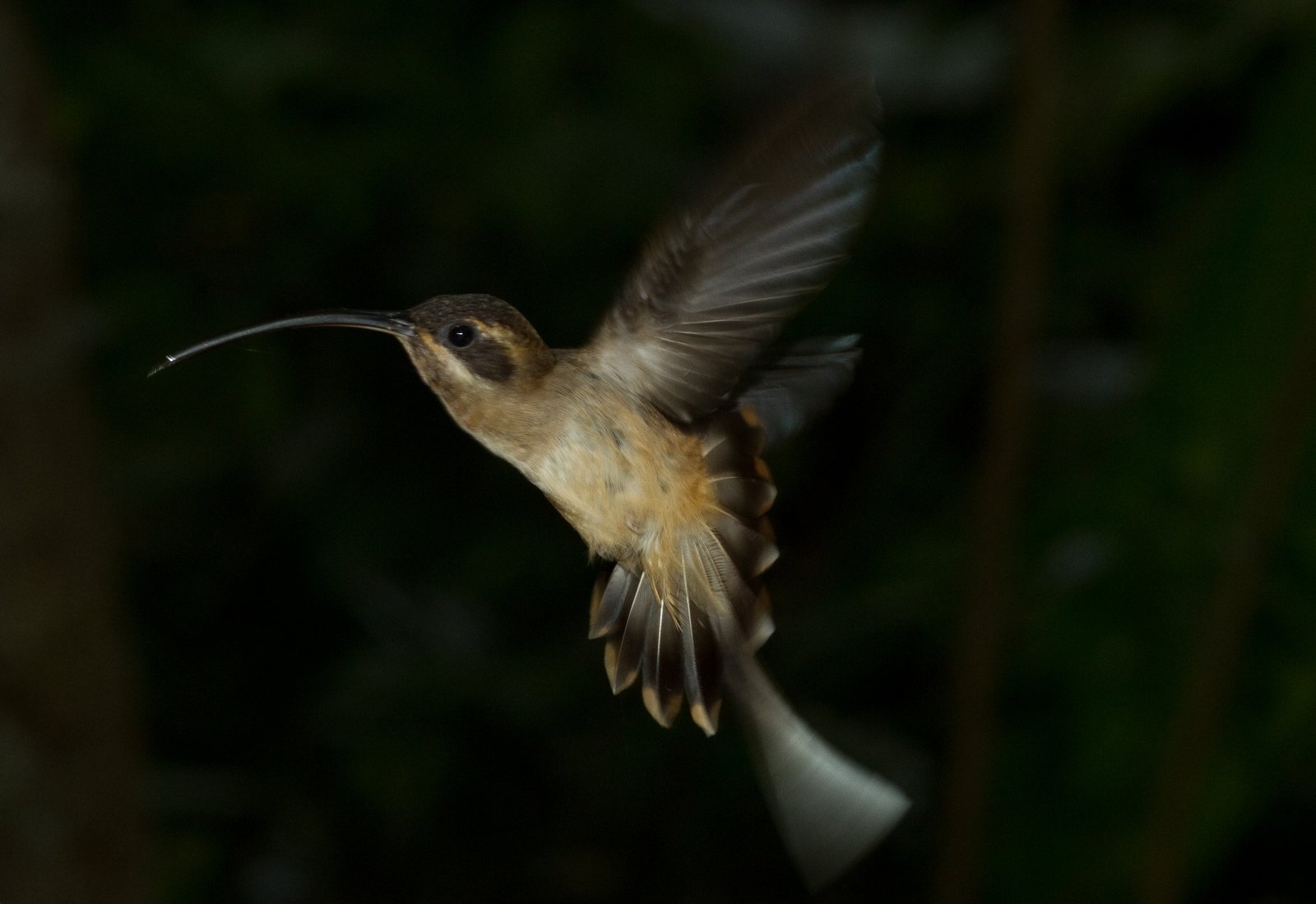
The Long-billed Hermit is a large, dull-coloured hermit of the humid forests west and north of the Andes. Like all hermits it has a long, decurved bill and a long, graduated tail with elongated white central feathers. Males sing in small groups at fixed sites in the forest understorey, known as leks.
Voice
The song at the lek is an endlessly repeated, high, squeaky single note, something like sreep, about once a second. The flight call is a sharp sleep.
Recording: Alberto Lobato — CC BY-NC-SA 4.0 · xeno-canto
Identification
14–16 cm, of which the bill is about 4 cm; the bill is long and decurved, with a yellow to orange lower mandible. The upperparts are dull bronzy green, and the rump is scaled buff. The underparts are greyish buff. The head shows a dark mask, bordered by a pale supercilium and a pale malar stripe, with a dark stripe down the centre of the throat. The tail is graduated; the elongated central feathers have long white tips. The sexes are nearly alike.
Confusion species
White-whiskered Hermit Phaethornis yaruqui of the Chocó is darker, with dark underparts and distinct white malar stripes. Green Hermit Phaethornis guy is greener, with a darker belly, and lives higher in montane forest. Pale-bellied Hermit Phaethornis anthophilus has a straighter bill, paler, unmarked underparts and no throat stripe. Great-billed Hermit Phaethornis malaris is very similar, but lives only east of the Andes.
Habitat
Understorey of humid lowland and foothill forest, forest edges, ravines, secondary forest and shady plantations, mostly below 1000 m, locally to about 1500 m. It visits scattered flowers with long corolla tubes, such as Heliconia, along a fixed route, and takes small arthropods. The cone-shaped nest hangs from the underside of the tip of a palm or Heliconia leaf.
Where the bird is most at home, classified by the vegetation units of the Andes and the west coast.


Range and movements
In Colombia in the Pacific lowlands, the Caribbean lowlands and the Magdalena and Cauca valleys. In Ecuador in the west, south to El Oro and Loja. In Peru only in the far north-west, in Tumbes. Absent east of the Andes, from Bolivia and the Galápagos. Outside the guide area from southern Mexico through Central America to north-western Venezuela.
- Resident
- dark = core range, pale = thinly spread
How and when to look
Wait at flowering Heliconia along forest trails and edges in the western lowlands; a bird often passes at regular intervals. The persistent squeaking of a lek gives away its place in the understorey.
Conservation status
Not Evaluated. The IUCN does not yet assess the species separately. In the guide area it is locally common; it tolerates secondary forest and shady plantations, but disappears where the understorey is cleared completely.
Scientific name
Phaethornis longirostris | (Delattre, 1843)
Delattre described the species in 1843 as Ornismya longirostris; because it was later moved to another genus, the author and year stand in brackets. The genus Phaethornis was introduced in 1827 by Swainson. The genus name combines Ancient Greek phaethōn, 'sun', with ornis, 'bird'. The species name combines Latin longus, 'long', with rostrum, 'bill'. The specimen the first description was based on came from Guatemala.