All species › Swifts › Hummingbirds › Great-billed Hermit
Great-billed Hermit | Phaethornis malaris
Langsnavelheremietkolibrie | Ermitaño piquigrande | Besourão-de-bico-grande
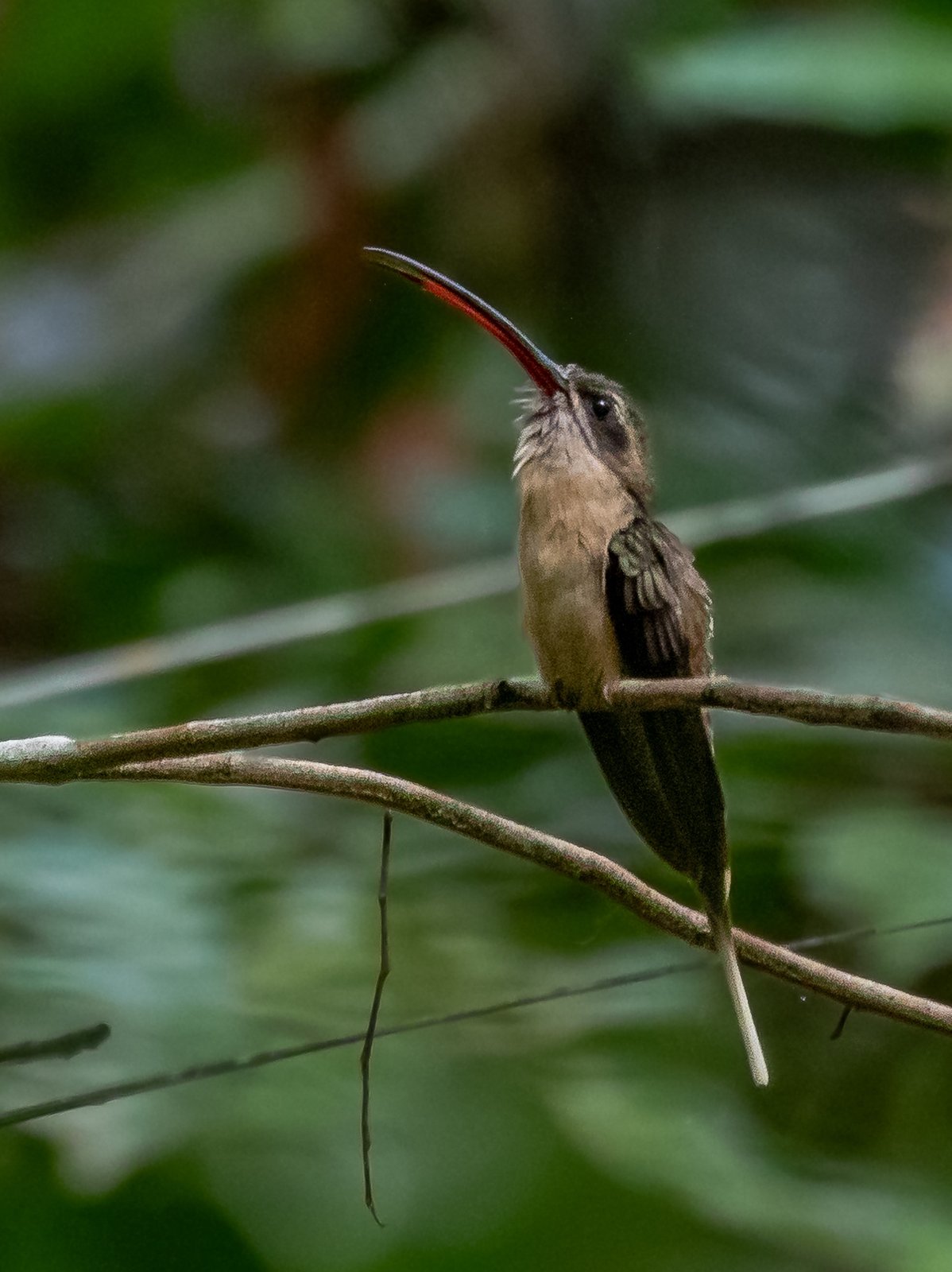
The Great-billed Hermit is the largest and most widespread long-tailed hermit of Amazonia in the guide area. Its bill is the longest of the lowland hermits. Males sing in small groups at leks in the dim forest understorey.
Voice
The song at the lek is a long series of high, squeaky single notes, something like sreep, repeated at regular intervals. The flight call is a sharp sleep.
Recording: Daan van der Hoeven — CC BY-NC-SA 4.0 · xeno-canto
Identification
15–17 cm, with a very long, decurved bill of about 4.5 cm; the lower mandible is yellow to orange. The upperparts are dull bronzy green, and the rump and uppertail-coverts have buff edges. The underparts are greyish to warm buff, warmer in the south of the guide area. A dark mask is bordered by a buff supercilium and malar stripe. The tail is graduated, with long, white-tipped central feathers. The sexes are nearly alike.
Confusion species
Long-billed Hermit Phaethornis longirostris is very similar, but lives only west and north of the Andes. White-bearded Hermit Phaethornis hispidus is greyer, with a shorter bill, a white malar stripe and a grey belly. Straight-billed Hermit Phaethornis bourcieri has an almost straight bill. Needle-billed Hermit Phaethornis philippii has rufous underparts and a straight bill.
Habitat
Understorey of humid terra firme lowland forest, várzea forest, forest edges and old secondary forest, and foothill forest on the eastern slope, mostly below 1000 m, locally higher. It visits flowers with long corolla tubes, such as Heliconia and Costus, along a fixed route, and takes small arthropods. The cone-shaped nest hangs from the underside of a leaf tip.
Where the bird is most at home, classified by the vegetation units of the Andes and the west coast.


Range and movements
In Colombia east of the Andes, in Amazonia and the foothills. In Ecuador in the east. In Peru throughout Amazonia and the foothills of the eastern slope. In Bolivia in the lowlands and foothills of the north and centre. Absent west of the Andes and from the Galápagos. Outside the guide area in southern Venezuela, Brazilian Amazonia and the Guianas.
- Resident
- dark = core range, pale = thinly spread
How and when to look
Along forest trails in Amazonian forest, at flowering Heliconia and Costus; birds often fly past low and fast. The constant squeaking of a lek gives away its place in the understorey.
Conservation status
Least Concern. Its range is large; deforestation has a local effect.
Scientific name
Phaethornis malaris | (Nordmann, 1835)
Nordmann described the species in 1835 as Trochilus malaris; because it was later moved to another genus, the author and year stand in brackets. The genus Phaethornis was introduced in 1827 by Swainson. The genus name combines Ancient Greek phaethōn, 'sun', with ornis, 'bird'. The species name comes from Medieval Latin malaris, 'of the cheek' (from mala, 'cheek'), after the cheek markings. The specimen the first description was based on came from Cayenne, French Guiana.