All species › Swifts › Hummingbirds › Pale-bellied Hermit
Pale-bellied Hermit | Phaethornis anthophilus
Bleke heremietkolibrie | Ermitaño ventripálido | Rabo-branco-de-barriga-pálida
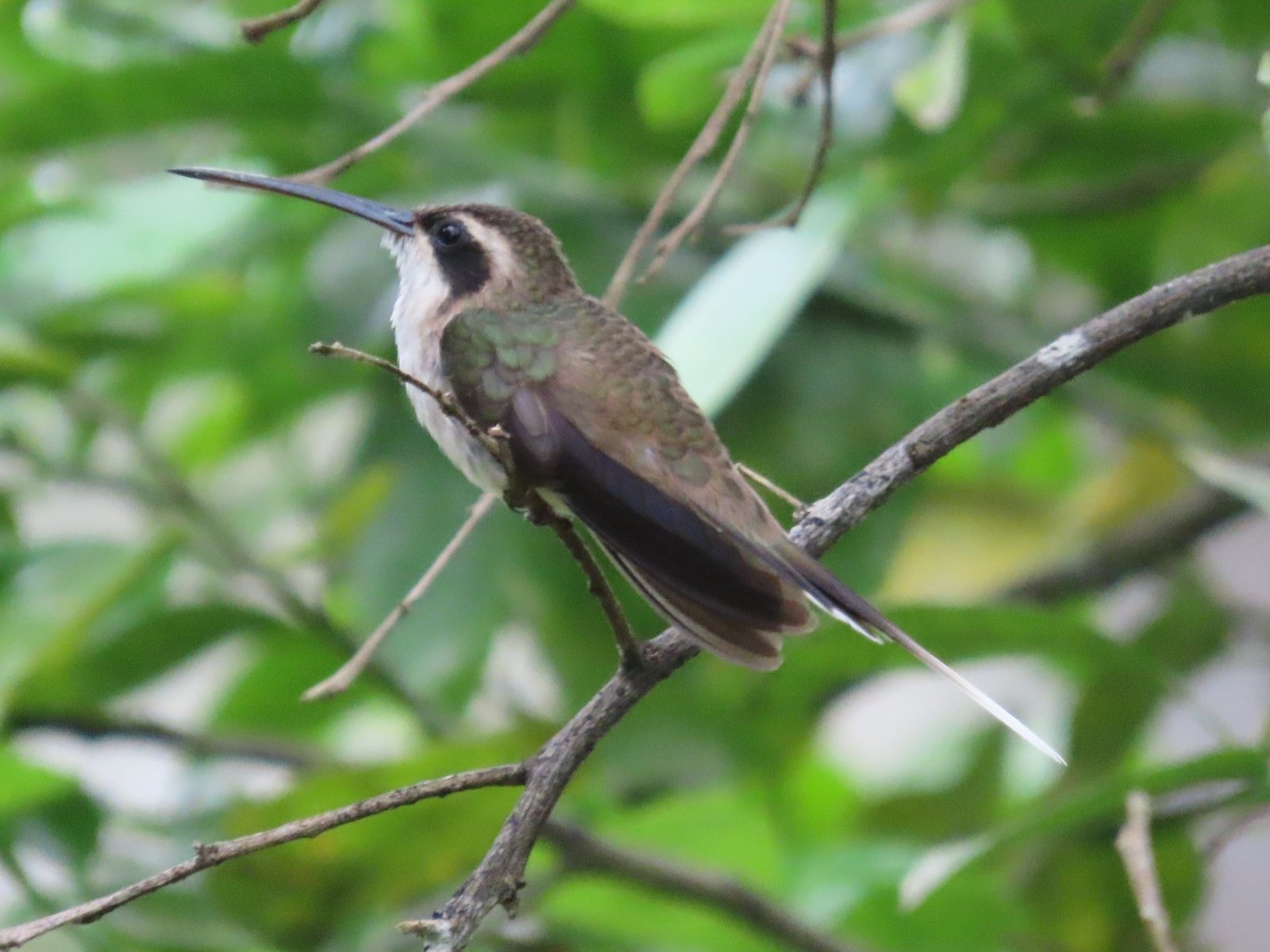
The Pale-bellied Hermit is a pale, long-tailed hermit of the drier lowlands of northern Colombia. It differs from related species in its rather straight bill and unmarked, whitish underparts. It lives in drier and more open forest types than most hermits.
Voice
The song at the lek is a series of high, squeaky notes, repeated at regular intervals. The flight call is a sharp, high tseep.
Recording: Ross Gallardy — CC BY-NC-SA 4.0 · xeno-canto
Identification
12–13 cm, with a long, only slightly decurved bill; the lower mandible is yellowish. The upperparts are greyish green to bronzy green. The underparts are pale greyish white, without a throat stripe. A black mask is bordered by a whitish supercilium and malar stripe. The tail is graduated, with elongated, white-tipped central feathers. The sexes are nearly alike.
Confusion species
Long-billed Hermit Phaethornis longirostris is larger, with a more decurved bill, greyish-buff underparts and a dark throat stripe. Stripe-throated Hermit Phaethornis striigularis is much smaller, with rufous underparts and a short tail. Sooty-capped Hermit Phaethornis augusti has a dark crown, a rufous rump and grey underparts, and lives mainly on dry foothill slopes.
Habitat
Understorey of dry and semi-dry forest, gallery forest, scrub, forest edges, secondary forest and shady plantations, also more humid forest at the edge of its range, mostly below 1000 m. It visits flowers with long corolla tubes along a fixed route and takes small arthropods. The nest hangs from the underside of a leaf tip.
Where the bird is most at home, classified by the vegetation units of the Andes and the west coast.


Range and movements
In Colombia in the Caribbean lowlands, the Magdalena valley and the north-east, including the Catatumbo area. Absent from Ecuador, Peru, Bolivia and the Galápagos. Outside the guide area in eastern Panama, including the Pearl Islands, and northern Venezuela.
- Resident
- dark = core range, pale = thinly spread
How and when to look
In gallery forest and dry forest in the Caribbean lowlands and the Magdalena valley, at flowering plants in the understorey. Birds often make short visits to the same flowers.
Conservation status
Least Concern. The dry forest of northern Colombia is heavily fragmented, but the species also uses secondary forest and plantations.
Scientific name
Phaethornis anthophilus | (Bourcier, 1843)
Bourcier described the species in 1843 as Trochilus anthophilus; because it was later moved to another genus, the author and year stand in brackets. The genus Phaethornis was introduced in 1827 by Swainson. The genus name combines Ancient Greek phaethōn, 'sun', with ornis, 'bird'. The species name combines Greek anthos, 'flower', with philos, 'loving', thus 'flower-loving'. The specimen the first description was based on came from (per the description).