All species › Passerines › Gnatwrens and gnatcatchers › Trilling Gnatwren
Trilling Gnatwren | Ramphocaenus melanurus
Zwartstaartmuggensluiper | Soterillo picudo | Chirito
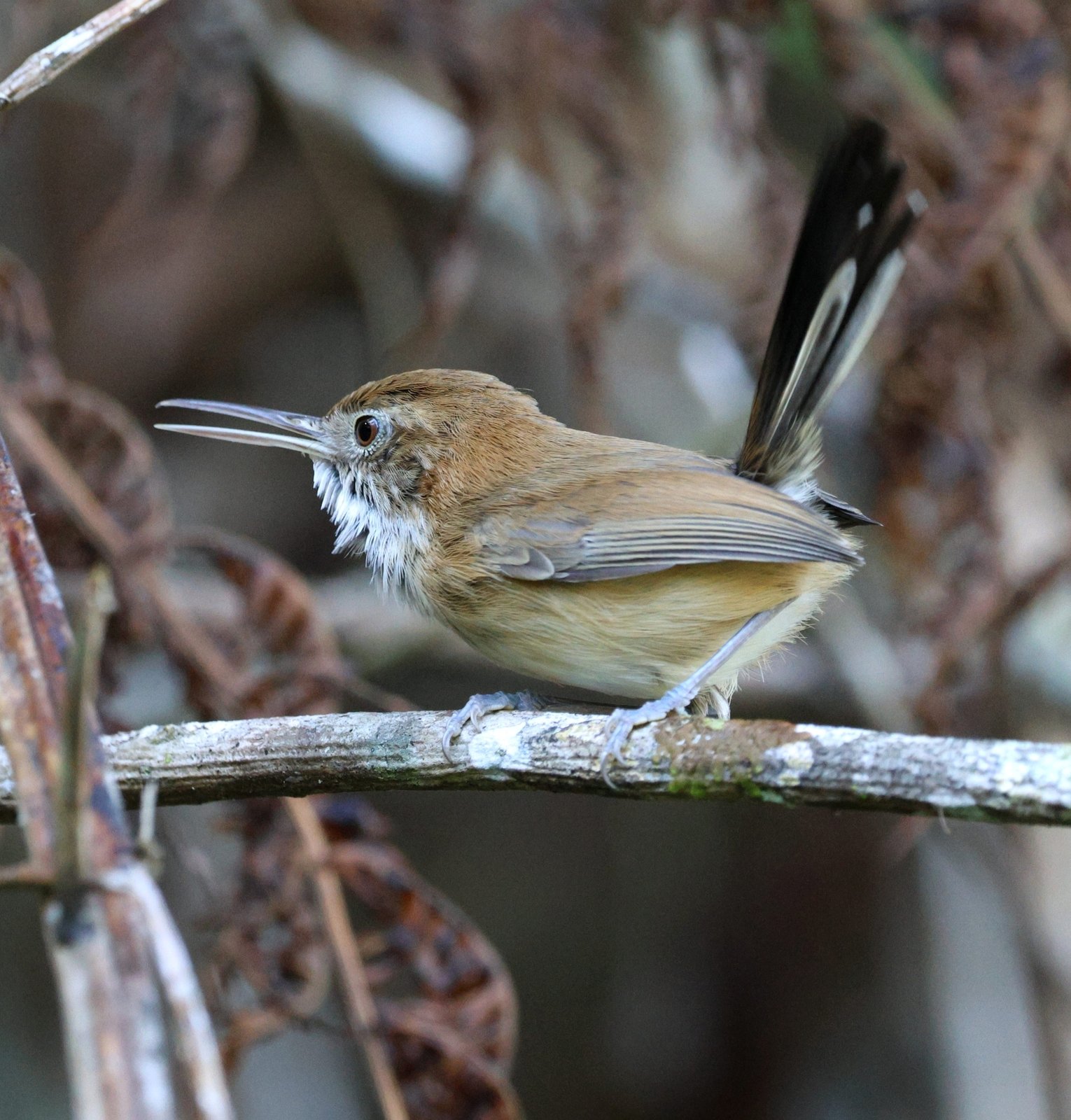
Trilling Gnatwren is a small, slim bird with a strikingly long, thin bill and a long, narrow tail that it constantly cocks and wags from side to side. It lives in dense vine tangles and scrub at forest edges and in secondary forest and is mostly detected by its clear trill. In the guide area it is the most widespread gnatwren, on both sides of the Andes.
Voice
The song is a clear, even trill on one pitch, lasting one to several seconds, sometimes slightly rising or falling. Also nasal, harsh calls.
Recording: Juan Freile — CC BY-NC-SA 4.0 · xeno-canto
Identification
12–13 cm, of which the bill is over 2 cm. Bill long, straight and thin. The upperparts are greyish brown, the head warmer brown. The face and sides of the neck are cinnamon to buff. The throat is whitish, the underparts pale buff, warmer on the flanks. The tail is long, narrow and blackish, with white tips to the outer feathers. The sexes are alike; juveniles are duller and shorter-billed.
Confusion species
Chattering Gnatwren Ramphocaenus sticturus is almost identical but darker, with an ochre tinge to the head, breast and flanks and a different, rattling voice; it lives in south-western Amazonia, south of the range of this species. Collared Gnatwren Microbates collaris and Tawny-faced Gnatwren Microbates cinereiventris are short-tailed and live lower, close to the ground. Gnatcatchers (Polioptila) have a shorter bill and grey upperparts.
Habitat
Dense vine tangles, scrub and tangled vegetation at forest edges, in forest openings, in secondary forest and in semi-dry forest, from sea level to about 1500 m. It forages in pairs for insects and spiders in the mid-levels and lower strata, often in mixed flocks. The nest is a deep cup low in a shrub or among leaves.
Where the bird is most at home, classified by the vegetation units of the Andes and the west coast.


Range and movements
In Colombia widespread in the lowlands and foothills on both sides of the Andes, from the Pacific coast and the Caribbean lowlands to Amazonia. In Ecuador both in the west and in the east. In Peru in the north-west and in northern Amazonia. In Bolivia replaced by Chattering Gnatwren. Absent from the Galápagos. Outside the guide area from Mexico to Panama and in Venezuela, the Guianas and Brazil.
- Resident
- dark = core range, pale = thinly spread
How and when to look
Listen at forest edges and in secondary forest for the clear trill, then check dense vine tangles at mid-level. The long bill and the cocked, wagging tail are distinctive, even when the bird is half hidden.
Conservation status
Not evaluated in this circumscription. The species in the broad sense was assessed as Least Concern; it tolerates secondary forest and forest edges and is common over much of the guide area.
Scientific name
Ramphocaenus melanurus | Vieillot, 1819
Vieillot described the species in 1819 and placed it straight away in the genus where it still stands. He introduced the genus Ramphocaenus in that same work. The genus name comes from Greek rhamphos, 'bill', and kainos, 'new, strange', after the very long, slender bill that Vieillot described. The species name comes from Greek melas, 'black', and oura, 'tail': 'black-tailed'. The specimen the first description was based on came from Vicinity of Rio de Janeiro, Brazil.