All species › Passerines › Finches, euphonias and allies › Trinidad Euphonia
Trinidad Euphonia | Euphonia trinitatis
Trinidadorganist | Eufonia de Trinidad | Gaturamo-de-trinidad
The Trinidad Euphonia is a small black-and-yellow euphonia of dry forest and scrub in northern Colombia, Venezuela and on Trinidad and Tobago. There it replaces the closely related Purple-throated Euphonia, which lives further south and east. It often sits in pairs high in trees with mistletoe.
Voice
A clear, repeated bee-bee or deedee, often in flight. The song is a short, high twitter.
Recording: Eduardo Freitez Gassán/Fernando Freitez Gassán — CC BY-NC-SA 4.0 · xeno-canto
Identification
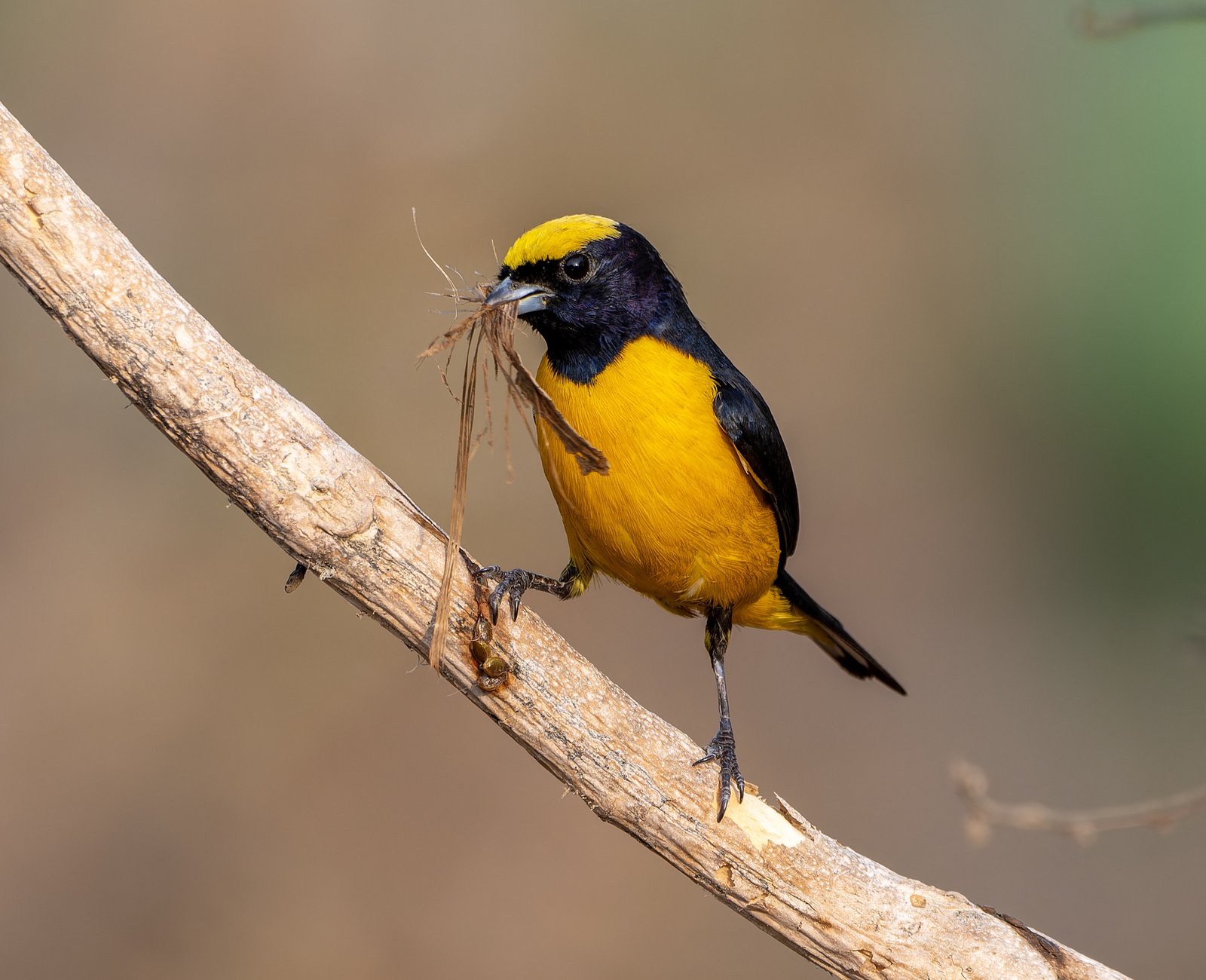
9 cm, small and compact, with a short, thick bill and a short tail. The male is glossy blue-black above, with a blue-black throat and cheeks. The yellow forecrown starts at the bill and extends to behind the eye. The underparts are deep yellow. There are white spots on the outer tail feathers, visible from below. The female is olive-green above and yellowish olive below, greyer on the centre of the belly. Young males resemble the female.
Confusion species
Purple-throated Euphonia Euphonia chlorotica is very similar, but has a smaller yellow crown patch and a more purple gloss on the throat and upperparts; the two rarely occur together in the guide area. Velvet-fronted Euphonia Euphonia concinna of the Magdalena valley has a narrow black band between the bill and the yellow crown. Thick-billed Euphonia Euphonia laniirostris is larger, with a thicker bill and a yellow rather than black throat. White-vented Euphonia Euphonia minuta has a white lower belly and a smaller yellow forehead patch.
Habitat
Dry deciduous forest, thorn scrub, gallery forest, open woodland, gardens and plantations with trees, mainly in the lowlands and foothills up to about 1000 m. It feeds mainly on mistletoe berries and other small fruit, which it seeks in the canopy. The nest is a domed structure with a side entrance, in a cavity, a clump of epiphytes or an old nest.
Where the bird is most at home, classified by the vegetation units of the Andes and the west coast.


Range and movements
In Colombia in the Caribbean lowlands of the north, from La Guajira and the foot of the Sierra Nevada de Santa Marta to the lower Magdalena valley. Absent from Ecuador, Peru, Bolivia and the Galápagos. Outside the guide area in northern Venezuela and on Trinidad and Tobago.
- Resident
- dark = core range, pale = thinly spread
How and when to look
In dry forest and wooded gardens in northern Colombia, watch trees with mistletoe; pairs often feed there. The repeated, clear call in flight draws attention to the bird.
Conservation status
Least Concern. The species is common in semi-open, dry country and tolerates gardens and farmland with trees.
Scientific name
Euphonia trinitatis | Strickland, 1851
Strickland described the species in 1851 and placed it straight away in the genus where it still stands. The genus Euphonia was introduced in 1806 by Desmarest, A-G. The genus name comes from Greek euphōnos, from eu 'good' and phōnē 'sound', meaning 'sweet-voiced', after the calls of these birds. The species name refers to Trinidad (Latin Trinitas), not necessarily the type locality. The specimen the first description was based on came from Trinidad.