All species › Passerines › Finches, euphonias and allies › Velvet-fronted Euphonia
Velvet-fronted Euphonia | Euphonia concinna
Pluchekaporganist | Eufonia frentinegra | Gaturamo-de-fronte-aveludada
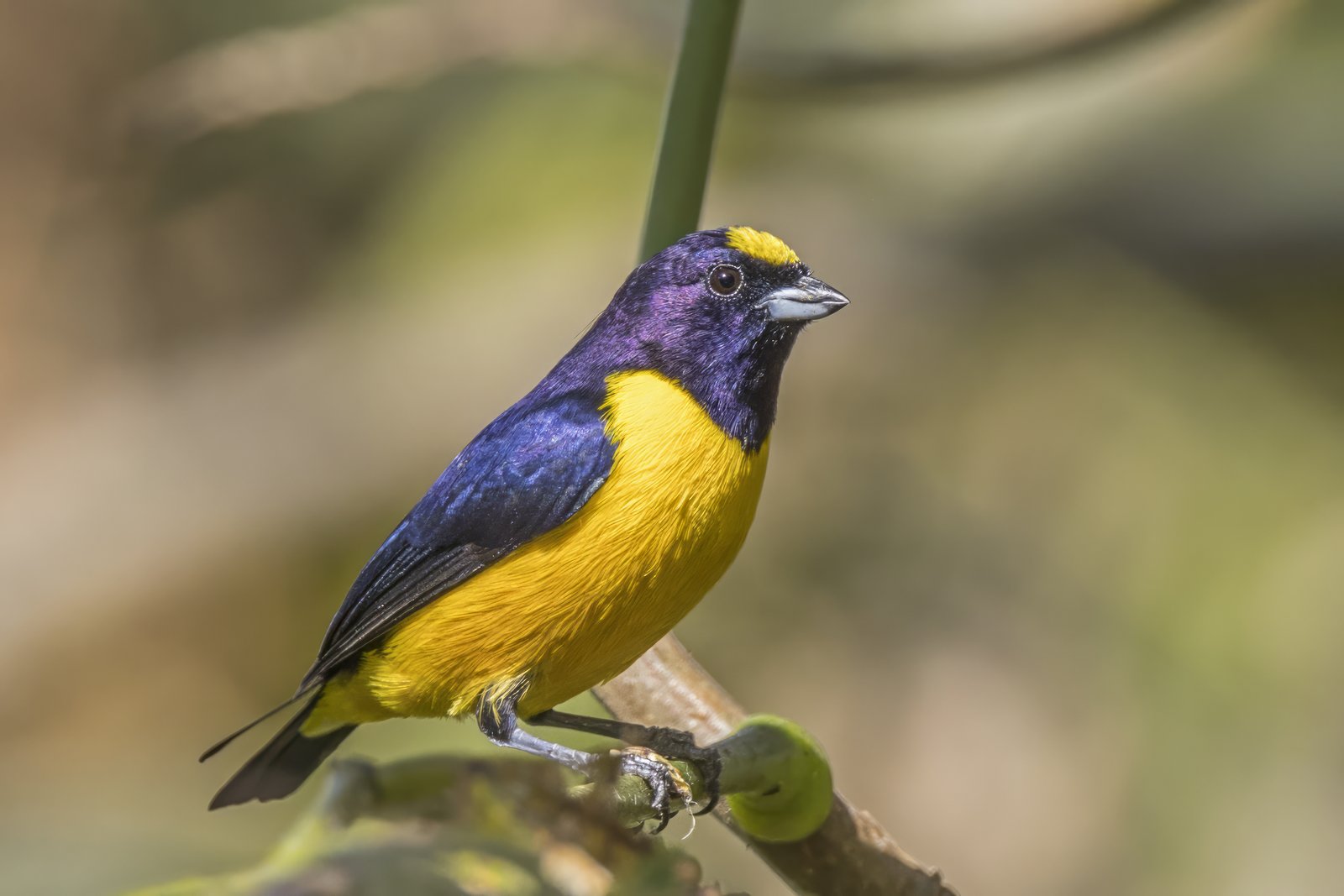
The Velvet-fronted Euphonia is a small euphonia found only in Colombia, in the Magdalena valley. The male owes its name to the narrow, velvety black band on the forehead, in front of the yellow forecrown. It lives in dry and semi-humid forest and in farmland with scattered trees.
Voice
Short, clear calls such as deet or chee-chee, and a short, twittering song of high, somewhat rasping notes.
Recording: Mauricio Cuellar Ramirez (@Birding.travel) — CC BY-NC-SA 4.0 · xeno-canto
Identification
9–10 cm, with a short, thick bill and a short tail. The male is glossy blue-black above with a purplish sheen; the throat and cheeks are the same colour. Above the bill is a narrow, velvety black frontal band, behind it a yellow forecrown reaching to above the eye. The underparts are yellow with an ochre tinge. The female is dull olive-green above, greyer on the nape, with a yellowish forehead and dull yellow underparts. Young males at first resemble the female.
Confusion species
Trinidad Euphonia Euphonia trinitatis is very similar, but in the male the yellow of the crown reaches the bill, without a black frontal band; it lives mainly in the Caribbean lowlands of northern Colombia. Thick-billed Euphonia Euphonia laniirostris is larger, with a thicker bill, a yellow rather than dark throat and a yellow crown extending further back. Purple-throated Euphonia Euphonia chlorotica also has a dark throat, but no black forehead, and in Colombia occurs mainly east of the Andes. Females can often only be identified by the male accompanying them.
Habitat
Dry and semi-humid forest, forest edges, scrub, shaded coffee and cacao plantations and pasture with scattered trees, roughly between 200 and 1000 m, locally higher. It forages in pairs or small groups in the canopy for small fruit, especially mistletoe berries. The nest is a domed structure with a side entrance, among epiphytes or in a cavity.
Where the bird is most at home, classified by the vegetation units of the Andes and the west coast.


Range and movements
Endemic to Colombia: in the Magdalena valley, mainly in its upper half, from Huila and Tolima north into the middle valley. Absent from Ecuador, Peru, Bolivia and the Galápagos. Not known outside the guide area.
- Resident
- dark = core range, pale = thinly spread
How and when to look
Look for the species in wooded pastures, forest edges and dry forest remnants in the upper Magdalena valley, especially at fruiting trees and mistletoe. Pairs give themselves away by their short calls as they fly between the treetops.
Conservation status
Least Concern. The range is small and the dry forest of the Magdalena valley has largely been cleared, but the species tolerates semi-open farmland with trees.
Scientific name
Euphonia concinna | Sclater, 1855
Sclater described the species in 1855 and placed it straight away in the genus where it still stands. The genus Euphonia was introduced in 1806 by Desmarest, A-G. The genus name comes from Greek euphōnos, from eu 'good' and phōnē 'sound', meaning 'sweet-voiced', after the calls of these birds. The species name is Latin concinnus, 'neat' or 'well-arranged', after the plumage. The specimen the first description was based on came from Bogotá, Colombia.