All species › Passerines › Finches, euphonias and allies › Purple-throated Euphonia
Purple-throated Euphonia | Euphonia chlorotica
Purperkeelorganist | Eufonia golipúrpura | Fim-fim
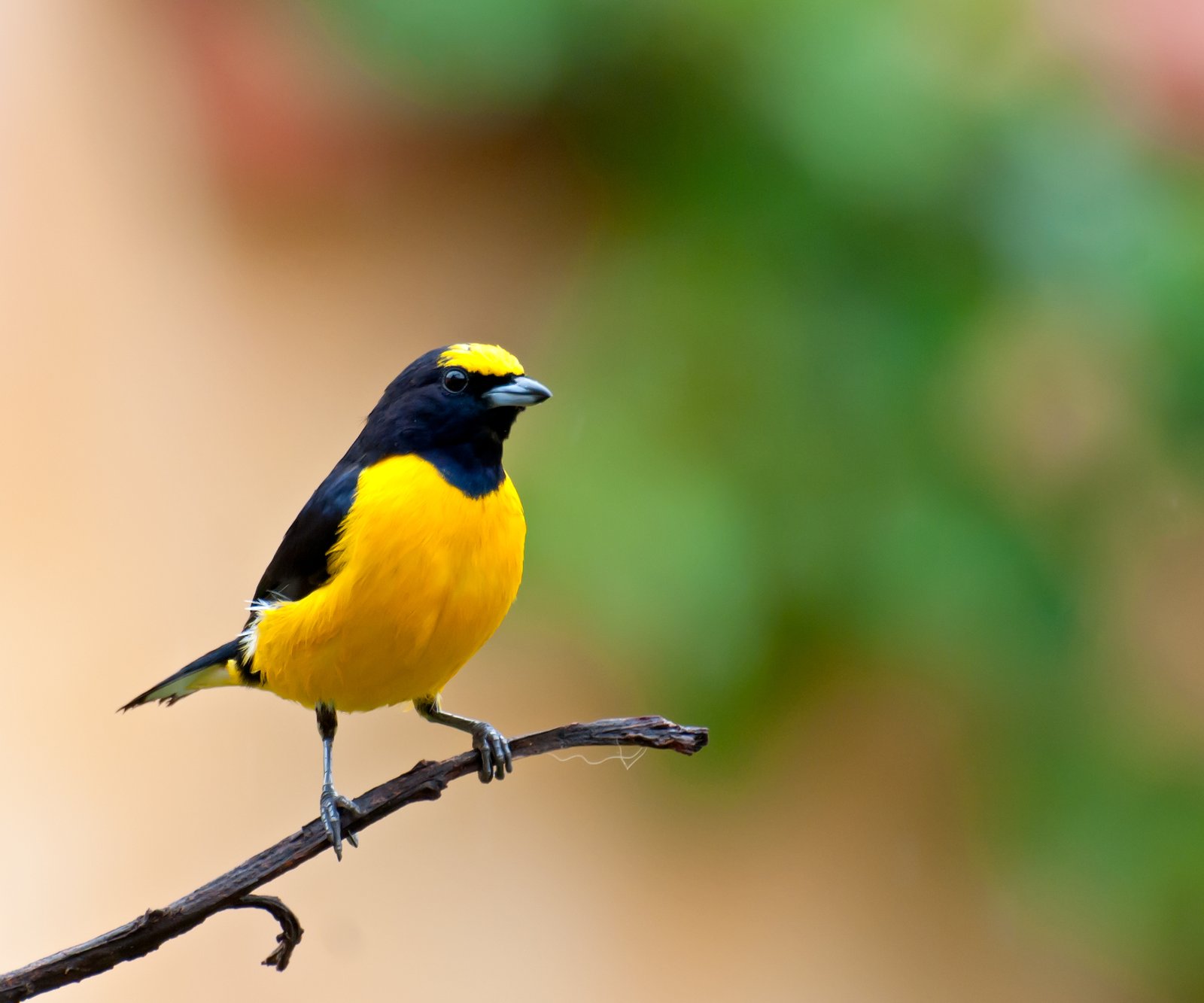
The Purple-throated Euphonia is the most widespread euphonia of the open lowlands east of the Andes, from Colombia to Argentina. It lives in forest edges, scrub, dry woodland and gardens and draws attention mainly by its clear, two-note call. The male has a yellow forehead patch and a dark throat with a purple gloss.
Voice
A clear, rather plaintive, two-note whistle, dee-dee, often repeated; also short, twittering notes and a soft, chattering song with imitations of other birds.
Recording: Marcos E. Sosa — CC BY-NC-SA 4.0 · xeno-canto
Identification
9–10 cm, with a short, thick bill. The male is glossy blue-black on the upperparts, cheeks and throat; the throat has a purple gloss. A yellow forehead patch extends to just behind the eye, no further. The underparts are yellow, and there are white spots on the outer feathers under the tail. The female is olive-green above, with a yellowish forehead, and yellowish olive-green below with a greyish-white centre to the belly. Young males at first resemble the female.
Confusion species
Thick-billed Euphonia Euphonia laniirostris is larger, with a yellow throat and a yellow crown that extends further back. Trinidad Euphonia Euphonia trinitatis in northern Colombia is very similar, but has a larger yellow crown patch; the two rarely occur together. White-vented Euphonia Euphonia minuta has a white lower belly and a smaller yellow forehead patch. Orange-bellied Euphonia Euphonia xanthogaster has a more orange-yellow breast and lives more in humid forest.
Habitat
Forest edges, open and dry woodland, scrub, gallery forest, river islands, cerrado, plantations and gardens, from the lowlands to about 2000 m in the dry Andean valleys. It feeds mainly on mistletoe berries, also on other small fruit, foraging in pairs or small groups in tree crowns. The nest is a globular structure with a side entrance, in a cavity, among epiphytes or in a dense shrub.
Where the bird is most at home, classified by the vegetation units of the Andes and the west coast.


Range and movements
In Colombia mainly east of the Andes, in the llanos and Amazonia, locally also in the north. In Ecuador locally in the eastern lowlands and in the south. In Peru widespread east of the Andes and in the dry valleys of the Marañón. In Bolivia widespread in the lowlands and in the dry valleys of the eastern Andean slope. Absent from the Galápagos. Outside the guide area in Venezuela, the Guianas, most of Brazil, Paraguay and northern Argentina.
- Resident
- dark = core range, pale = thinly spread
How and when to look
Listen at forest edges, along rivers and in gardens in the lowlands east of the Andes for the clear, two-note call, then scan the crowns of trees with mistletoe.
Conservation status
Least Concern. The species is widespread and tolerates open landscapes with trees well. Locally birds are trapped as cage birds.
Scientific name
Euphonia chlorotica | (Linnaeus, 1766)
Linnaeus described the species in 1766 as Tanagra chlorotica; because it was later moved to another genus, the author and year stand in brackets. The genus Euphonia was introduced in 1806 by Desmarest, A-G. The genus name comes from Greek euphōnos, from eu 'good' and phōnē 'sound', meaning 'sweet-voiced', after the calls of these birds. The species name comes from Greek khlōrotēs, 'greenness'. The specimen the first description was based on came from Cayenne, French Guiana.