All species › Passerines › Finches, euphonias and allies › Plumbeous Euphonia
Plumbeous Euphonia | Euphonia plumbea
Grijze organist | Eufonia plomiza | Gaturamo-anão
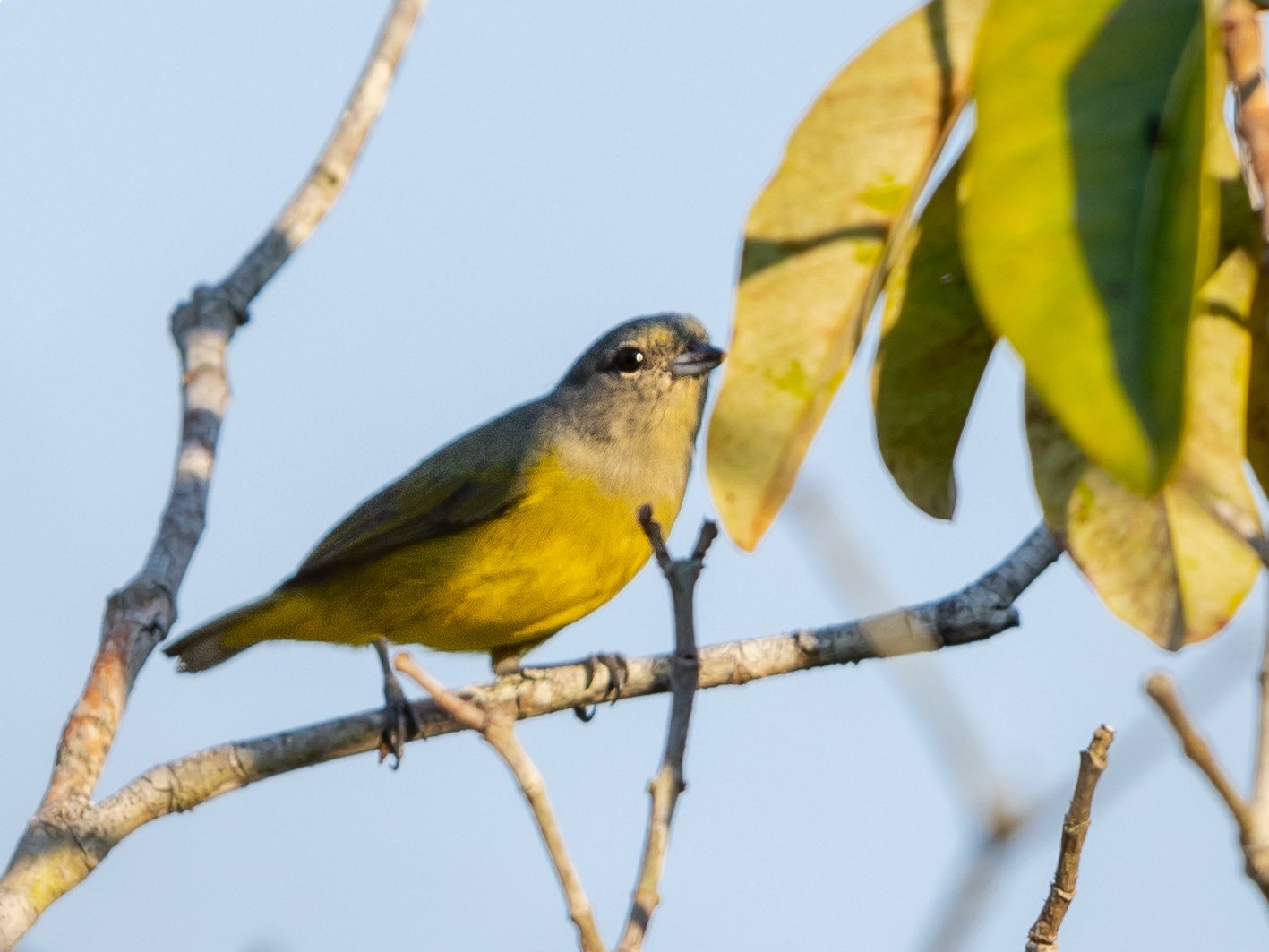
The Plumbeous Euphonia is one of the smallest euphonias, a bird of the Guiana Shield and north-western Amazonia. The male is dark lead-grey with deep yellow underparts, without the yellow crown of most of its relatives. In the guide area it is tied to forest and scrub on white sand in the far east of Colombia and north-eastern Peru.
Voice
Soft, high, rather plaintive whistles and short, twittering calls; the song is poorly described.
Recording: JAYRSON ARAUJO DE OLIVEIRA — CC BY-NC-SA 4.0 · xeno-canto
Identification
9 cm, very small, with a short, thick bill and a short tail. The male is dark lead-grey with a bluish gloss on the head, throat and upperparts; the rest of the underparts are deep yellow, sharply demarcated from the grey throat. There is no yellow crown and no white in the tail. The female has a grey head and nape, olive-green upperparts and yellowish olive-green underparts with a greyish centre. Young birds resemble the female.
Confusion species
White-vented Euphonia Euphonia minuta is blue-black rather than grey, with a small yellow forehead patch and a white lower belly. Thick-billed Euphonia Euphonia laniirostris and Purple-throated Euphonia Euphonia chlorotica have a yellow crown and blue-black upperparts. Females of other euphonias may have a grey nape, but are larger, with a less grey head.
Habitat
Low, open forest and scrub on white sand and their edges, also savanna with scattered trees and edges of taller forest, in the lowlands. It searches the crowns of low trees for mistletoe berries and other small fruit, in pairs or small groups. Little is known about the nest.
Where the bird is most at home, classified by the vegetation units of the Andes and the west coast.


Range and movements
In Colombia in the far east, in Guainía and Vaupés and locally in adjacent departments. In Peru in the north-east, in white-sand forest in Loreto, including the area around Iquitos. Absent from Ecuador, Bolivia and the Galápagos. Outside the guide area in southern Venezuela, the Guianas and northern Brazil.
- Resident
- dark = core range, pale = thinly spread
How and when to look
Visit white-sand forest around Iquitos or in Guainía and watch the low crowns for a small euphonia without a yellow crown. Check trees with mistletoe in particular.
Conservation status
Least Concern. White-sand forest is a vulnerable, patchy habitat, but in most of the range it is little affected.
Scientific name
Euphonia plumbea | Du Bus de Gisignies, B-AL, 1855
Du Bus de Gisignies, B-AL described the species in 1855 and placed it straight away in the genus where it still stands. The genus Euphonia was introduced in 1806 by Desmarest, A-G. The genus name comes from Greek euphōnos, from eu 'good' and phōnē 'sound', meaning 'sweet-voiced', after the calls of these birds. The species name is Latin plumbeus, 'lead-coloured', after the grey plumage. The specimen the first description was based on came from Guyana.