All species › Passerines › Finches, euphonias and allies › Orange-crowned Euphonia
Orange-crowned Euphonia | Euphonia saturata
Vuurkruinorganist | Eufonia coroninaranja | Gaturamo-de-coroa-laranja
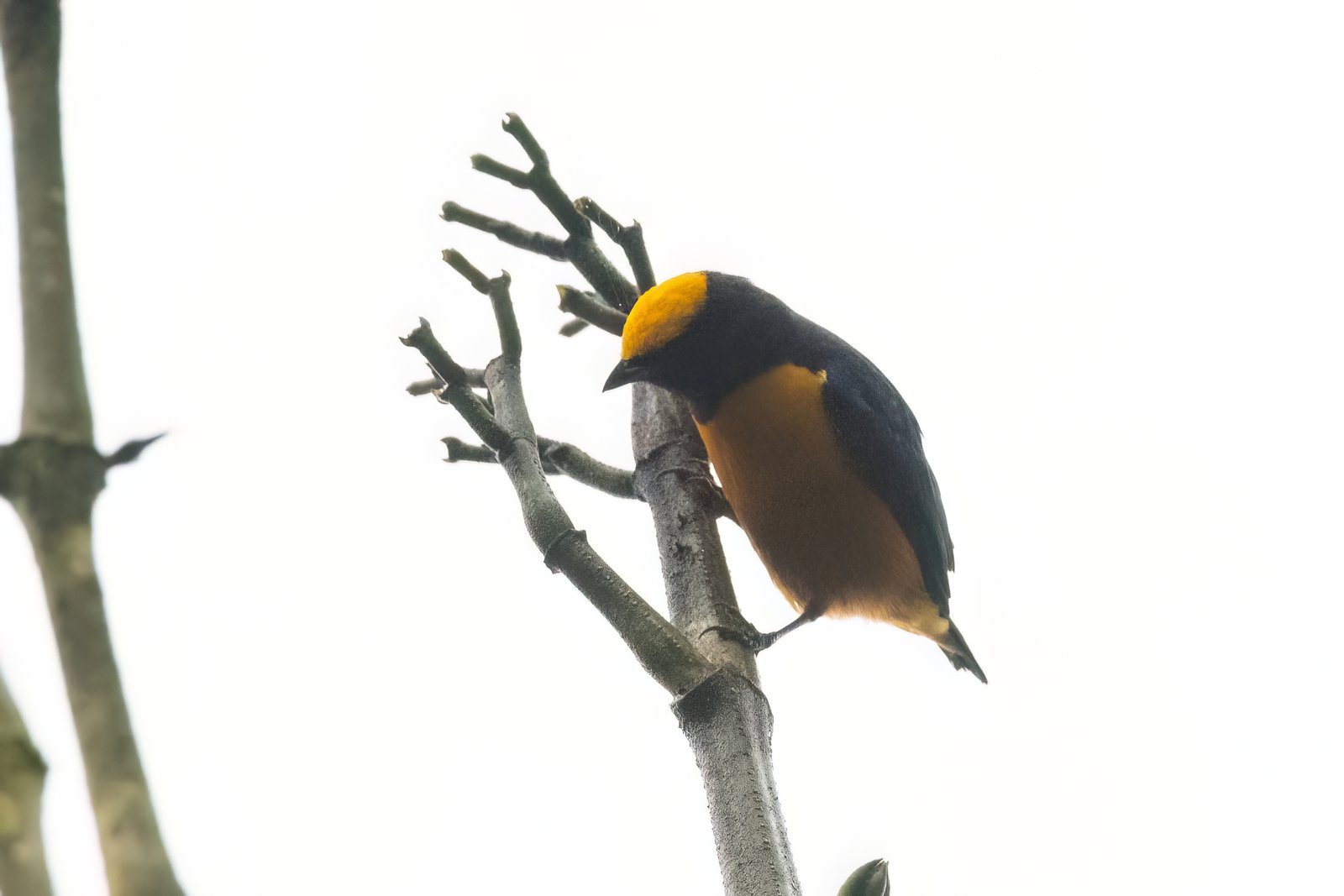
The Orange-crowned Euphonia is a euphonia of forest edges, open woodland and gardens west of the Andes, from western Colombia to the far north-west of Peru. The male has an orange-yellow crown extending far onto the hindcrown and uniform orange-yellow underparts. It searches tree crowns for mistletoe berries and small fruit.
Voice
Clear, short whistles, often in pairs, and a varied, chattering song of twittering and rasping notes.
Recording: José María Loaiza B. — CC BY-NC-SA 4.0 · xeno-canto
Identification
10 cm, with a short, thick bill. The male is glossy blue-black on the upperparts, cheeks and throat, with an orange-yellow crown extending to behind the eye, and uniform deep orange-yellow underparts. The tail has no white spots. The female is olive-green above and uniform yellowish olive-green below, without a clear feature. Young males resemble the female and first acquire a dark throat.
Confusion species
Thick-billed Euphonia Euphonia laniirostris has a yellow rather than dark throat and white spots under the tail. Fulvous-vented Euphonia Euphonia fulvicrissa has a smaller yellow forehead patch and tawny undertail coverts and lives in wetter forest. White-vented Euphonia Euphonia minuta has a small yellow forehead patch and a white lower belly. The female is best told from other female euphonias by accompanying males and by its uniform underparts.
Habitat
Edges of humid and semi-humid forest, open woodland, secondary growth, plantations, orchards and gardens with trees, from the lowlands to about 1500 m, locally higher. It feeds mainly on mistletoe berries and other small fruit, in pairs or small groups in tree crowns. The nest is a globular structure with a side entrance, in a cavity or among epiphytes.
Where the bird is most at home, classified by the vegetation units of the Andes and the west coast.


Range and movements
In Colombia west of the Andes, mainly on the Pacific side, in the Cauca valley and in the south-west. In Ecuador in the western lowlands and foothills, from Esmeraldas to El Oro and Loja. In Peru only in the far north-west, in Tumbes. Absent from Bolivia and the Galápagos. The range lies almost entirely within the guide area.
- Resident
- dark = core range, pale = thinly spread
How and when to look
In western Ecuador, look along forest edges, in gardens and near plantations for trees with mistletoe; birds often perch high and are first recognised by the orange-yellow crown of the male.
Conservation status
Least Concern. The species tolerates landscapes with trees, plantations and gardens well.
Scientific name
Euphonia saturata | (Cabanis, 1861)
Cabanis described the species in 1861 as Phonasca saturata; because it was later moved to another genus, the author and year stand in brackets. The genus Euphonia was introduced in 1806 by Desmarest, A-G. The genus name comes from Greek euphōnos, from eu 'good' and phōnē 'sound', meaning 'sweet-voiced', after the calls of these birds. The species name is Latin saturatus, 'saturated' or 'deeply coloured', after the dark plumage. The specimen the first description was based on came from Colombia.