All species › Passerines › Finches, euphonias and allies › Yellow-collared Chlorophonia
Yellow-collared Chlorophonia | Chlorophonia flavirostris
Geelkraagorganist | Clorofonia acollarada | Gaturamo-de-colar-amarelo
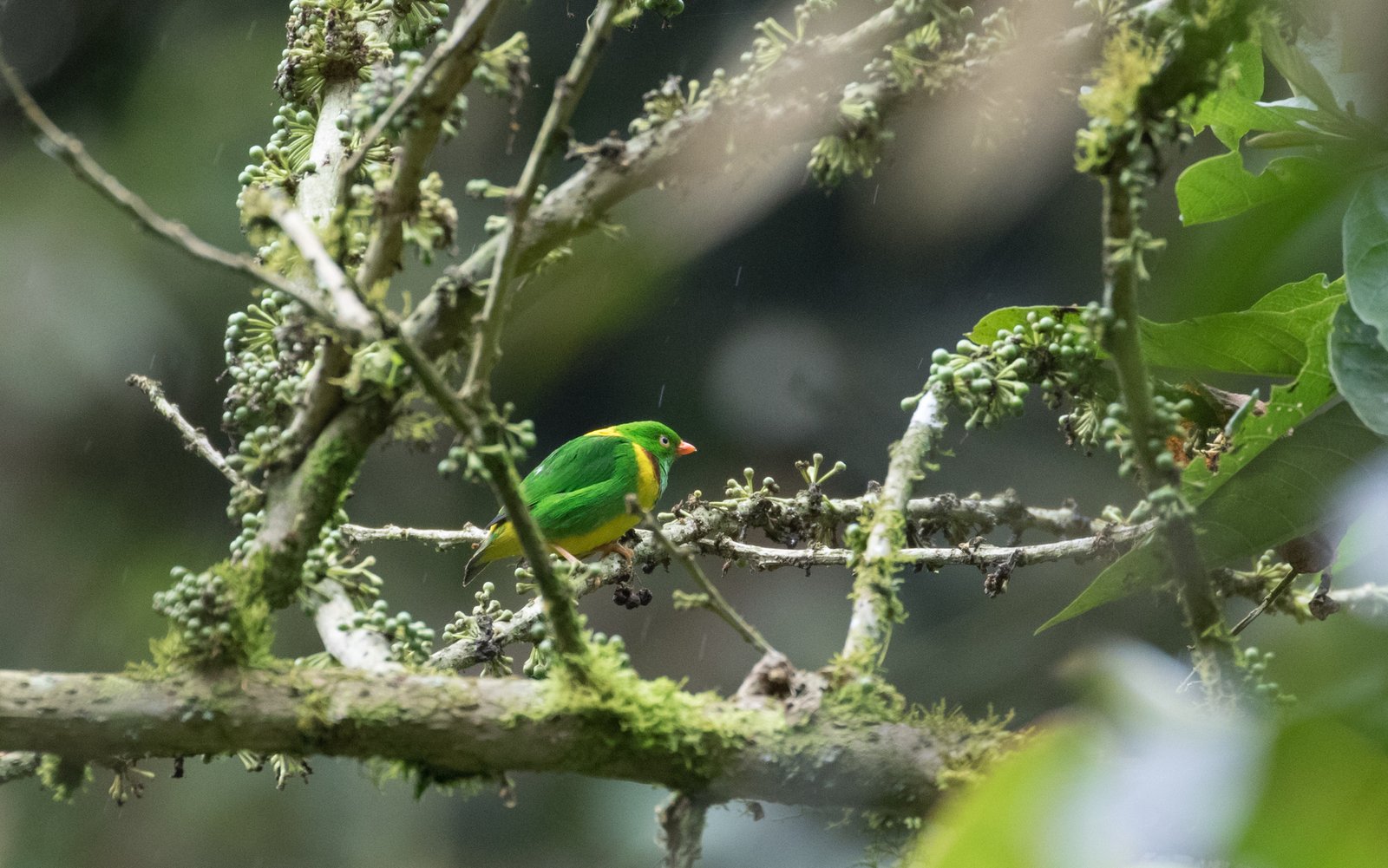
The Yellow-collared Chlorophonia is a small, bright green chlorophonia of the very wet Chocó forest on the Pacific side of the Andes. The male has a yellow band across the nape, and both sexes have an orange bill and orange legs. In small groups it wanders through the mossy canopy in search of mistletoe.
Voice
A soft, high, rather plaintive whistle, often in series, and soft, nasal and twittering notes, especially in flight.
Recording: Mitch Lysinger — CC BY-NC-SA 4.0 · xeno-canto
Identification
10 cm, small and compact, with a short, orangey bill and orange legs. The male is bright green on the head, breast and upperparts, with a narrow yellow band across the nape and a yellow belly, separated from the green breast by a narrow dark line. The female is entirely green, with a yellower centre to the belly, no yellow nape band, but the same orange bill and legs. Young birds resemble the female.
Confusion species
Blue-naped Chlorophonia Chlorophonia cyanea has a blue nape band instead of a yellow one, a dark bill, and lives mainly on the eastern slope of the Andes. Females of euphonias of the genus Euphonia are more olive-green, with a dark bill and dark legs.
Habitat
Very wet, mossy foothill and lower montane forest and their edges, also in the lowlands of the Chocó, mainly between 300 and 2000 m. It lives in pairs or small groups high in the canopy and feeds mainly on mistletoe berries; it follows the fruit supply and may therefore be absent from a site for some time. The nest is a globular structure of moss among epiphytes.
Where the bird is most at home, classified by the vegetation units of the Andes and the west coast.


Range and movements
In Colombia on the Pacific slope of the Western Andes and in the adjacent Chocó lowlands, from the north to the border with Ecuador. In Ecuador in the north-west, in Esmeraldas, Imbabura, Carchi and northern Pichincha. Absent from Peru, Bolivia and the Galápagos. Outside the guide area in eastern Panama.
- Resident
- dark = core range, pale = thinly spread
How and when to look
In wet, mossy forest on the western slope of the Andes in northern Ecuador and south-western Colombia, look for small groups in the crowns of trees with mistletoe. The orange bill is a good feature in the female too.
Conservation status
Least Concern. The range is small and deforestation in the Chocó reduces its habitat, but the species is locally fairly numerous in the remaining forests.
Scientific name
Chlorophonia flavirostris | Sclater, 1861
Sclater described the species in 1861 and placed it straight away in the genus where it still stands. The genus Chlorophonia was introduced in 1851 by Bonaparte. The genus name combines Greek chlōros, 'green', with the genus name Euphonia. The species name comes from Latin flavus, 'yellow', and rostrum, 'bill': 'yellow-billed'. The specimen the first description was based on came from Ecuador.