All species › Passerines › Finches, euphonias and allies › Chestnut-breasted Chlorophonia
Chestnut-breasted Chlorophonia | Chlorophonia pyrrhophrys
Zwartbrauworganist | Clorofonia pechicastaña | Gaturamo-de-peito-castanho
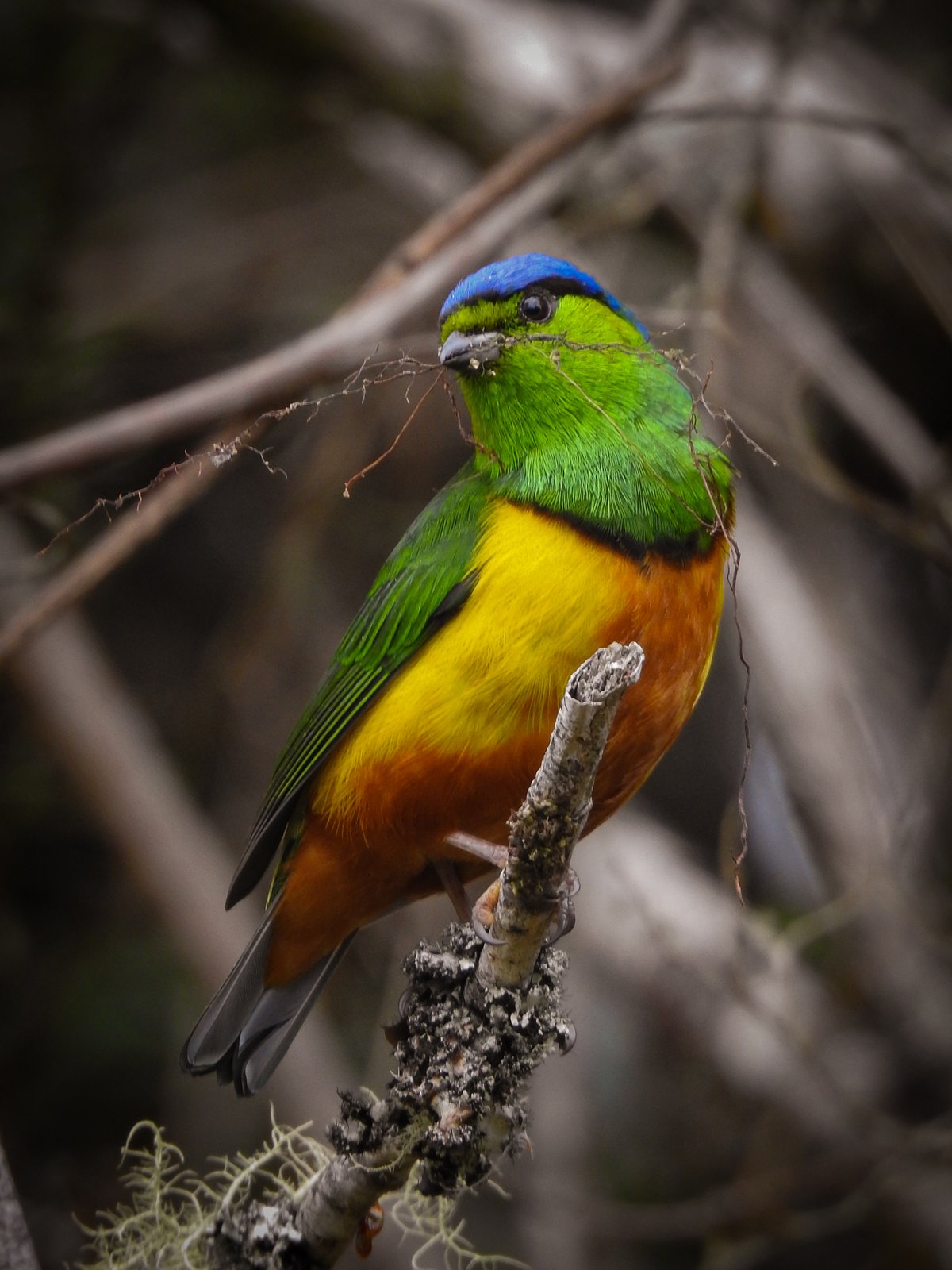
The Chestnut-breasted Chlorophonia is a chlorophonia of the cloud forest of the northern and central Andes. The male combines a green head with a blue, black-bordered crown and a chestnut stripe down the yellow underparts. It lives higher than most other euphonias and forages in the mossy canopy.
Voice
A soft, nasal, descending call, often repeated, and soft, chattering and twittering notes from the canopy.
Recording: Carlos Delgado JUMABITA — CC BY-NC-SA 4.0 · xeno-canto
Identification
11 cm, compact, with a short bill. The male has a green head, throat and upperparts, a cobalt-blue crown and nape bordered at the sides by a narrow black line above the eye, and a narrow black band between the green throat and the yellow breast. A chestnut stripe runs down the centre of the breast and belly; the flanks are yellow. The female is green with a blue crown and nape, greenish-yellow underparts and no chestnut. Young birds resemble the female, with a duller crown.
Confusion species
Blue-naped Chlorophonia Chlorophonia cyanea has a green crown with only a blue band on the nape, a blue eye-ring and no chestnut on the underparts; it usually lives lower. Golden-rumped Euphonia Chlorophonia cyanocephala has a light blue hood, but the male has a black throat and blue-black upperparts.
Habitat
Humid, mossy cloud forest and upper montane forest and their edges, mainly between 1500 and 3000 m. It lives in pairs or small groups in the canopy and feeds mainly on mistletoe berries and other small fruit; it often joins mixed tanager flocks. The nest is a globular structure of moss, hidden on a mossy branch.
Where the bird is most at home, classified by the vegetation units of the Andes and the west coast.


Range and movements
In Colombia in all three Andean ranges. In Ecuador on both slopes of the Andes, mainly on the eastern slope. In Peru on the eastern slope, south to the centre of the country. Absent from Bolivia and the Galápagos. Outside the guide area in the Andes of western Venezuela.
- Resident
- dark = core range, pale = thinly spread
How and when to look
In high cloud forest, look for mixed tanager flocks and watch the mossy crowns for small green birds picking mistletoe berries. The soft, nasal call often gives the birds away before their colours do.
Conservation status
Least Concern. The species is widespread but usually occurs in small numbers; clearing of cloud forest locally reduces its habitat.
Scientific name
Chlorophonia pyrrhophrys | (Sclater, 1851)
Sclater described the species in 1851 as Euphonia pyrrhophrys; because it was later moved to another genus, the author and year stand in brackets. The genus Chlorophonia was introduced in 1851 by Bonaparte. The genus name combines Greek chlōros, 'green', with the genus name Euphonia. The species name comes from Greek pyrrhos, 'flame-coloured', and ophrys, 'eyebrow'. The specimen the first description was based on came from Bogotá, Colombia.