All species › Tinamous › Tinamous › Variegated Tinamou
Variegated Tinamou | Crypturellus variegatus
Bonte tinamoe | Tinamú abigarrado | Inhambu-anhangá
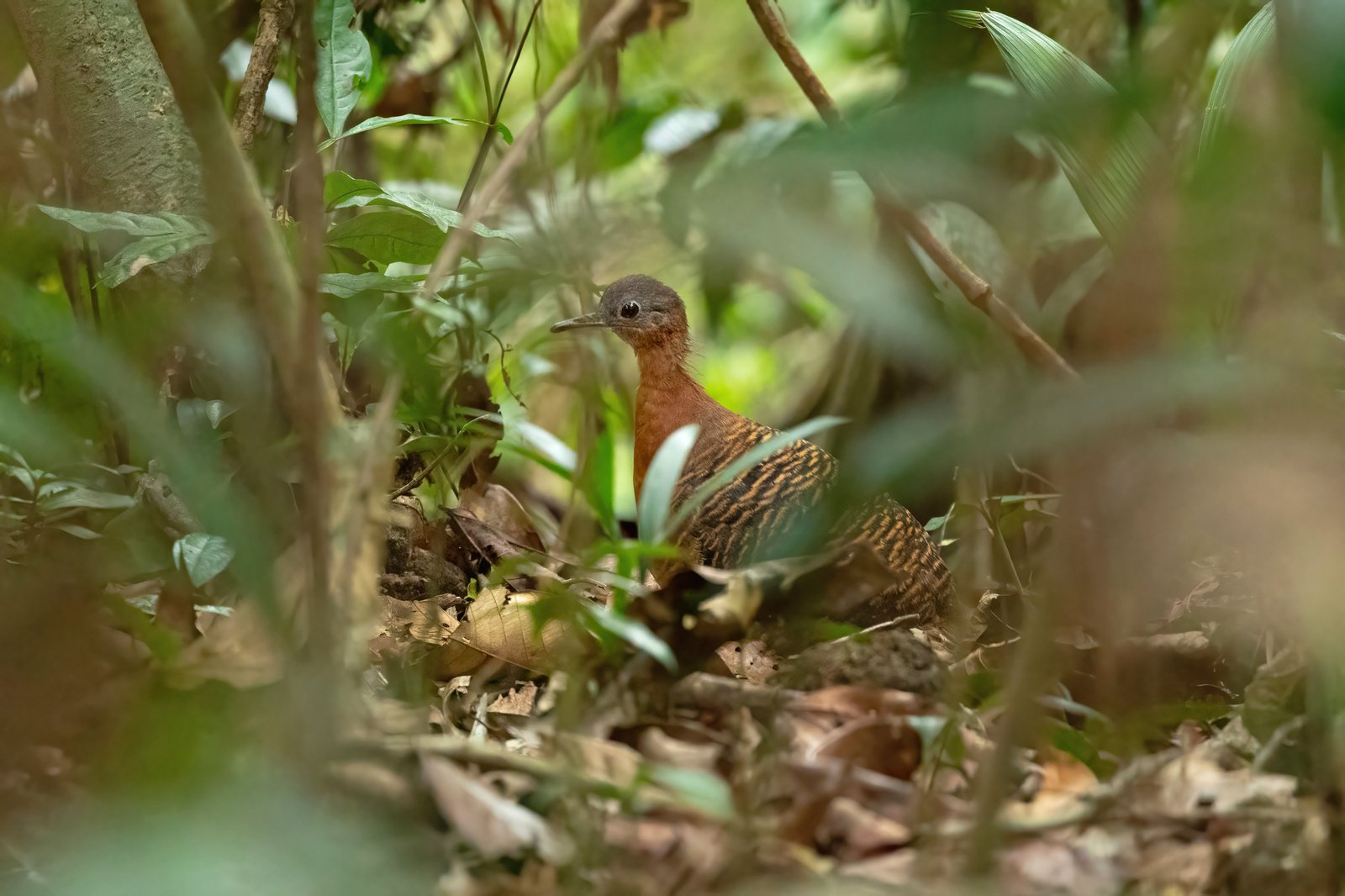
The Variegated Tinamou is one of the most widespread tinamous of the Amazonian rainforest, with a black cap, a rufous neck and a strongly black-and-buff barred back. Its song, a long whistle followed by a series of rising notes, is a familiar sound of terra firme forest.
Voice
A long, pure, slightly rising whistle, followed after a short pause by a series of shorter notes that rise in pitch and accelerate. Mainly in the early morning and at dusk, sometimes during the day.
Recording: Yannick Wiegers — CC BY-NC-SA 4.0 · xeno-canto
Identification
28–31 cm, with a small head, a thin neck and almost no tail. The crown and sides of the head are blackish, the throat white, the neck and breast rufous, the belly paler buff with dark barring on the flanks. The upperparts are black with broad rufous to buff bars. The legs are olive-yellow to greyish green. The sexes are nearly alike.
Confusion species
Black-capped Tinamou Crypturellus atrocapillus also has a black cap, but red legs and, in the male, an almost plain back. Barred Tinamou Crypturellus casiquiare has a rufous head and lives on white sand. Brazilian Tinamou Crypturellus strigulosus and Little Tinamou Crypturellus soui lack the black cap and the strongly barred back.
Habitat
The floor of tall, humid terra firme forest in the lowlands and foothills, locally also old secondary forest; mostly below 1000 m. It walks over the forest floor searching for fallen fruit, seeds and invertebrates. The nest is on the ground between tree roots; the male incubates the eggs.
Where the bird is most at home, classified by the vegetation units of the Andes and the west coast.


Range and movements
In Colombia in the eastern lowlands of the Amazon and Orinoco basins. In Ecuador in the Amazonian lowlands. In Peru in the Amazonian lowlands and lower foothills. In Bolivia in the northern lowlands. Absent west of the Andes and from the Galápagos. Outside the guide area in Venezuela, the Guianas, Brazilian Amazonia and, isolated, in the Atlantic Forest of eastern Brazil.
- Resident
- dark = core range, pale = thinly spread
How and when to look
Listen in the early morning in terra firme forest for the song of one long note followed by rising notes. On quiet trails in little-hunted forest the bird sometimes walks slowly over the forest floor.
Conservation status
Least Concern (LC). It disappears where heavily hunted and suffers from deforestation, but the range is very large.
Scientific name
Crypturellus variegatus | (Gmelin, 1789)
Gmelin described the species in 1789 as Tetrao variegatus; because it was later moved to another genus, the author and year stand in brackets. The genus Crypturellus was introduced in 1914 by Brabourne, WWK-H & Chubb. The genus name comes from Greek kruptos, 'hidden', and oura, 'tail', with the Latin diminutive -ellus: 'little hidden tail'. The species name comes from Latin variegatus, 'variegated'. The specimen the first description was based on came from the Guianas.