All species › Jacamars and puffbirds › Puffbirds › Western Striolated Puffbird
Western Striolated Puffbird | Nystalus obamai
Obama's baardkoekoek | Buco estriado occidental | Rapazinho-estriado-do-oeste
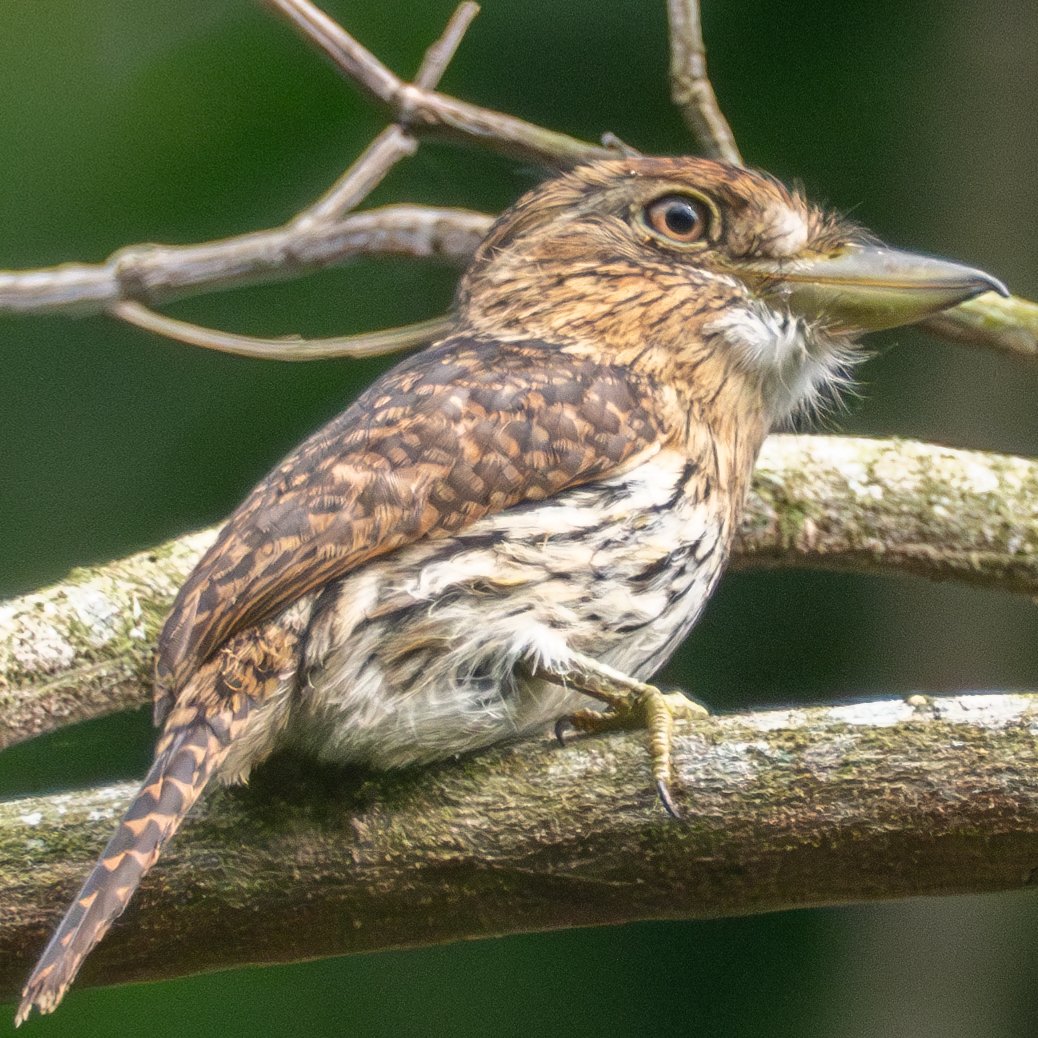
The Western Striolated Puffbird is the western half of the former Striolated Puffbird, described as a separate species in 2013 and named after Barack Obama. It lives at forest edges in the Andean foothills and the adjacent Amazonian lowlands. In the field it differs from its eastern sister species mainly in song.
Voice
A soft, sad series of whistles with a rising then falling cadence, like whip, whee-wheeu, wheeeeeuu, mainly shortly after dawn and before dusk. The male often starts, the female follows slightly lower.
Recording: Juan Freile — CC BY-NC-SA 4.0 · xeno-canto
Identification
20–21 cm, with a large head, a heavy, dull greyish-green bill with a dark tip and a medium-length tail. The upperparts are brown with fine buff and rufous barring. A buff band crosses the hindneck. The face is streaked, the throat white. The breast is buff, the belly whitish, both with fine black streaks, especially on the breast and flanks. The sexes are alike.
Confusion species
Eastern Striolated Puffbird Nystalus striolatus is almost identical; it differs mainly in song and in the guide area occurs only in the far north-east of Bolivia. White-eared Puffbird Nystalus chacuru has a red bill and a white ear patch and lives in open country. Rufous-necked Puffbird Malacoptila rufa has a grey head with a rufous neck and a white moustachial stripe. Spotted Puffbird Bucco tamatia is scalloped, with an orange-rufous throat.
Habitat
Edges of humid lowland and foothill forest, also terra firme forest, swamp forest and transitional forest, clearings with tall trees; from the lowlands up to about 1300 m in Colombia, 1700 m in Ecuador and 1850 m in Bolivia. It perches in the lower canopy or the crown and sallies for large insects. It presumably nests in a burrow in the ground, as related species do.
Where the bird is most at home, classified by the vegetation units of the Andes and the west coast.


Range and movements
In Colombia in the south, at the foot of the eastern slope of the Andes. In Ecuador in the foothills and adjacent lowlands of the east. In Peru along the eastern slope and in the Amazonian lowlands. In Bolivia in the foothills and lowlands of the north and centre. Absent from the Galápagos. Outside the guide area in western Amazonian Brazil, south of the Amazon and west of the Rio Madeira.
- Resident
- dark = core range, pale = thinly spread
How and when to look
Along roads and forest edges in the foothills of the eastern slope, in the early morning or late afternoon, when the birds sing. The bird often sits high and in the open on a bare branch.
Conservation status
Not evaluated as a separate species; the former, broadly defined Striolated Puffbird is listed as Least Concern. The range is large and the species tolerates forest edges.
Scientific name
Nystalus obamai | Whitney, Piacentini, Schunck, Aleixo, Sousa, Silveira & Rêgo, 2013
Whitney, Piacentini, Schunck, Aleixo, Sousa, Silveira & Rêgo described the species in 2013 and placed it straight away in the genus where it still stands. The genus Nystalus was introduced in 1863 by Cabanis & Heine. The genus name comes from Greek nustalos, 'drowsy'. The species name obamai honours Barack Obama (born 1961), the 44th president of the United States. The specimen the first description was based on came from (per the description).