All species › Woodpeckers and allies › Woodpeckers › White-barred Piculet
White-barred Piculet | Picumnus cirratus
Zebradwergspecht | Carpinterito barrado | Pica-pau-anão-barrado
The White-barred Piculet is a widespread piculet of eastern South America that reaches the guide area only in south-eastern Bolivia. Its underparts are densely barred black and white, which gives it its name. Like all piculets it clambers through thin branches and vines and hardly uses its tail for support.
Voice
A high, rapid trill, tsirrrrr, and sharp single tsik calls. It drums briefly and softly on dead twigs.
Recording: Bernard BOUSQUET — CC BY-NC-SA 4.0 · xeno-canto
Identification
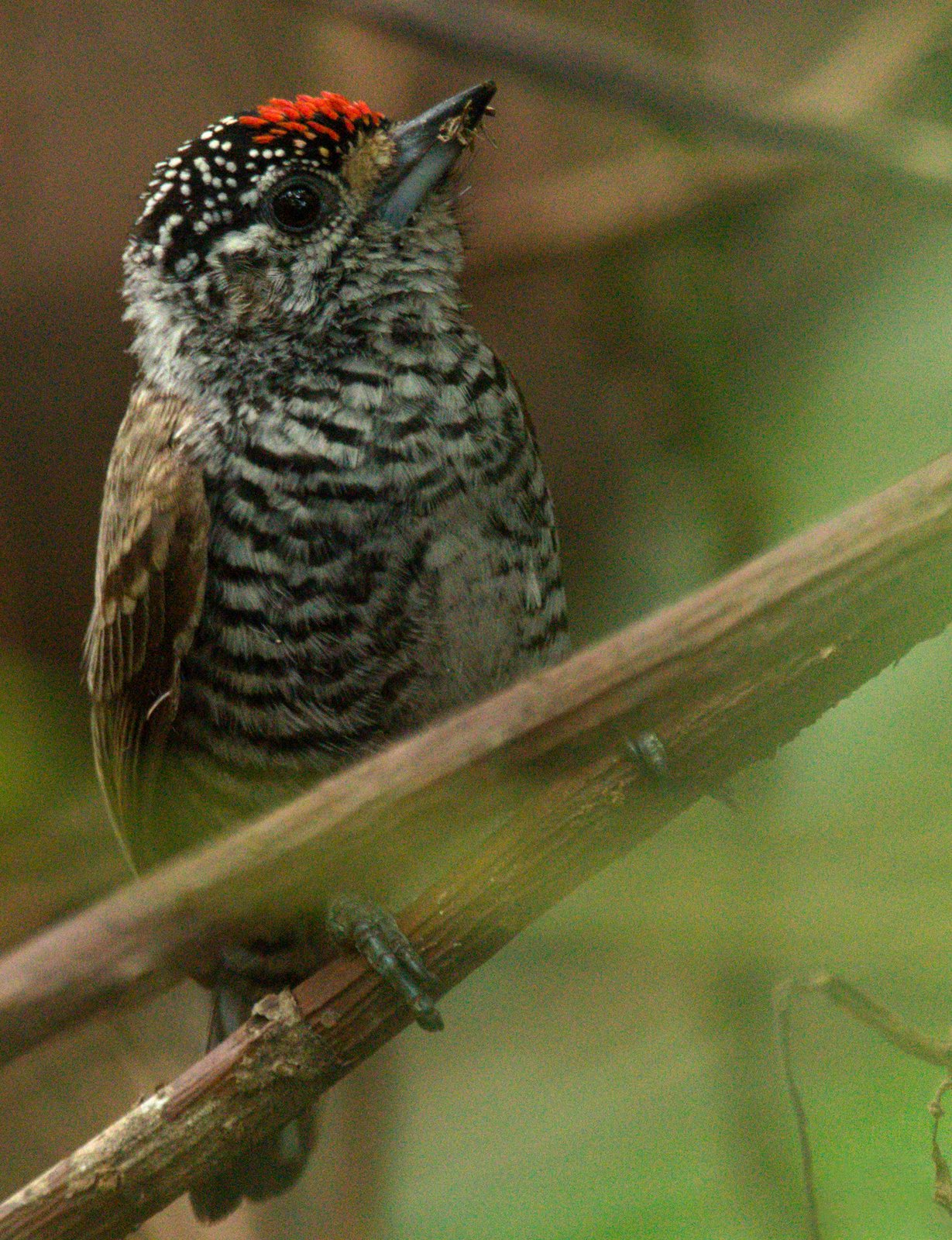
10 cm, with a short, straight bill. The crown is black with white dots; the male has red feather tips on the forecrown. The upperparts are greyish brown to brown. The cheek is brown, with a pale stripe behind the eye. The underparts are white with regular, dense black bars from throat to undertail. The tail is black, with white inner webs to the central feathers. The female has no red on the head.
Confusion species
Ocellated Piculet Picumnus dorbignyanus, higher in the Andes, is scaled and spotted below rather than evenly barred. White-wedged Piculet Picumnus albosquamatus of the eastern lowlands has black scales and spots on white underparts and no regular bars. Rusty-necked Piculet Picumnus fuscus is ochre and almost unmarked below.
Habitat
Dry forest, Chaco woodland, gallery forest, forest edges and secondary scrub with scattered trees in the lowlands and low foothills, up to about 1000 m. It forages on thin branches and lianas in the lower and middle strata, often in pairs or with mixed flocks. It eats ants, termites and insect larvae. It nests in a self-excavated cavity in a thin dead branch.
Where the bird is most at home, classified by the vegetation units of the Andes and the west coast.


Range and movements
In Bolivia in the south-east, mainly in Santa Cruz, Chuquisaca and Tarija, in the Chaco and adjacent dry forests. From Peru there are only a few unconfirmed reports; the species is not established there. Absent from Colombia, Ecuador and the Galápagos. Outside the guide area in Paraguay, northern Argentina, Uruguay, eastern and southern Brazil and locally in the Guianas.
- Resident
- dark = core range, pale = thinly spread
How and when to look
Search the Chaco woodland and dry forests of Santa Cruz and Tarija, in mixed flocks in the lower branches. The soft tapping and the high trill often give the bird away before its plumage does.
Conservation status
Least Concern. The species has a large range and tolerates secondary forest and forest edges.
Scientific name
Picumnus cirratus | Temminck, 1825
Temminck described the species in 1825 and placed it straight away in the genus where it still stands. He introduced the genus Picumnus in that same work. The genus name refers to Picumnus, a Roman god of fertility and agriculture, brother of Pilumnus, whose name is related to Latin picus, 'woodpecker'. The species name comes from Latin cirratus, 'curly-haired', from cirrus, 'ringlet, curl, fringe'. The specimen the first description was based on came from Brazil and Paraguay.