All species › Parrots › African and New World parrots › White-bellied Parrot
White-bellied Parrot | Pionites leucogaster
Witbuikcaique | Perico de vientre blanco | Marianinha-de-cabeça-amarela
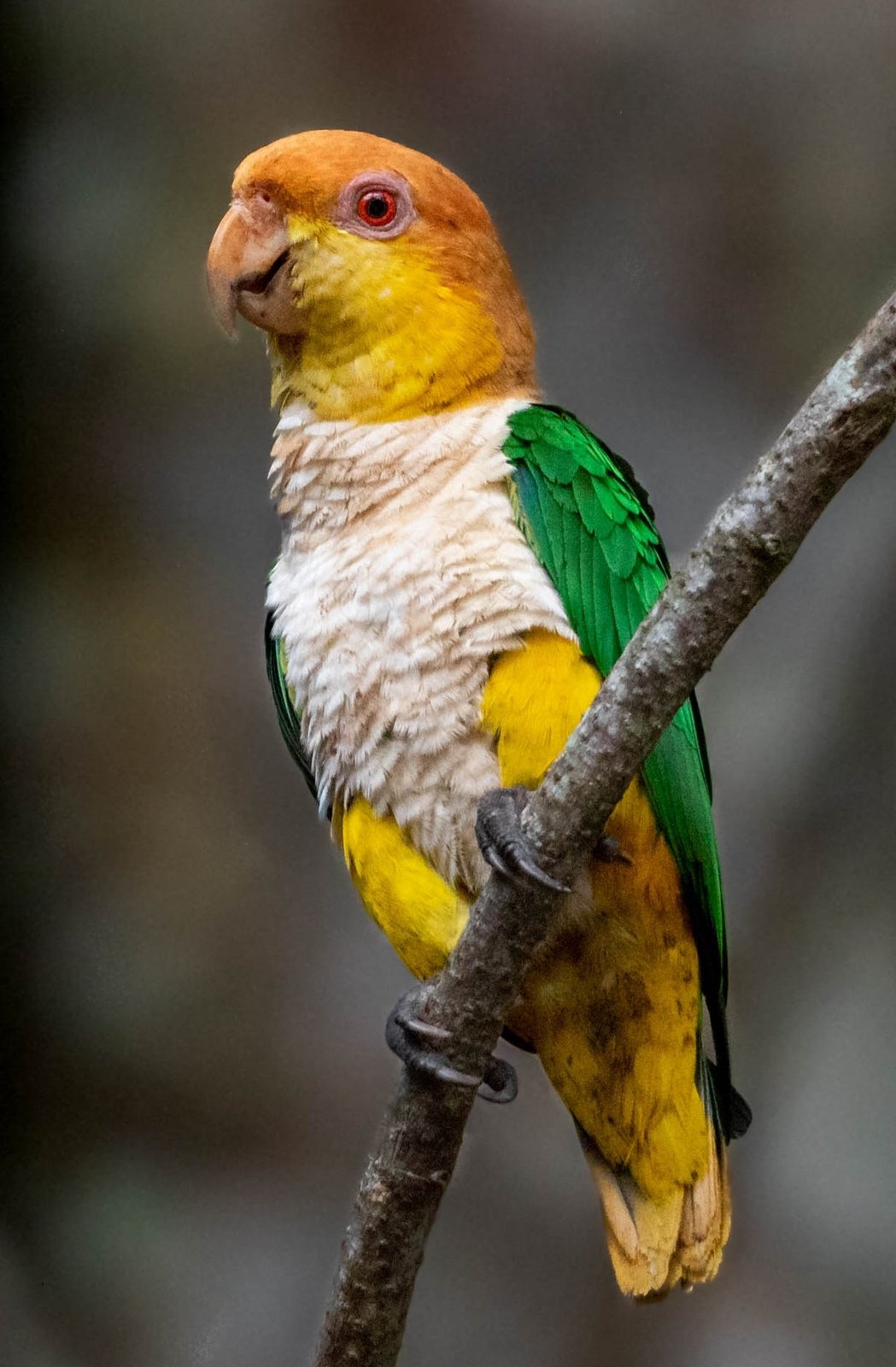
The White-bellied Parrot is the southern counterpart of the Black-headed Parrot: just as stocky and noisy, but with an apricot head instead of a black cap. In the guide area it lives in the Amazonian lowlands south of the Amazon and the Marañón. Small groups clamber and hang agilely in the canopy.
Voice
High, shrill, screeching calls and a wide variety of whistles and chatter, similar to those of the Black-headed Parrot. Groups are noisy, also when perched in the canopy.
Recording: Richard E. Webster — CC BY-NC-SA 4.0 · xeno-canto
Identification
23 cm, stocky, with a short, square tail. The crown and nape are apricot to orange-yellow, the cheeks and throat yellow. The back, wings and tail are green, the flight feathers partly blue. The breast and belly are creamy white. In the guide area birds have yellow thighs; elsewhere in the range the thighs are green, and in some forms the tail is also partly yellow. The bill is pale horn, the eye orange-red. The sexes are alike; juveniles have some dark feathers on the crown and a dark eye.
Confusion species
Black-headed Parrot Pionites melanocephalus has a black cap and a black bill and lives north of the Amazon and the Marañón. Saffron-headed Parrot Pyrilia pyrilia also has a yellow head, but a green breast and belly; it lives in northern Colombia, outside the range of the White-bellied Parrot. Other lowland parrots of similar size have a green belly.
Habitat
Humid lowland terra firme and várzea forest, also forest edges and tall secondary forest, up to about 1000 m at the foot of the Andes. It eats fruit, seeds and flowers high in the canopy. It lives in pairs and groups of five to ten birds. The nest is in a tree cavity.
Where the bird is most at home, classified by the vegetation units of the Andes and the west coast.


Range and movements
In Peru in the eastern lowlands south of the Amazon and the Marañón, from southern Loreto and Ucayali to Madre de Dios and Puno. In Bolivia in the northern and central lowlands, in Pando, Beni, northern La Paz and Cochabamba and northern Santa Cruz. Absent from Colombia, Ecuador and the Galápagos. Outside the guide area in Brazilian Amazonia south of the Amazon.
- Resident
- dark = core range, pale = thinly spread
How and when to look
Search from canopy towers and along forest edges in Madre de Dios, for example around Tambopata and Manu; groups give themselves away by their shrill calls. They also visit clay licks to eat soil.
Conservation status
Not evaluated in the circumscription followed here. In the guide area the species is widespread in largely intact forest; in the east of the range, in Brazil, numbers are declining due to deforestation.
Scientific name
Pionites leucogaster | (Kuhl, 1820)
Kuhl described the species in 1820 as Psittacus leucogaster; because it was later moved to another genus, the author and year stand in brackets. The genus Pionites was introduced in 1890 by Heine. The genus name is derived from the genus Pionus with the Greek suffix -itēs, 'resembling'. The species name comes from Greek leukos, 'white', and gastēr, 'belly'. The specimen the first description was based on came from Brazil.