All species › Passerines › Shrike-babblers, Erpornis and vireos › White-eyed Vireo
White-eyed Vireo | Vireo griseus
Witoogvireo | Vireo ojiblanco | Juruviara-de-olho-branco
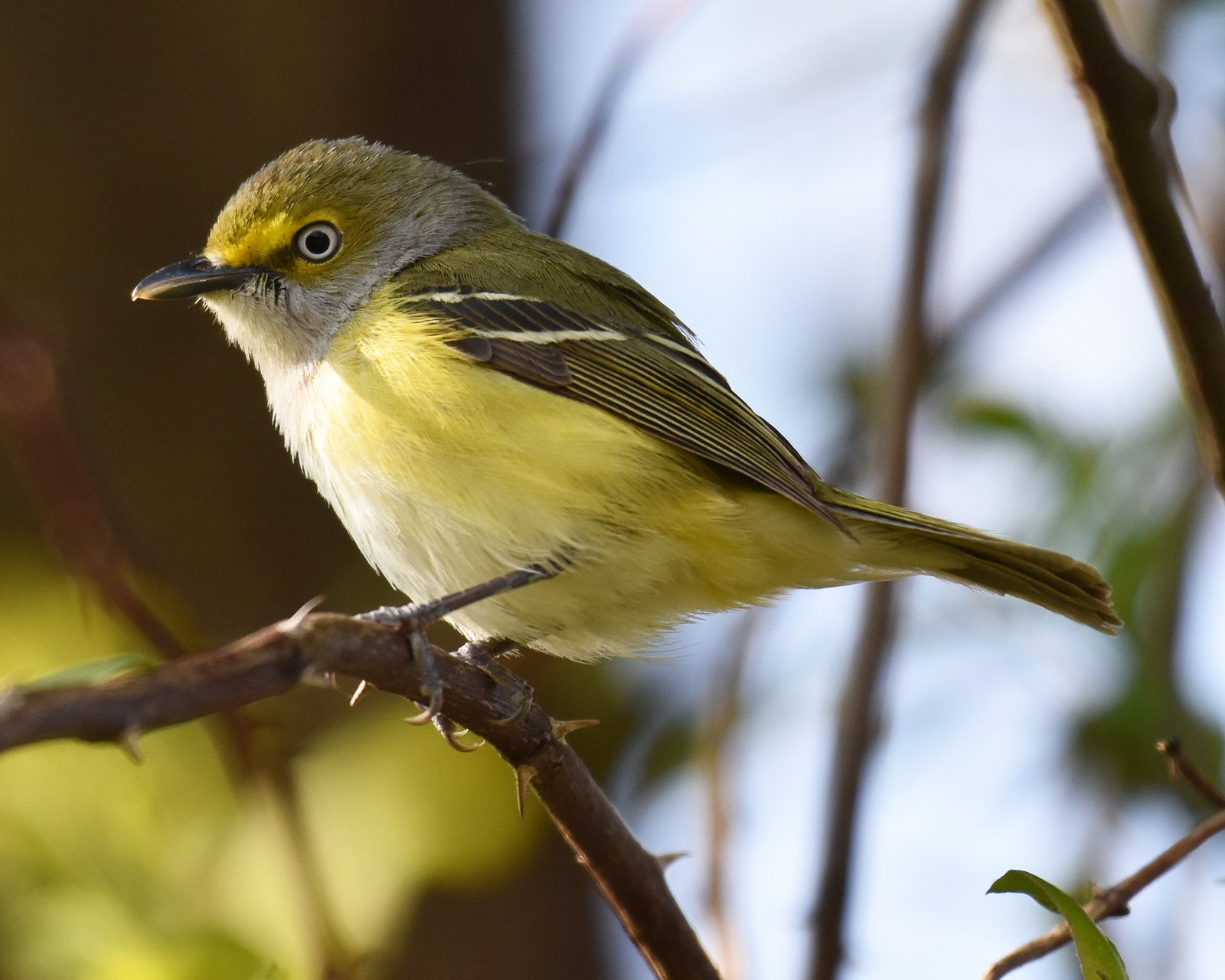
The White-eyed Vireo is a small, active vireo with a white iris and yellow spectacles. It breeds in the eastern United States and winters south to Central America and the Caribbean. In the guide area it is a rare vagrant, with only a few records in northern Colombia.
Voice
The song is a fast, emphatic phrase of five to seven notes, often starting and ending with a sharp chick, also with imitations of other birds. The call is a rasping, scolding chatter.
Recording: steve — CC BY-SA 4.0 · xeno-canto
Identification
12–13 cm, with a fairly thick, dark bill. The upperparts are greyish olive-green, the nape greyer. Yellow lores and a yellow eye-ring form spectacles. The iris is white in adults, dark in young birds in their first autumn. Two white wing bars. The underparts are white, with yellow flanks. The sexes are alike.
Confusion species
Thick-billed Vireo Vireo crassirostris on Providencia has a dark iris, a thicker bill and yellower underparts. San Andres Vireo Vireo caribaeus has a grey-brown iris and less yellow on the flanks. Yellow-throated Vireo Vireo flavifrons is larger, with a bright yellow throat and breast.
Habitat
Dense scrub, forest edges, young secondary woodland and overgrown gardens in the lowlands. It forages low in dense vegetation for insects and also eats fruit in winter. It does not breed in the guide area.
Where the bird is most at home, classified by the vegetation units of the Andes and the west coast.


Range and movements
Colombia: rare vagrant, with a few records in the north. Ecuador, Peru and Bolivia: not recorded. Absent from the Galápagos. Outside the guide area it breeds in the eastern United States and north-eastern Mexico and winters in the south-eastern United States, Central America and the Caribbean.
How and when to look
A record is most likely between October and April, in scrub on the Caribbean coast and on the islands. Listen for the sharp chick at the start and end of the song.
Conservation status
Least Concern. The breeding population is large and stable.
Scientific name
Vireo griseus | (Boddaert, 1783)
Boddaert described the species in 1783 as Tanagra grisea; because it was later moved to another genus, the author and year stand in brackets. The genus Vireo was introduced in 1808 by Vieillot. The genus name is Latin vireo, a green migratory bird, perhaps the female golden oriole or the greenfinch; related to virere, 'to be green'. The species name comes from Medieval Latin griseus, 'grey'. The specimen the first description was based on came from New Orleans, Louisiana, United States.