All species › Passerines › Manakins › White-ruffed Manakin
White-ruffed Manakin | Corapipo altera
Witkraagmanakin | Saltarín gorgiblanco | Dançarino-de-gola-branca
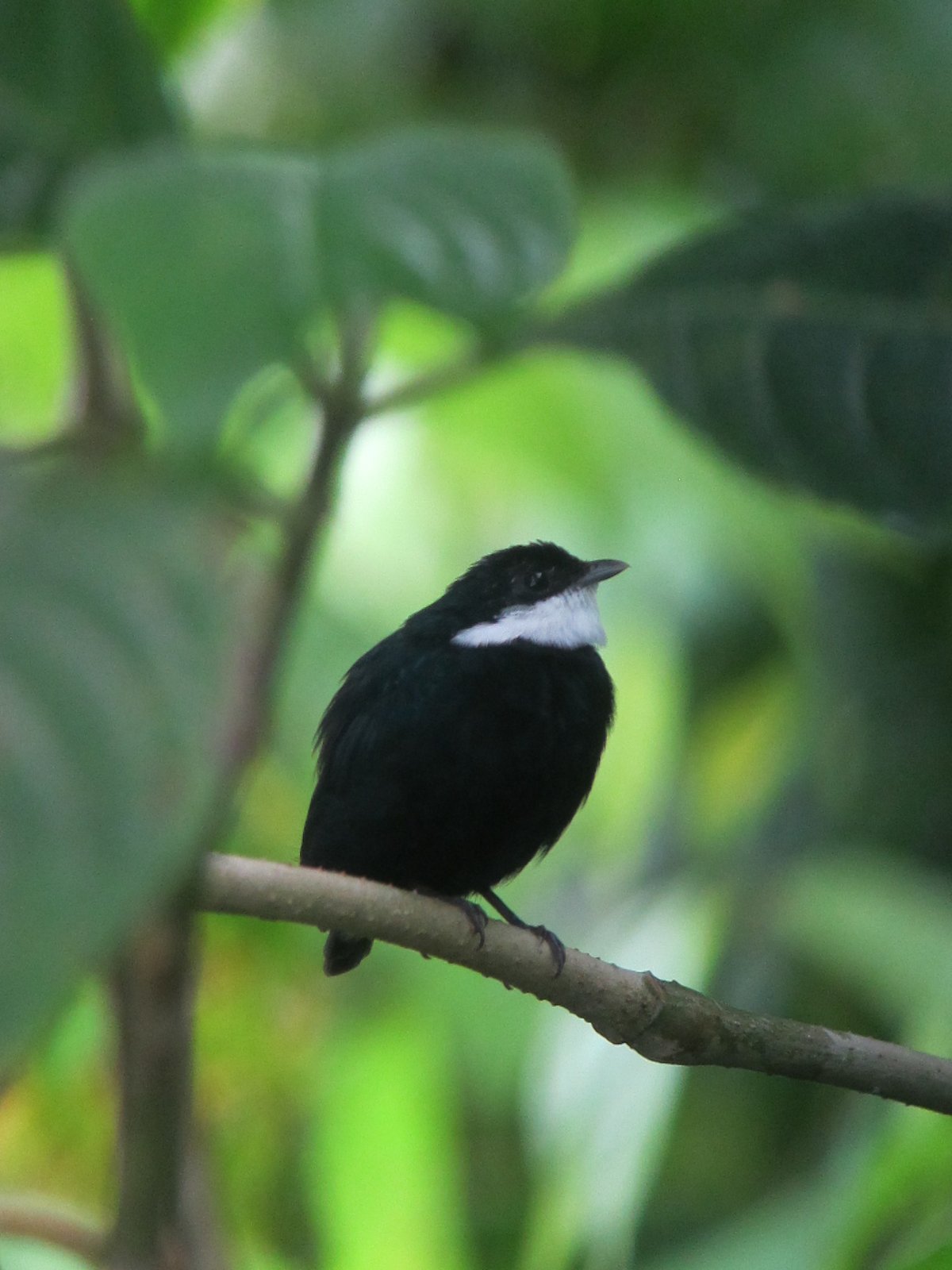
The White-ruffed Manakin is a small blue-black manakin with a white throat that the male raises into a ruff during display. It is a Central American species that reaches the guide area only in the far north-west of Colombia. Males display on fallen logs on the forest floor, with short flights and crackling wing sounds.
Voice
A high, thin, sharp tseee, often in a short series. During display crackling or rattling wing sounds, followed by a high tsee-tsee.
Recording: Johan Chaves — CC BY-NC-SA 4.0 · xeno-canto
Identification
10 cm, compact, with a short tail and a short black bill. The male is glossy blue-black, with a pure white throat that extends onto the sides of the neck and is raised as a ruff when excited. The female is olive-green above, with a grey throat and sides of the head and an olive-grey breast grading into a paler, yellowish belly. Young males resemble the female, with the first black feathers on the face.
Confusion species
White-bibbed Manakin Corapipo leucorrhoa is very similar, but the white on the male's throat extends less far onto the sides of the neck; it lives further east, in northern Colombia. The male White-crowned Manakin Pseudopipra pipra has a white crown rather than a white throat. Females of other manakins, such as Golden-headed Manakin Ceratopipra erythrocephala and Red-capped Manakin Ceratopipra mentalis, lack the grey throat.
Habitat
Humid foothill forest and lower montane forest, also older secondary forest, at roughly 400 to 1500 m; in Central America many birds move to lower forest outside the breeding season. It lives in the understorey and middle storey, often at fruiting shrubs, and eats small fruits and insects.
Where the bird is most at home, classified by the vegetation units of the Andes and the west coast.


Range and movements
In the guide area only in the far north-west of Colombia, in the border region with Panama in the Serranía del Darién, northern Chocó and the Urabá region. Absent from Ecuador, Peru, Bolivia and the Galápagos. Outside the guide area from Honduras to Panama.
- Resident
- dark = core range, pale = thinly spread
How and when to look
In the guide area the species is confined to remote hill forest on the Panamanian border. Look in humid forest on the slopes for small groups of birds at fruiting shrubs and listen for the high tseee.
Conservation status
Not Evaluated in the taxonomy followed by this guide. The species is locally common in Central America, but in Colombia it is confined to a small area; loss of hill forest is the main threat there.
Scientific name
Corapipo altera | Hellmayr, 1906
Hellmayr described the species in 1906 and placed it straight away in the genus where it still stands. The genus Corapipo was introduced in 1854 by Bonaparte. The second part of the genus name is New Latin pipo, 'manakin'. Bonaparte gave no explanation for the first part; it may be Greek korax, 'raven' (i.e. black), korē, 'maiden, nymph', or korē, 'shining pupil of the eye'. The specific name is Latin alter, altera, 'second, next, another'. The specimen the first description was based on came from Carrillo, Costa Rica.