All species › Swifts › Hummingbirds › Wire-crested Thorntail
Wire-crested Thorntail | Discosura popelairii
Gekuifde draadkolibrie | Colicerda crestuda | Rabo-de-espinho-de-topete
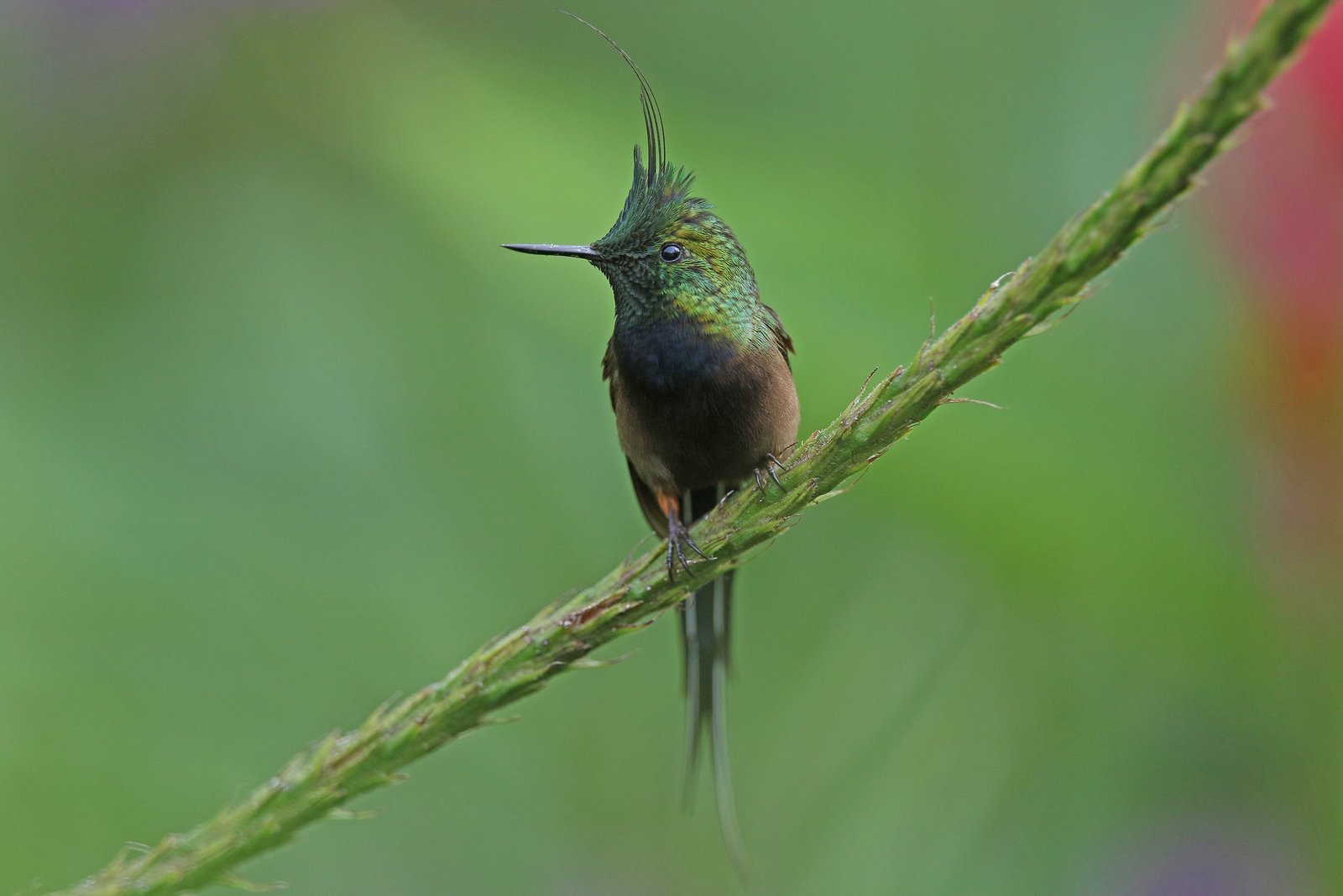
The Wire-crested Thorntail is a very small hummingbird of the foothills on the eastern slope of the Andes. The male has a long, hair-thin crest and a long, deeply forked tail with narrow, pointed feathers. Thorntails hover with a slow, insect-like flight, holding the tail cocked upwards.
Voice
Mostly silent; soft, short tsip notes. When hovering a soft, bee-like hum of the wings.
Recording: Daniel Lane — CC BY-NC-SA 3.0 · xeno-canto
Identification
8–12 cm; the male is clearly longer than the female because of its long tail. Short, straight black bill. The male has a glittering green crown with a long, narrow, hair-like crest, coppery green upperparts, a white band across the rump, a glittering green throat and black underparts; the long, forked tail is steel blue. The female lacks the crest and is green above, with a white rump band, black underparts with a white malar stripe and a white flank patch, and a shorter, slightly forked blue-black tail with white tips.
Confusion species
Black-bellied Thorntail Discosura langsdorffi has no crest, has a coppery band below the green throat in the male and lives in the Amazonian lowlands. Coquettes (Lophornis), such as Rufous-crested Coquette Lophornis delattrei, also have a white rump band, but a short, rounded, partly rufous tail; females show rufous or buff on the head or throat. Green Thorntail Discosura conversii occurs only west of the Andes.
Habitat
Humid foothill forest and its edges, clearings and gardens with flowering shrubs, mostly between about 500 and 1500 m. It feeds mainly in the canopy and at the forest edge at small flowers, including those of Inga trees, and comes down to flowering shrubs in clearings. Little is known about its breeding biology.
Where the bird is most at home, classified by the vegetation units of the Andes and the west coast.


Range and movements
In Colombia in the foothills of the eastern slope, mainly from western Meta southwards. In Ecuador in the foothills of the eastern slope. In Peru along the eastern slope south to Puno. In Bolivia only a single record, from the far north-west. Absent from the Galápagos. Does not occur outside the guide area.
- Resident
- dark = core range, pale = thinly spread
How and when to look
At flowering verbena hedges (Stachytarpheta) and flowering trees at lodges in the foothills of the eastern slope in Ecuador. Watch for the slow, hovering flight with cocked tail and the white rump band.
Conservation status
Least Concern. The species is local and not numerous; deforestation of the foothills affects its habitat.
Scientific name
Discosura popelairii | (Du Bus de Gisignies, B-AL, 1846)
Du Bus de Gisignies, B-AL described the species in 1846 as Trochilus popelairii; because it was later moved to another genus, the author and year stand in brackets. The genus Discosura was introduced in 1850 by Bonaparte. The genus name combines Greek diskos, 'disc' or 'plate', with oura, 'tail'. The species name honours Baron Jean-Baptiste Louis Joseph Popelaire de Terloo (1810–1870), a Belgian explorer, naturalist and collector in tropical America. The specimen the first description was based on came from Peru.