All species › Passerines › Thrushes and allies › Wood Thrush
Wood Thrush | Hylocichla mustelina
Amerikaanse boslijster | Zorzal maculado | Sabiá-dos-bosques
The Wood Thrush is a sturdy, rufous-brown thrush with heavily spotted underparts, which breeds in deciduous forest in eastern North America and winters from southern Mexico to Panama. In the guide area it is a rare vagrant, with only a few records in north-western Colombia.
Voice
The song, rarely heard on the wintering grounds, is a fluty, whistled phrase ending in a trilled note. The call is a rapid, sharp pit-pit-pit, the sound most often heard in winter quarters.
Recording: Jacob Saucier — CC BY-NC-SA 4.0 · xeno-canto
Identification
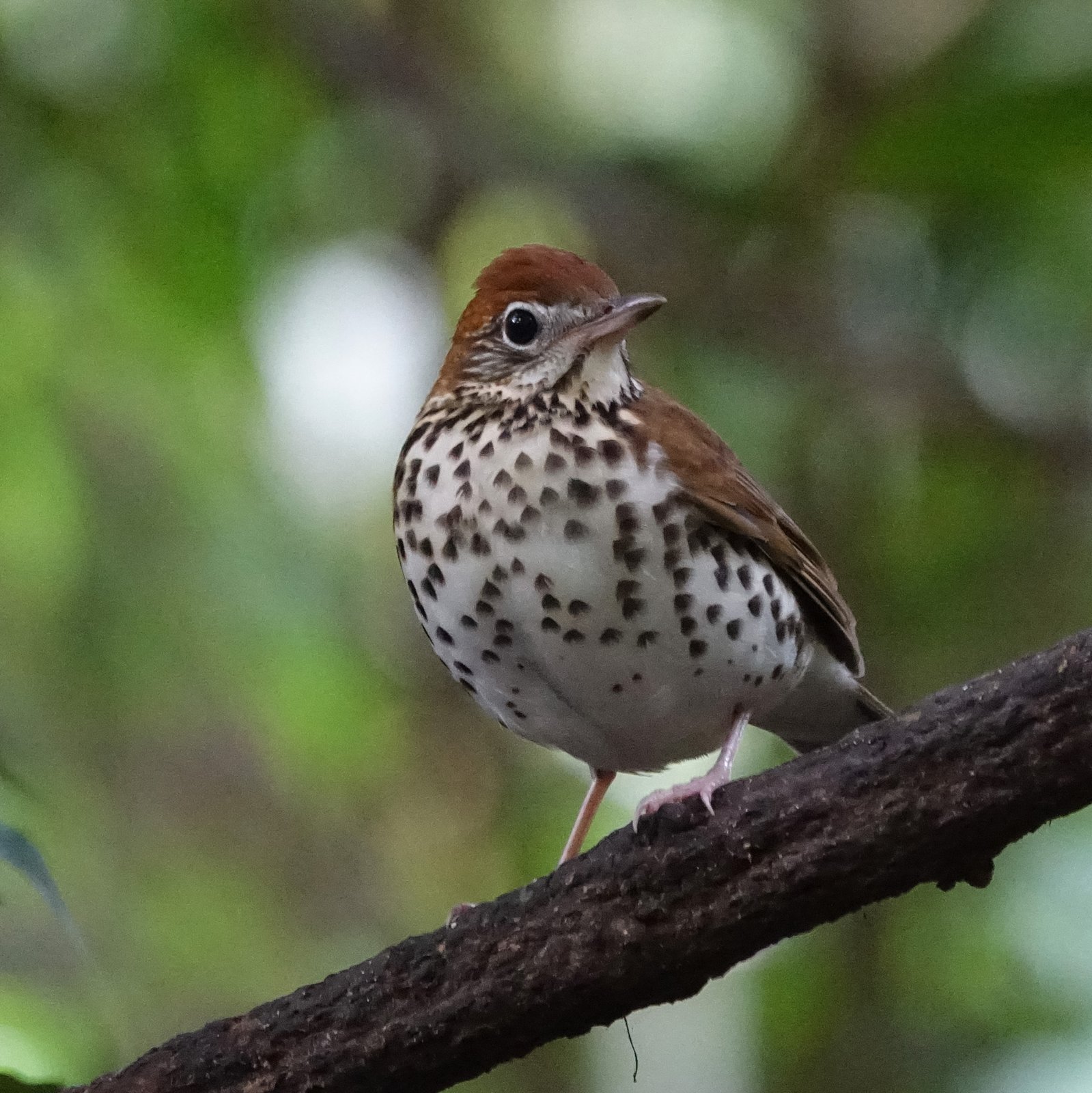
19–21 cm, stocky, with a fairly short tail. The crown and nape are bright rusty brown, the back and tail warmer olive-brown. The cheek is white with dark streaks and there is a distinct white eye-ring. The underparts are white with large, round, black spots on the breast, flanks and belly. The bill is dark with a pale base to the lower mandible, and the legs are pink. The sexes are alike.
Confusion species
Swainson's Thrush Catharus ustulatus, Grey-cheeked Thrush Catharus minimus and Veery Catharus fuscescens, which occur in the guide area as winter visitors or passage migrants from North America, are smaller and slimmer, have an olive-brown or greyish-brown crown without a rusty cap, and smaller, less crisp spots mainly on the breast.
Habitat
In winter quarters in the interior of humid lowland forest and lower montane forest, also older secondary forest, mostly below 1500 m. It forages on the ground in the leaf litter, flicking leaves aside in search of insects, and also eats fruit. Wintering birds hold individual territories.
Where the bird is most at home, classified by the vegetation units of the Andes and the west coast.


Range and movements
In the guide area only a few records in north-western Colombia, mainly near the Panama border. Not known from Ecuador, Peru, Bolivia or the Galápagos. Outside the guide area it breeds in the eastern United States and south-eastern Canada and winters from southern Mexico to Panama.
How and when to look
A bird in the guide area is most likely between October and April in humid forest in north-western Colombia. Listen for the sharp pit-pit-pit from the forest floor.
Conservation status
Least Concern. The North American population has, however, declined sharply since the 1960s, through fragmentation of breeding forest and loss of forest on the wintering grounds.
Scientific name
Hylocichla mustelina | (Gmelin, 1789)
Gmelin described the species in 1789 as T[urdus] mustelinus; because it was later moved to another genus, the author and year stand in brackets. The genus Hylocichla was introduced in 1864 by Baird. The genus name combines Greek hulē, 'woodland', with kikhlē, 'thrush': a translation of the English name Wood Thrush. The species name comes from Latin mustela, 'weasel', for the weasel-like rufous-brown upperparts. The specimen the first description was based on came from New York, United States.