All species › Passerines › Antbirds › Yellow-breasted Warbling Antbird
Yellow-breasted Warbling Antbird | Hypocnemis subflava
Geelborstorpheusmierkruiper | Hormiguero pechiamarillo | Cantador-galego
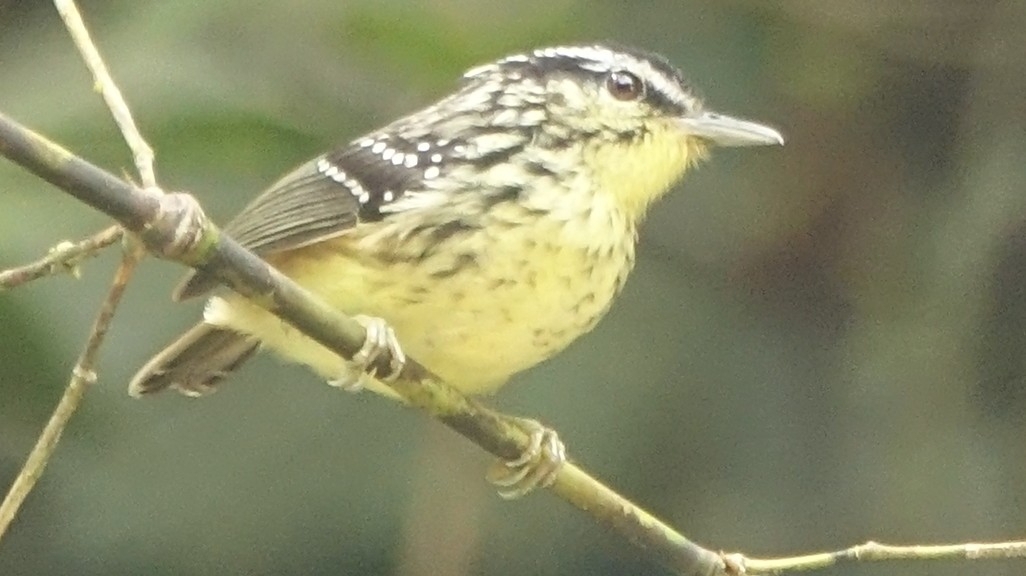
The Yellow-breasted Warbling Antbird is the warbling antbird of the foothills in the south of the guide area, with clearly yellow underparts. It lives mainly in bamboo, vine tangles and rank growth at forest edges. Where it occurs together with the Peruvian Warbling Antbird, it keeps to edges and bamboo and the other species to the forest understorey.
Voice
The male sings a series of six to nine clear whistles that become faster and lower and end in hoarse notes; the female answers with a shorter series. The call is a rasping cher-cher.
Recording: Fernando Igor de Godoy — CC BY-NC-SA 4.0 · xeno-canto
Identification
11–12 cm, small and compact, with a fairly short tail. The crown is black with white streaks, with a white supercilium and a black eyestripe. The mantle is streaked black and white, the rest of the upperparts olive-brown with a rufous rump. The wings are black with two white wingbars. The throat, breast and belly are yellow, with black streaks on the breast; the flanks are olive to rufous. The female has ochre spots on the crown and is a slightly duller yellow.
Confusion species
Peruvian Warbling Antbird Hypocnemis peruviana has a white throat and breast and rufous flanks and lives more in the forest understorey. Yellow-browed Antbird Hypocnemis hypoxantha occurs only further north, has a yellow supercilium and an unstreaked olive mantle. Striated Antbird Drymophila devillei also lives in bamboo, but has a much longer, white-tipped tail and white underparts.
Habitat
Bamboo (Guadua), vine tangles and dense rank growth at forest edges, in secondary forest and along roads and rivers, from the edge of the lowlands up to about 1500 m. It searches for insects and spiders among leaves and stems, usually up to a few metres above the ground. The nest is an open cup low in the vegetation.
Where the bird is most at home, classified by the vegetation units of the Andes and the west coast.


Range and movements
Colombia and Ecuador: absent. Peru: along the base of the Andes and in the adjacent lowlands from central Peru south to Cusco, Madre de Dios and Puno. Bolivia: in the north-west and along the base of the Andes in La Paz, Beni and Cochabamba. Absent from the Galápagos. Outside the guide area in the far west of Brazil (Acre).
- Resident
- dark = core range, pale = thinly spread
How and when to look
Search roads with bamboo and rank growth in the foothills, for example along the road to Manu or in the Yungas of La Paz. The duet carries a long way in the morning.
Conservation status
Least Concern. The species tolerates edges and secondary growth and locally benefits from openings in the forest.
Scientific name
Hypocnemis subflava | Cabanis, 1873
Cabanis described the species in 1873 and placed it straight away in the genus where it still stands. The genus Hypocnemis was introduced in 1847 by Cabanis. The genus name combines Greek hupo, 'somewhat like', and knēmis, 'leggings'. The species name comes from Latin subflavus, 'yellowish' or 'pale yellow'. The specimen the first description was based on came from Monterico, Ayacucho, Peru.