All species › Parrots › African and New World parrots › Yellow-faced Parrotlet
Yellow-faced Parrotlet | Forpus xanthops
Geelwangmuspapegaai | Cotorrita carigualda | Tuim-de-cara-amarela
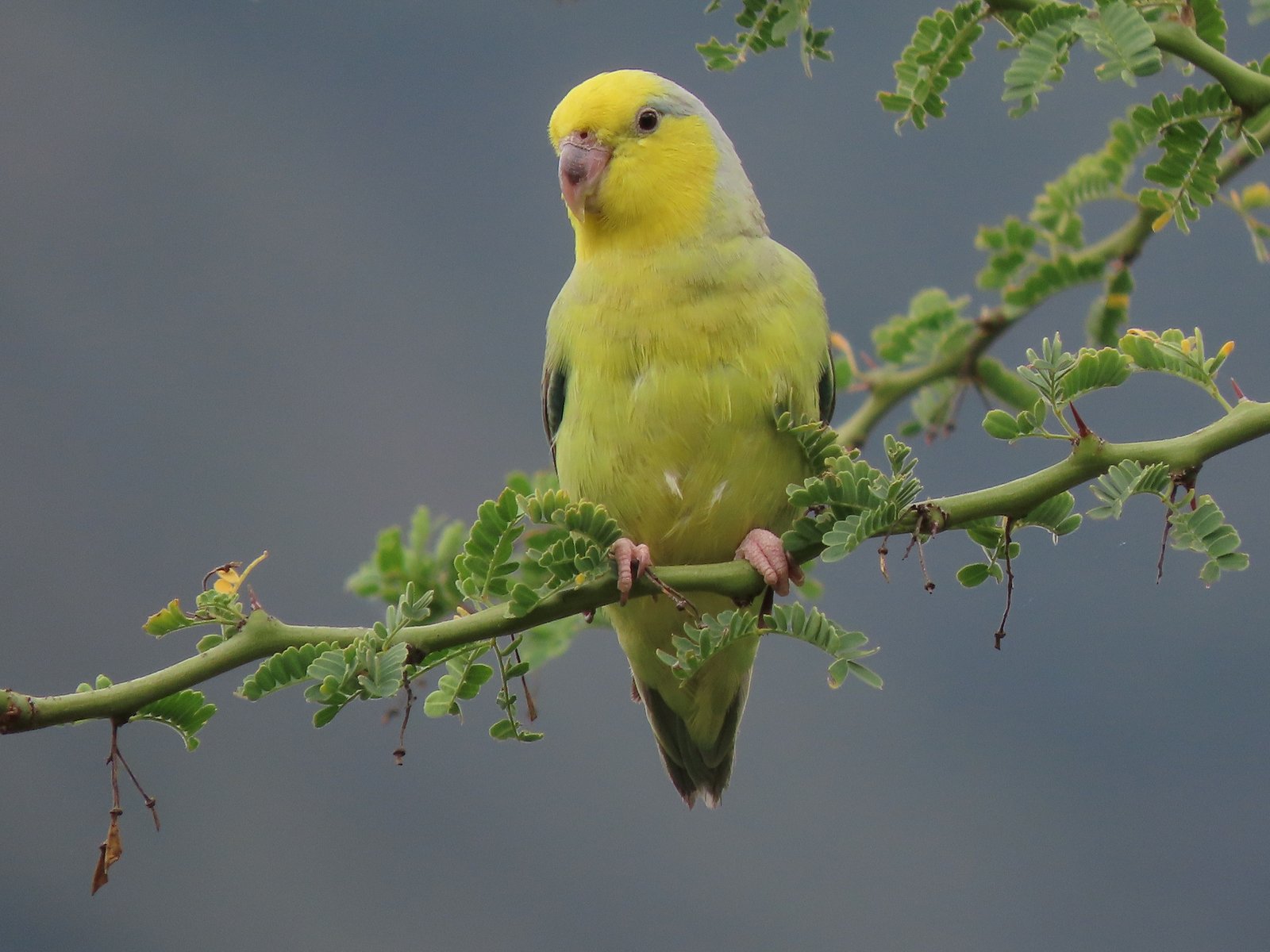
The Yellow-faced Parrotlet is the largest parrotlet and occurs only in the dry Marañón valley of northern Peru. The yellow face and greyish back separate it from all other parrotlets. Small groups feed on seeds and fruit in cactus scrub and along fields, and breed in holes in steep banks.
Voice
A sharp, dry chattering and short, shrill calls, mainly in flight; louder and harsher than the calls of Pacific Parrotlet.
Recording: Jerome Fischer — CC BY-NC-SA 4.0 · xeno-canto
Identification
14–15 cm, with a short, wedge-shaped tail and a pale, horn-coloured bill. The forehead, face and throat are bright yellow, the crown yellowish green. The mantle and back are greyish green, the underparts yellowish green. The male has a deep violet-blue rump and violet-blue secondaries and wing coverts. The female has a paler blue rump and little or no blue in the wing. Juveniles resemble the female, with a duller yellow face.
Confusion species
Pacific Parrotlet Forpus coelestis is smaller, with a green face and a blue streak behind the eye, and lives west of the Andes. Scarlet-fronted Parakeet Psittacara wagleri is much larger, with a long, pointed tail and red on the forehead. No other parrotlets occur in the Marañón valley.
Habitat
Dry scrub with cacti and thorny shrubs, riverside growth along rivers and streams, and fields and orchards in the dry valley, roughly between 600 and 2500 m, mainly between 1000 and 1800 m. It eats seeds of grasses and herbs, fruit of cacti and shrubs, and also crops. It nests in a hole in a steep bank of earth or soft rock, often in small colonies.
Where the bird is most at home, classified by the vegetation units of the Andes and the west coast.


Range and movements
Only in Peru: in the dry Marañón valley and its side valleys in the north of the country, mainly in Amazonas, Cajamarca and La Libertad. Absent from Colombia, Ecuador, Bolivia and the Galápagos. Does not occur outside the guide area.
- Resident
- dark = core range, pale = thinly spread
How and when to look
Search the Marañón valley near Balsas, on the road from Celendín to Leymebamba, along streams with scrub and near fields. Groups often perch on cacti or on the ground among crops and fly off fast and low.
Conservation status
Vulnerable. The range is small, and the species is trapped for the cage-bird trade; in addition, dry scrub is being lost to agriculture. The population is thought to be declining.
Scientific name
Forpus xanthops | (Salvin, 1895)
Salvin described the species in 1895 as Psittacula xanthops; because it was later moved to another genus, the author and year stand in brackets. The genus Forpus was introduced in 1858 by Boie. The genus name, introduced by Boie in 1858, is probably arbitrary. It may come from Greek phoreō, 'to possess', and pous, 'foot', for the dexterous toes; according to Prestwich (1963) it is an anagram of Latin profus, 'spread out', for the short, wedge-shaped tail. The species name comes from Greek xanthos, 'yellow', and ōps, 'face', for the yellow face. The specimen the first description was based on came from Viña, Huamachuco, La Libertad, Peru.