All species › Passerines › Tyrant flycatchers and allies › Yungas Tyrannulet
Yungas Tyrannulet | Phyllomyias weedeni
Yungasvliegenpikker | Mosquerito de las yungas | Piolhinho-das-yungas
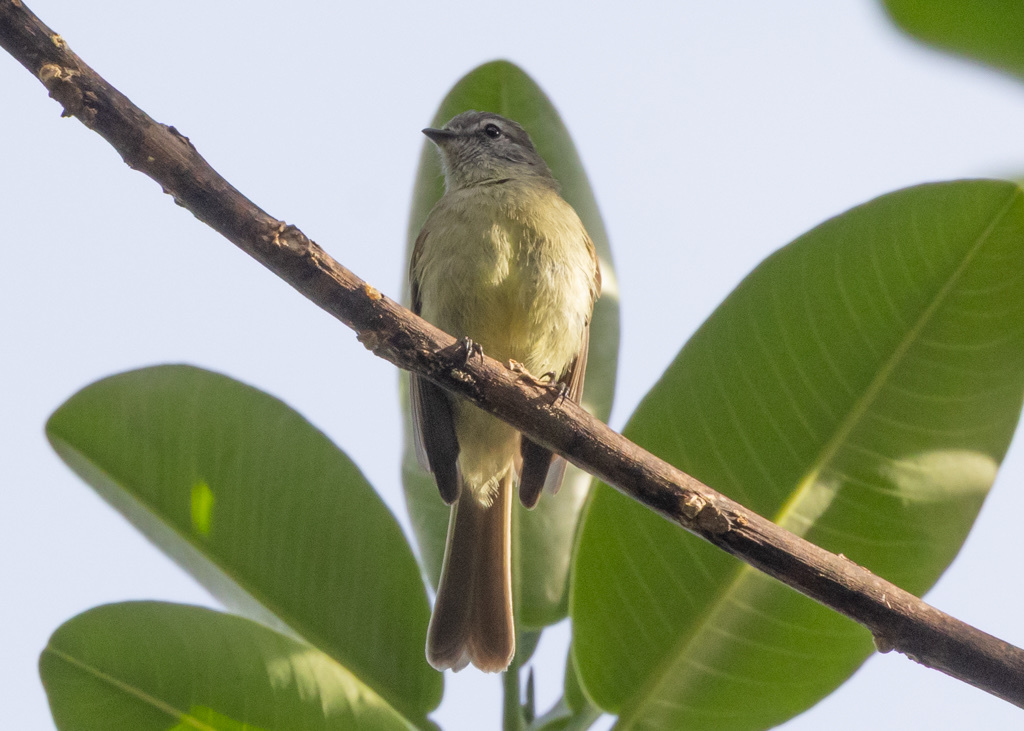
The Yungas Tyrannulet is a small tyrant flycatcher of lower montane forest on the eastern slope of the Andes in Bolivia and the far south-east of Peru. The species was only described in 2008; it had long been overlooked beside the very similar Sclater's Tyrannulet and was recognised mainly by its voice. Its range is small.
Voice
High, thin notes in short series. The song differs clearly from that of Sclater's Tyrannulet and was a key character in the description of the species.
Recording: Sebastian K. Herzog — CC BY-NC-SA 4.0 · xeno-canto
Identification
11 cm, with a short, narrow, dark bill. The crown is grey, the back olive-green, with a narrow pale eyebrow. The wings are dark, with two narrow yellowish wing bars. The throat and breast are pale grey with a yellowish wash, the belly pale yellow. The sexes are alike.
Confusion species
Sclater's Tyrannulet Phyllomyias sclateri is slightly larger, with broader, paler wing bars, usually lives higher on the slope and has a different song. Bolivian Tyrannulet Zimmerius bolivianus has a pale iris and yellow edges to the wing feathers instead of wing bars. Southern Beardless Tyrannulet Camptostoma obsoletum has a small crest and lives in more open country.
Habitat
Humid foothill and lower montane forest, mainly the edges and canopy, roughly between 500 and 1300 m. It gleans small insects from the foliage in the upper levels, often with mixed flocks. The nest has not been described.
Where the bird is most at home, classified by the vegetation units of the Andes and the west coast.


Range and movements
Bolivia: on the eastern slope of the Andes in La Paz, with a few records in Cochabamba and Beni. Peru: in the far south-east, in Puno. Absent from Colombia, Ecuador and the Galápagos. Hardly occurs outside the guide area.
- Resident
- dark = core range, pale = thinly spread
How and when to look
Search mixed flocks in the foothill forest of the Yungas in La Paz, for example along roads towards Caranavi and around Madidi. Learn the song, as in the field the species is told from Sclater's Tyrannulet mainly by voice.
Conservation status
Near Threatened. Its range is small and the foothill forest of the Yungas is being cleared for agriculture in many places.
Scientific name
Phyllomyias weedeni | Herzog, Kessler & Balderrama T, 2008
Herzog, Kessler & Balderrama T described the species in 2008 and placed it straight away in the genus where it still stands. The genus Phyllomyias was introduced in 1860 by Cabanis & Heine. The genus name combines Greek phullon, 'leaf', with Modern Latin myias, 'flycatcher'. The species name honours Alan Weeden (born 1924), American businessman, philanthropist and conservationist. The specimen the first description was based on came from Cerro Asunta Pata, La Paz, Bolivia.