All species › Passerines › Tyrant flycatchers and allies › Planalto Tyrannulet
Planalto Tyrannulet | Phyllomyias fasciatus
Schubkopvliegenpikker | Mosquerito oliváceo | Piolhinho
The Planalto Tyrannulet is a small, olive-green and yellow tyrant flycatcher of forest edges and open woodland in eastern Brazil and neighbouring countries. The guide area lies at the extreme western edge of its range: only a few records are known from eastern Bolivia. Southern birds partly move north outside the breeding season.
Voice
A short series of usually three clear whistles, the last one lower, and single soft calls.
Recording: JAYRSON ARAUJO DE OLIVEIRA — CC BY-NC-SA 4.0 · xeno-canto
Identification
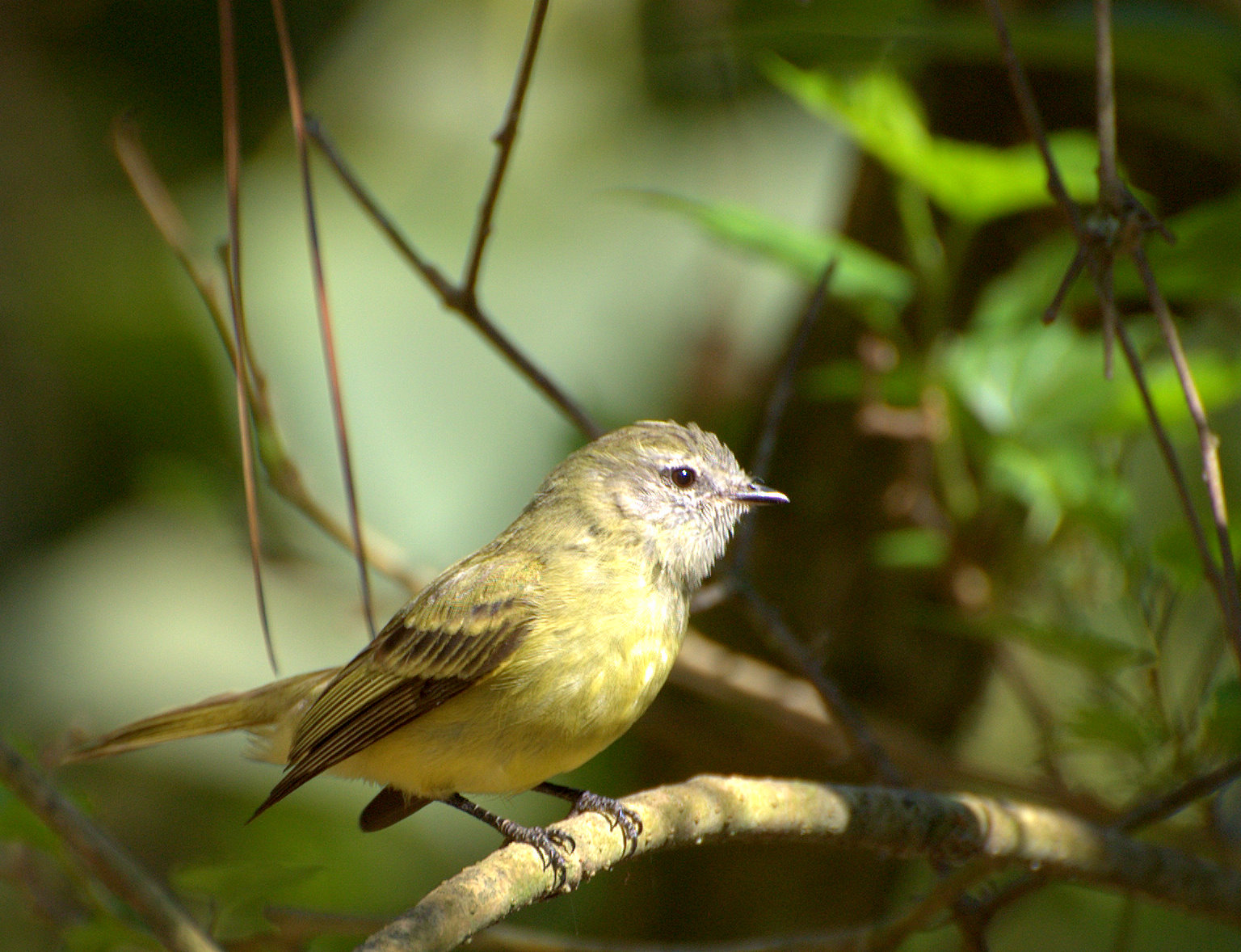
11.5 cm, with a short, dark bill. The crown is dark slate-grey, with a short whitish eyebrow and pale lores. The back is olive-green. The wings are dark, with narrow, pale yellow wing bars and edges to the secondaries. The throat is greyish white, the breast greyish olive and the belly bright yellow. The sexes are alike.
Confusion species
Southern Beardless Tyrannulet Camptostoma obsoletum has a small crest, more obvious pale wing bars and a pale base to the lower mandible. Mouse-colored Tyrannulet Nesotriccus murinus is browner and duller, lacking the grey crown and bright yellow belly. Greenish Elaenia Myiopagis viridicata is larger, with a yellow crown patch and no distinct wing bars. Sclater's Tyrannulet Phyllomyias sclateri lives in montane forest and has broader, paler wing bars.
Habitat
Forest edges, open and semi-open woodland, gallery forest and gardens with trees, from the lowlands into the hills. It takes small insects and berries in the canopy, often with mixed flocks. The nest is an open cup high in a tree.
Where the bird is most at home, classified by the vegetation units of the Andes and the west coast.


Range and movements
Bolivia: only a few records in the east, mainly in Santa Cruz and a single one in Beni; whether the species occurs regularly or breeds there is uncertain. Absent from Colombia, Ecuador, Peru and the Galápagos. Outside the guide area in eastern and central Brazil, eastern Paraguay and north-eastern Argentina.
- Summer visitor (c. Apr–Sep)
- Winter visitor (c. Oct–Mar)
- Passage (Mar–Apr, Oct–Nov)
- dark = core range, pale = thinly spread
How and when to look
In the guide area the species cannot be searched for in a targeted way. A sighting at forest edges in eastern Santa Cruz deserves a good description, photographs and preferably a sound recording.
Conservation status
Least Concern. The species is widespread in Brazil and tolerates secondary forest and gardens.
Scientific name
Phyllomyias fasciatus | (Thunberg, 1822)
Thunberg described the species in 1822 as P[ipra] fasciata; because it was later moved to another genus, the author and year stand in brackets. The genus Phyllomyias was introduced in 1860 by Cabanis & Heine. The genus name combines Greek phullon, 'leaf', with Modern Latin myias, 'flycatcher'. Latin fasciatus means 'banded', referring to the wing bars. The specimen the first description was based on came from Jaguaquara, Bahia, Brazil.