All species › Passerines › Tyrant flycatchers and allies › Sclater's Tyrannulet
Sclater's Tyrannulet | Phyllomyias sclateri
Streepbuikvliegenpikker | Mosquerito de Sclater | Piolhinho-de-sclater
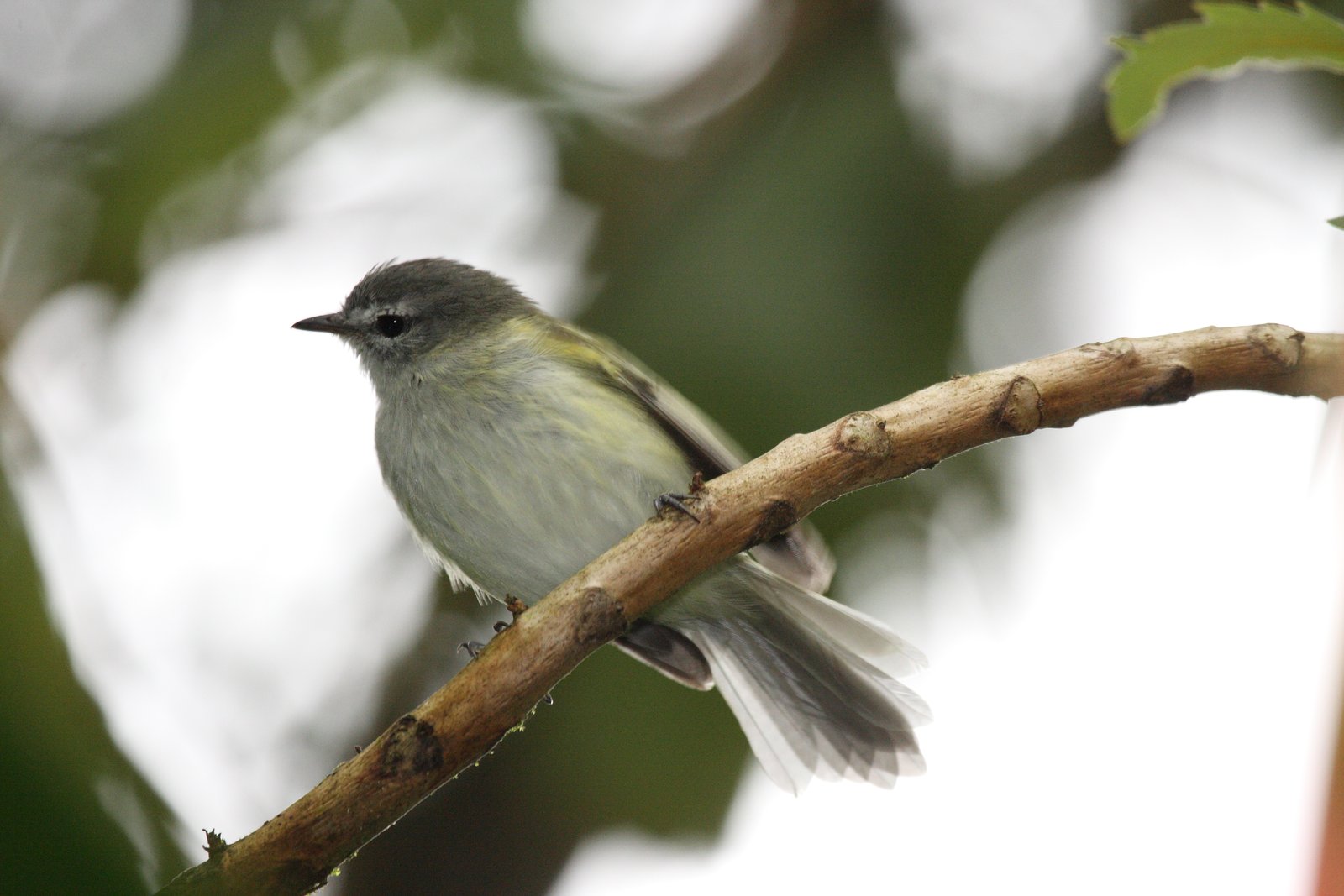
Sclater's Tyrannulet is a small, grey and olive-green tyrant flycatcher of montane forest on the eastern slope of the southern Andes. It feeds in the middle and upper levels of the forest and often travels with mixed flocks. In the guide area it is restricted to south-eastern Peru and the Bolivian Yungas.
Voice
A high, thin, fast trill and short series of high, twittering notes.
Recording: Jacob Wijpkema — CC BY-NC-SA 4.0 · xeno-canto
Identification
12 cm, with a short, dark bill and a rather long tail. The crown is grey, the back olive-green. A whitish eyebrow extends behind the eye, with a dark eyestripe below. The wings are dark, with two distinct whitish to pale yellow wing bars and pale edges to the secondaries. The throat and breast are greyish white, the belly and flanks pale yellow. The sexes are alike.
Confusion species
Yungas Tyrannulet Phyllomyias weedeni is smaller and slimmer, with narrower wing bars, lives lower on the slope and is best told by voice. Rough-legged Tyrannulet Acrochordopus burmeisteri is yellower below and has a pale lower mandible. White-throated Tyrannulet Mecocerculus leucophrys has an obvious white throat, a longer tail and lives higher, up to the treeline. Bolivian Tyrannulet Zimmerius bolivianus lacks distinct wing bars, has yellow edges to the wing feathers instead, and a pale iris.
Habitat
Humid and semi-humid montane forest, forest edges and tall secondary growth, roughly between 1000 and 2700 m. It gleans small insects from leaves and twig tips, mostly in the middle and upper levels of the forest, often in mixed flocks. Little is known about the nest.
Where the bird is most at home, classified by the vegetation units of the Andes and the west coast.


Range and movements
Peru: on the eastern slope of the Andes in the south-east, in Cusco and Puno. Bolivia: in the Yungas and montane forests of La Paz, Cochabamba and Santa Cruz, south to Chuquisaca and Tarija. Absent from Colombia, Ecuador and the Galápagos. Outside the guide area in north-western Argentina.
- Resident
- dark = core range, pale = thinly spread
How and when to look
Search mixed flocks in montane forest along roads through the Yungas, for example the Manu road in Cusco or the montane forests near Samaipata in Santa Cruz; look for a small grey-headed bird with two pale wing bars in the middle storey.
Conservation status
Least Concern. The species is locally fairly common, but depends on montane forest, which is being cleared in many places.
Scientific name
Phyllomyias sclateri | Berlepsch, 1901
Berlepsch described the species in 1901 and placed it straight away in the genus where it still stands. The genus Phyllomyias was introduced in 1860 by Cabanis & Heine. The genus name combines Greek phullon, 'leaf', with Modern Latin myias, 'flycatcher'. The species name honours Philip Lutley Sclater (1829–1913), British zoologist and ornithologist who described many South American birds. The specimen the first description was based on came from Bueyes, Santa Cruz, Bolivia.