All species › Passerines › Tyrant flycatchers and allies › Euler's Flycatcher
Euler's Flycatcher | Lathrotriccus euleri
Eulers tiran | Mosquero de Euler | Enferrujado
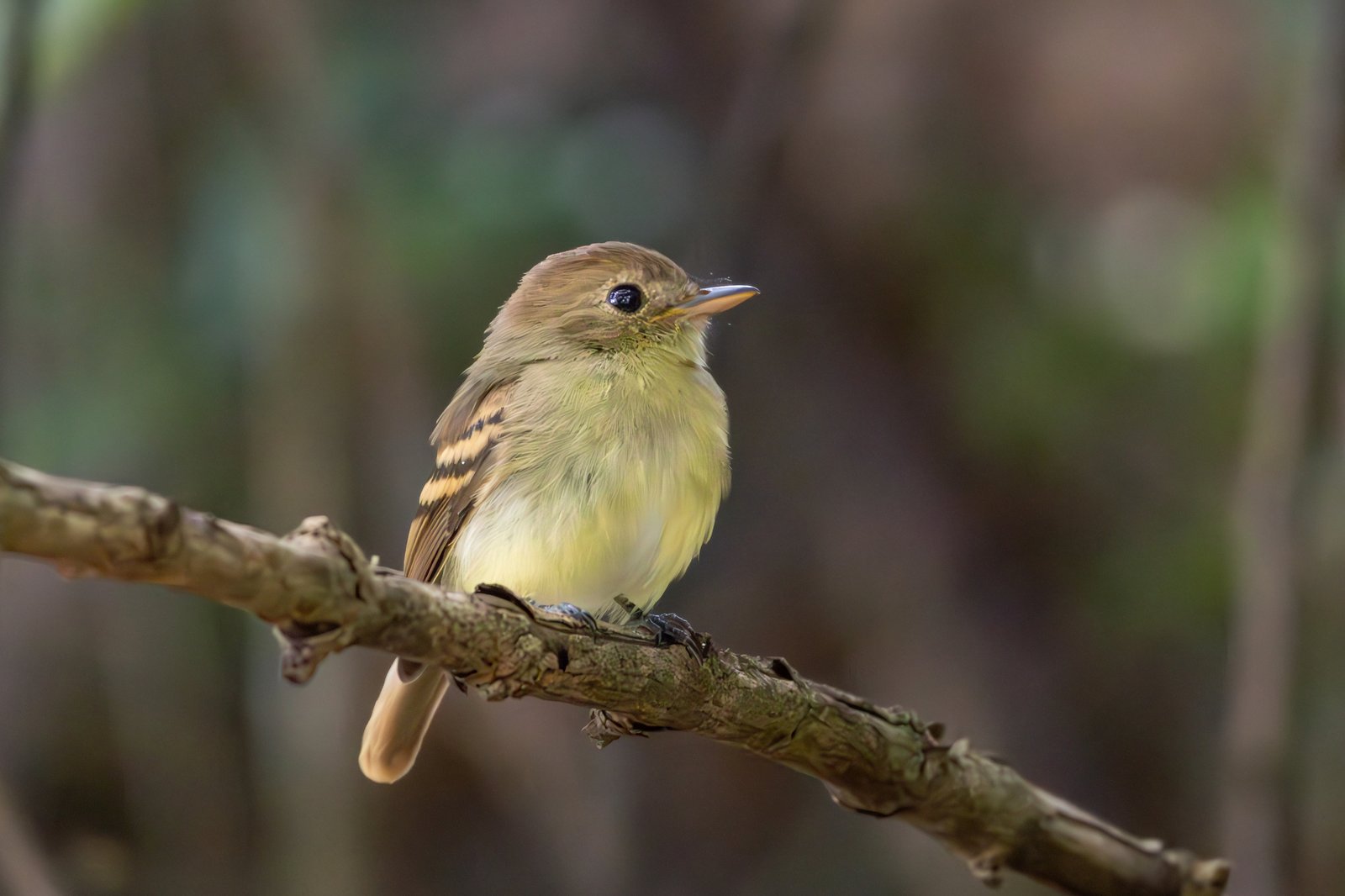
Euler's Flycatcher is a small, brownish olive tyrant of the understorey and mid-storey of forest east of the Andes. It closely resembles the North American Empidonax flycatchers, but has buff wing bars and a browner back. Besides residents, austral migrants also occur in the guide area, moving in the austral winter from southern Brazil, Paraguay and Argentina to Amazonia.
Voice
A slightly hoarse, descending series of three or four notes, jee-dee-dee-dee, repeated at intervals, and a short, dry chip.
Recording: Juan Freile — CC BY-NC-SA 4.0 · xeno-canto
Identification
13.5 cm. The upperparts are brownish olive, with a pale, narrow eye-ring and a pale spot in front of the eye. The wings are dark with two buff to whitish wing bars. The throat is whitish, the breast greyish olive to brownish and the belly pale yellow. The upper mandible is dark, the lower mandible pale orange-yellow. The sexes are alike.
Confusion species
Fuscous Flycatcher Cnemotriccus fuscatus has a long, pale supercilium, a darker brown back and an all-dark bill, and lives mainly in riverside scrub. Alder Flycatcher Empidonax alnorum and Willow Flycatcher Empidonax traillii are greener above, with longer primaries, and keep more to open scrub; they occur only in the northern winter. Eastern Wood Pewee Contopus virens is larger, greyer, perches upright high on open branches and has almost no eye-ring. Bran-colored Flycatcher Myiophobus fasciatus is smaller, more rufous-brown, with a streaked breast.
Habitat
Understorey and mid-storey of humid lowland forest, forest edge, várzea, secondary forest and foothill forest; residents in Bolivia also in lower Yungas forest up to about 1500 m. It sits quietly on a low to middle branch and catches insects in short sallies to leaves or in the air. The nest is an open cup in a cavity, among roots or in a tree stump.
Where the bird is most at home, classified by the vegetation units of the Andes and the west coast.


Range and movements
Colombia: in the lowlands east of the Andes, mainly in the south. Ecuador: in the east. Peru: in the Amazonian lowlands and on the lower eastern slope. Bolivia: as a resident in the north and along the eastern foot of the Andes, and also as a migrant. In the austral winter (roughly April–September) austral migrants occur in the Amazonian lowlands of Bolivia, Peru, Ecuador and southern Colombia. Absent from the Galápagos. Outside the guide area in Venezuela, the Guianas, Brazil, Paraguay and northern Argentina.
- Resident
- dark = core range, pale = thinly spread
How and when to look
In the understorey of lowland forest east of the Andes, listen for the hoarse, descending song and then look for a small, brownish olive tyrant with buff wing bars sitting quietly on a low branch.
Conservation status
Least Concern. Widespread and common in forest and forest edge, including secondary forest.
Scientific name
Lathrotriccus euleri | (Cabanis, 1868)
Cabanis described the species in 1868 as Empidochanes Euleri; because it was later moved to another genus, the author and year stand in brackets. The genus Lathrotriccus was introduced in 1986 by Lanyon & Lanyon. The genus name comes from Greek lathrios, 'secret, hidden', and triccus, 'small bird'; according to its authors (W. and S. Lanyon, 1986), 'hidden' refers not to the bird's habits but to its obscurity within the genus Empidonax. The species name honours Carl Euler (1834–1901), Swiss ornithologist and consul who collected birds in Brazil. The specimen the first description was based on came from Cantagalo, Rio de Janeiro, Brazil.