All species › Pelicans, herons and ibises › Herons, egrets and bitterns › American Bittern
Position in the tree Birds Aves › Birds with a flexible palate Neognathae › All other modern birds Neoaves › Birds of the elements Elementaves › Tropicbirds and waterbirds Phaethoquornithes › Core waterbirds Aequornithes
American Bittern | Botaurus lentiginosus
Amerikaanse roerdomp | Avetoro lentiginoso
The American Bittern is a large, brown-streaked heron of dense marshes, almost invisible in reeds and cattails thanks to its camouflage. In the guide area it is mainly a winter visitor from North America in Mexico; it also breeds at a few sites in Mexico. Further south it becomes increasingly rare.
Voice
In the breeding season a deep, pumping oonk-a-loonk, carrying far and heard mainly at dusk. In winter usually silent; when flushed a hoarse, croaking kok-kok.
Recording: Stanislas Wroza — CC BY-NC-SA 4.0 · converted to mono · xeno-canto
Identification
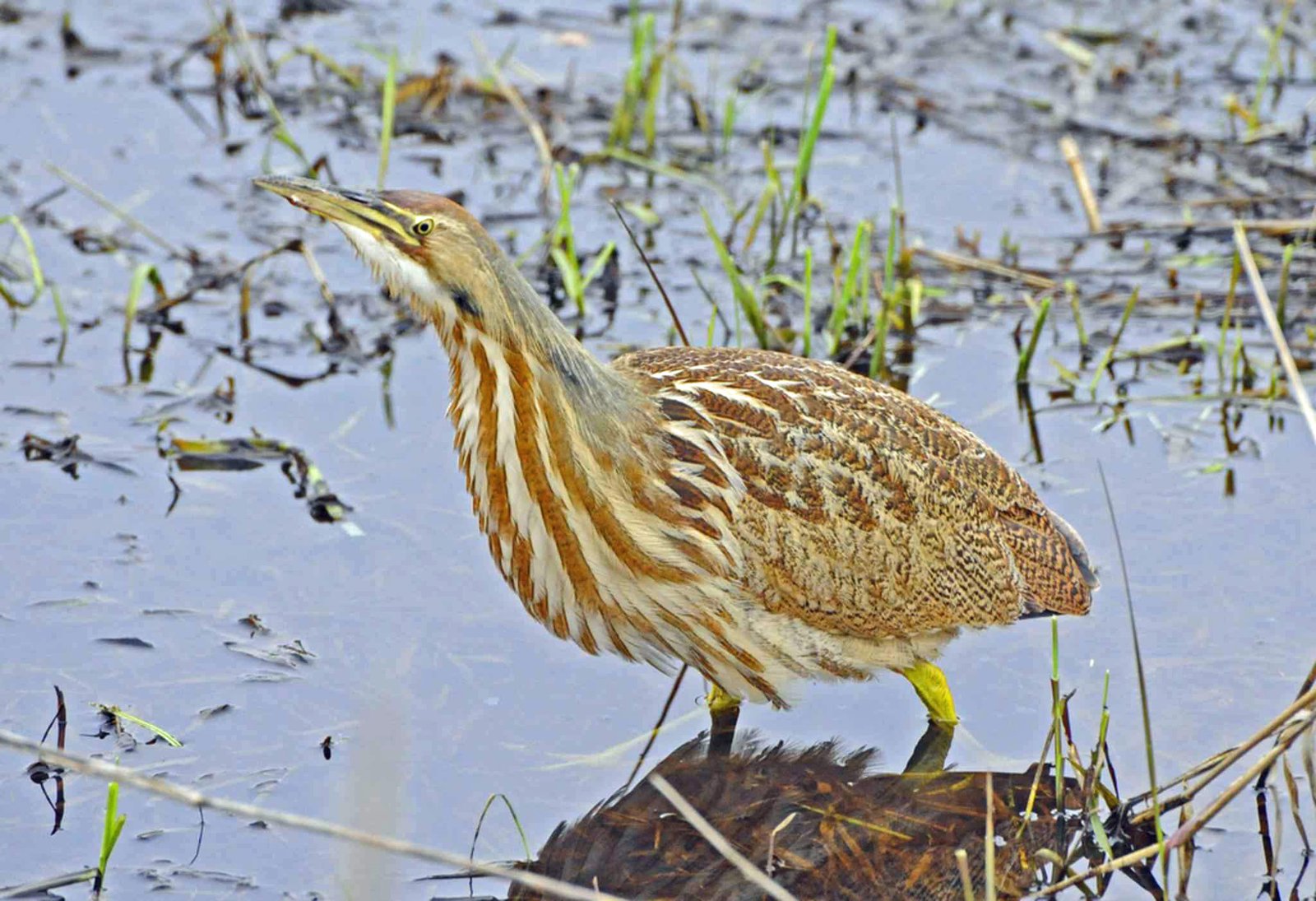
58–85 cm. A stocky, medium-sized heron with a thick neck, a fairly short, yellowish bill and green-yellow legs. The upperparts are warm brown, finely speckled and vermiculated dark; the underparts are buff with broad, rufous-brown lengthwise streaks. A long black stripe runs from the gape down the side of the neck, and the crown is plain rufous-brown. In flight the dark, blackish flight feathers contrast with the brown coverts. The sexes are alike; juveniles lack the black neck stripe or show it only faintly. When alarmed the bird points its bill and neck straight up and sways with the reeds.
Confusion species
Pinnated Bittern Botaurus pinnatus is larger, has a finely black-barred crown and neck, lacks the broad black neck stripe and shows less contrasting flight feathers in flight; the two species overlap in south-eastern Mexico. Young Black-crowned Night Herons Nycticorax nycticorax and young Yellow-crowned Night Herons Nyctanassa violacea are greyer brown, spotted white, and have larger eyes and no black neck stripe. Young tiger herons, such as Bare-throated Tiger Heron Tigrisoma mexicanum, are barred across rather than streaked lengthwise.
Habitat
Fresh and brackish marshes with dense reeds, cattails or tall bulrushes, wet grasslands, salt marshes, rice fields and vegetated lake shores; in winter also on the Mexican Plateau. It hunts standing still or creeping very slowly for fish, frogs, small mammals and insects. The nest is on the ground or on bent-over stems in dense marsh vegetation.
Where the bird is most at home, classified by the vegetation units of Mexico and Central America.



Range and movements
In winter mainly in northern and central Mexico, from Baja California, Sonora and Tamaulipas south over the Mexican Plateau to Jalisco, Michoacán and Veracruz, less numerous to Oaxaca, the Yucatán Peninsula and Chiapas. Further south, from Guatemala and Belize to Panama, rare and irregular. There are breeding records at a few sites in northern and central Mexico. Outside the guide area the species breeds across much of Canada and the United States and winters in the southern United States and on Cuba.
- Winter visitor (c. Oct–Mar)
- dark = core range, pale = thinly spread
How and when to look
In winter worth searching for in large cattail marshes, such as around Lake Chapala and in the marshes of Sinaloa and Tamaulipas. The birds are often only noticed when they flush; patiently scanning reed edges in the early morning and evening improves the chances.
Conservation status
Not threatened. It has declined through the loss of wetlands, especially in the North American breeding range. In the guide area a rather scarce winter visitor and a rare, local breeder.
Scientific name
Botaurus lentiginosus | (Rackett, 1813)
Rackett described the species in 1813 as Ardea lentiginosa; because it was later moved to another genus, the author and year stand in brackets. The genus Botaurus was introduced in 1819 by Stephens. Botaurus is Medieval Latin for a bittern; the word combines Latin bos 'ox' with taurus 'bull', after the booming call (compare butire 'to boom'). lentiginosus is Latin for 'freckled, speckled', after the brown-flecked plumage. The specimen the first description was based on came from Puddletown, Dorset, England.