All species › Pelicans, herons and ibises › Herons, egrets and bitterns › Least Bittern
Position in the tree Birds Aves › Birds with a flexible palate Neognathae › All other modern birds Neoaves › Birds of the elements Elementaves › Tropicbirds and waterbirds Phaethoquornithes › Core waterbirds Aequornithes
Least Bittern | Botaurus exilis
Amerikaans woudaapje | Avetorillo panamericano
The Least Bittern is the smallest heron in the guide area, scarcely larger than a thrush. It lives hidden in dense reeds and cattails and is heard more often than seen. In the guide area it breeds locally in marshes from Mexico to Panama; in winter it is joined by migrants from North America.
Voice
A soft, low, cooing koo-koo-koo-koo, heard from the reeds mainly in the breeding season, and a loud, cackling kek-kek-kek when disturbed.
Recording: José María Loaiza B. — CC BY-NC-SA 4.0 · converted to mono · xeno-canto
Identification
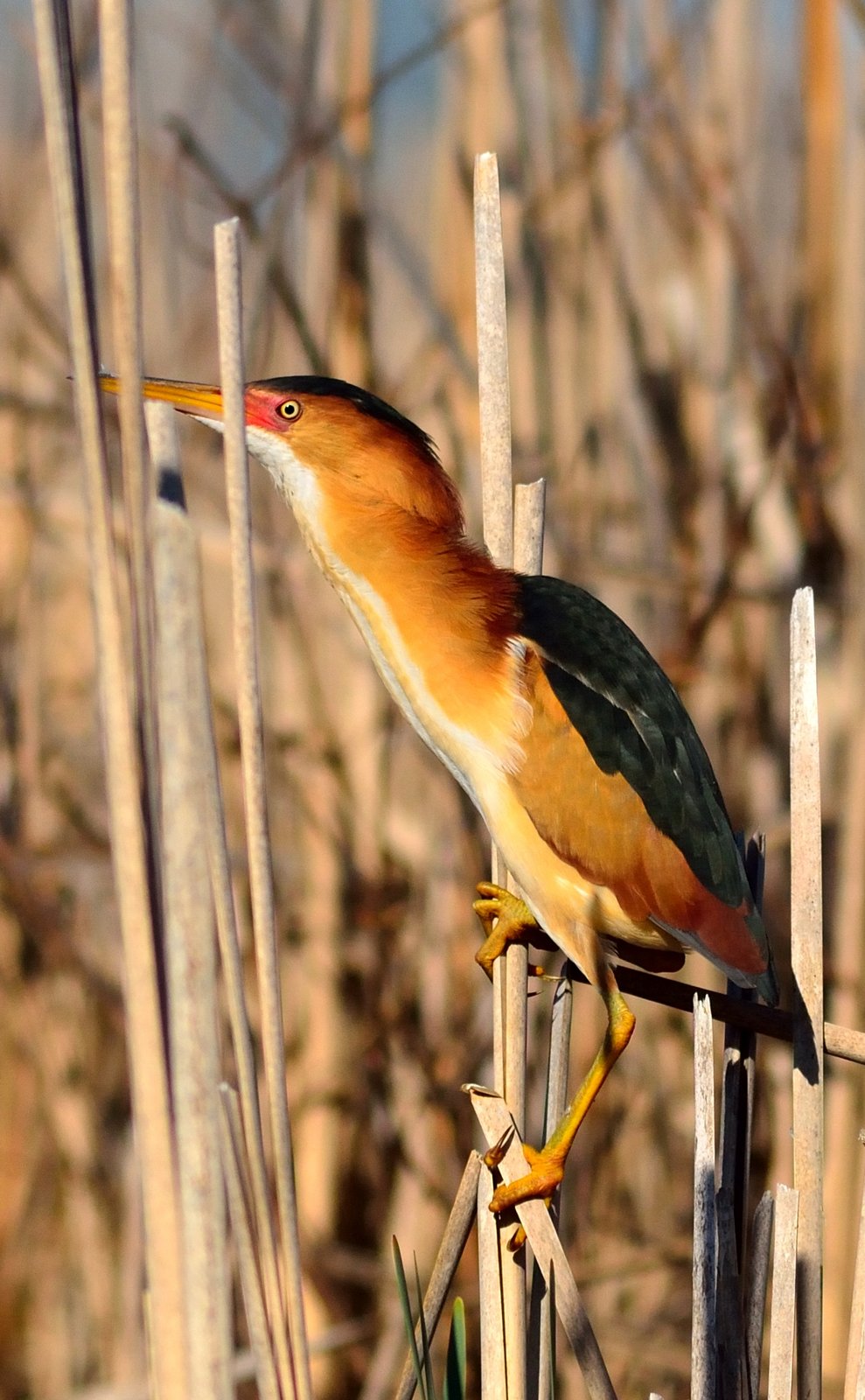
28–36 cm. A very small, slender heron with a narrow neck, a pointed yellow bill and yellowish legs. The male has a black crown and a black back, the female a dark brown crown and back with pale stripes along the mantle. Both have a warm buffy-brown head and neck, a pale, buff-streaked foreneck and a large, buff patch on the upperwing, which stands out against the dark flight feathers in flight. Juveniles resemble the female but are more heavily streaked. A very rare dark morph is chestnut where the normal morph is buff. It clambers nimbly through reeds and, when alarmed, points its bill straight up.
Confusion species
Green Heron Butorides virescens is larger, has a dark green back, a chestnut neck and orange legs, and lacks the pale wing patch. Young Black-crowned Night Herons Nycticorax nycticorax are much larger and spotted white. American Bittern Botaurus lentiginosus and Pinnated Bittern Botaurus pinnatus are much larger and evenly streaked brown, without a contrasting wing patch.
Habitat
Fresh and brackish marshes with dense reeds, cattails or bulrushes, the shores of lakes and lagoons, salt marshes, mangrove edges and rice fields; mainly in the lowlands, locally higher on the Mexican Plateau. It hunts small fish, frogs and insects, often clinging to reed stems over the water. The nest is a small platform of stems in dense marsh vegetation over water.
Where the bird is most at home, classified by the vegetation units of Mexico and Central America.





Range and movements
Breeds at scattered sites throughout the guide area: in north-western Mexico from Baja California and Sonora southwards, on the Mexican Plateau, along the Gulf coast from Tamaulipas to the Yucatán Peninsula and further from Belize and Guatemala to Panama. Outside the breeding season there are more records owing to migrants from North America, especially in Mexico. Outside the guide area the species breeds in eastern and south-western North America, in the Greater Antilles and scattered across South America.
- Summer visitor (c. Apr–Sep)
- dark = core range, pale = thinly spread
How and when to look
Good places are the cattail marshes of Tabasco, Lake Chapala, Crooked Tree in Belize and Palo Verde and Caño Negro in Costa Rica. The birds are seen best when crossing an open patch in the vegetation or on a short flight low over the reeds, when the pale wing patch stands out.
Conservation status
Not threatened. In the guide area locally fairly common, but probably often overlooked because of its secretive habits. It depends on marshes with dense vegetation, which have declined through drainage and conversion to farmland.
Scientific name
Botaurus exilis | (Gmelin, 1789)
Gmelin described the species in 1789 as Ardea exilis; because it was later moved to another genus, the author and year stand in brackets. The genus Botaurus was introduced in 1819 by Stephens. Botaurus is Medieval Latin for a bittern; the word combines Latin bos 'ox' with taurus 'bull', after the booming call (compare butire 'to boom'). exilis is Latin for 'small, slender', after the tiny size of this bittern. The specimen the first description was based on came from Jamaica.