All species › Passerines › Wagtails and pipits › American Pipit
Position in the tree Birds Aves › Birds with a flexible palate Neognathae › All other modern birds Neoaves › Landbirds Telluraves › Falcons, parrots and passerines Australaves › Falcons and passerines Eufalconimorphae › Parrots and passerines Psittacopasserae
American Pipit | Anthus rubescens
Pacifische waterpieper | Bisbita norteamericano
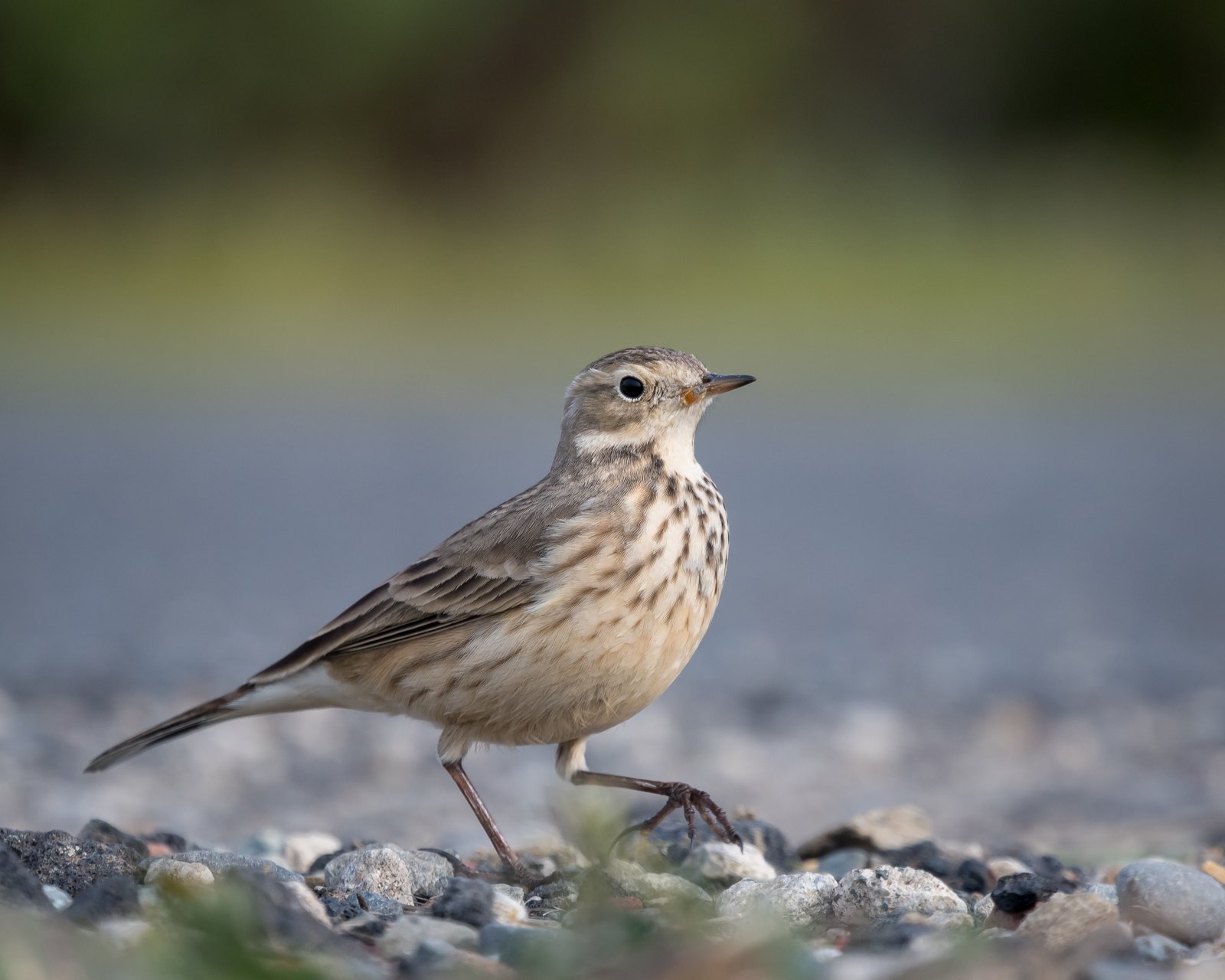
The American Pipit is a slender, greyish-brown pipit that constantly pumps its tail. It breeds on the tundra and in the high mountains of North America and north-eastern Siberia and is a common winter visitor to open country across much of Mexico. It was formerly treated as one species with Water Pipit Anthus spinoletta of Eurasia.
Voice
The call, often given in flight and when flushed, is a sharp pi-pit or chee-cheep, sometimes single. The song, a rapid series of even notes in a song flight, is rarely heard in the guide area.
Recording: Manuel Grosselet — CC BY-NC-SA 4.0 · converted to mono · xeno-canto
Identification
15–17 cm. Slender, with a thin, pointed bill, dark legs and a fairly long tail with white outer tail feathers. In winter plumage the upperparts are greyish brown with faint streaks, the underparts pale buff with dark streaks on breast and flanks. A pale supercilium, a pale eye-ring and a dark malar stripe mark the head; two narrow pale wing bars. In breeding plumage, seen on late birds in spring, the upperparts are greyer and the underparts warmer buff and less streaked. It pumps its tail almost constantly.
Confusion species
Sprague's Pipit Anthus spragueii is paler and scaly above, has a pale, plain face and pale pink legs, does not pump its tail and lives only in native grassland. Red-throated Pipit Anthus cervinus, a vagrant, is more heavily streaked above, including the rump, and has pale legs. Savannah Sparrow Passerculus sandwichensis also lives in open country and is streaked, but has a short conical bill and does not pump its tail. Horned Lark Eremophila alpestris also walks on bare fields but has a black-and-yellow face pattern and a black tail.
Habitat
In winter open country with bare ground or short grass: shores of lakes and reservoirs, mudflats, saltmarsh, wet pastures, fields and fallow land, also short grass in the high mountains. It often lives in loose flocks. It walks on the ground, searching for insects and seeds.
Where the bird is most at home, classified by the vegetation units of Mexico and Central America.



Range and movements
Breeds on the tundra and in the high mountains of Alaska, Canada, the Rocky Mountains and north-eastern Siberia. Winters in the southern United States and Mexico. In the guide area widespread in winter from Baja California and northern Mexico south to Oaxaca and Chiapas; scarce in Guatemala and El Salvador and rare further south to Costa Rica.
- Winter visitor (c. Oct–Mar)
- dark = core range, pale = thinly spread
How and when to look
In winter found along lakes and on fields around Mexico City, in the farmland of Baja California and along reservoirs in Nuevo León and Coahuila. Flocks draw attention with their sharp call when flushed.
Conservation status
Not threatened (LC). Common and widespread; in the guide area a numerous winter visitor.
Scientific name
Anthus rubescens | (Tunstall, 1771)
Tunstall described the species in 1771 as Alauda Rubescens; because it was later moved to another genus, the author and year stand in brackets. The genus Anthus was introduced in 1805 by Bechstein. Anthus is the Latin word for a small bird of grasslands mentioned by Pliny the Elder. rubescens is Latin for 'reddish', from ruber 'red'. The specimen the first description was based on came from Pennsylvania.