All species › Passerines › Thrushes and allies › American Robin
Position in the tree Birds Aves › Birds with a flexible palate Neognathae › All other modern birds Neoaves › Landbirds Telluraves › Falcons, parrots and passerines Australaves › Falcons and passerines Eufalconimorphae › Parrots and passerines Psittacopasserae
American Robin | Turdus migratorius
Roodborstlijster | Zorzal robín
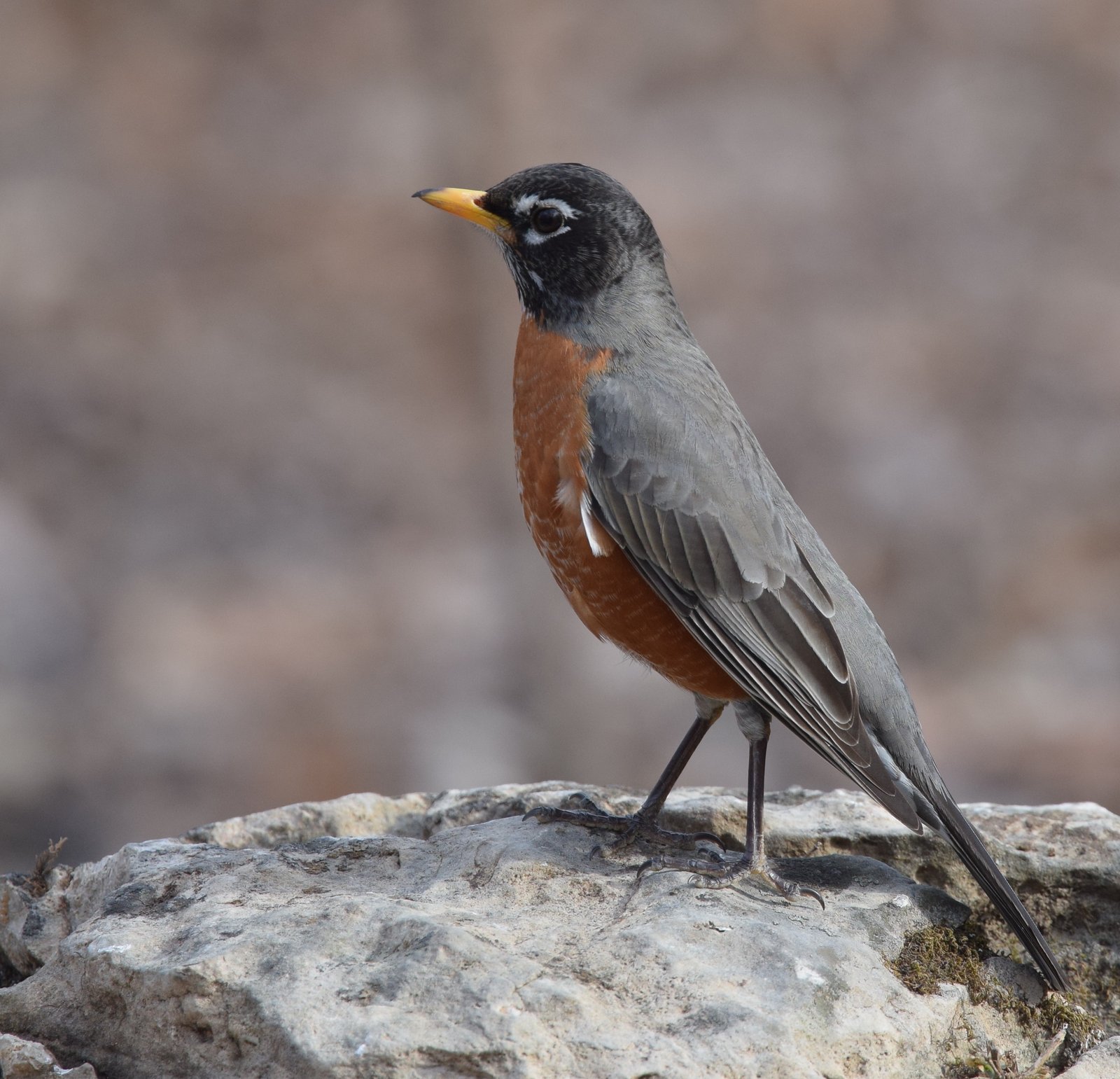
The American Robin is the best-known thrush of North America: greyish-brown above with an orange-red breast and belly. In the guide area it breeds as a resident in the mountains of northern and central Mexico, with a separate, pale population in southern Baja California. In winter flocks from the north join them, wandering mainly through northern Mexico in search of fruiting trees.
Voice
The song is a series of clear, whistled phrases of two or three notes, alternately rising and falling, often before sunrise. Calls include a sharp peek, a rapidly repeated tuk-tuk-tuk when alarmed and a high, thin tseep in flight.
Recording: Richard E. Webster — CC BY-NC-SA 4.0 · shortened to the first 60 s, mono · xeno-canto
Identification
23–28 cm. Back and wings greyish-brown, head darker grey to blackish, with a broken white eye-ring. Throat white with black streaks; breast and belly plain orange-red, undertail coverts white. Bill yellow with a dark tip. The female has a paler head and a duller breast. Juveniles have dark spots on a paler orange breast and pale spots on the back. Residents in the Mexican mountains have a less contrasting head and a duller, more buff breast; birds in southern Baja California are paler and greyer still.
Confusion species
Rufous-backed Thrush Turdus rufopalliatus (Pacific slope of western Mexico) has a rufous back and a grey head, with a streaked white throat and orange flanks but a white belly. Rufous-collared Thrush Turdus rufitorques (Chiapas and northern Central America) has a black or greyish-brown body with a rufous collar and breast. Aztec Thrush Ridgwayia pinicola is dark brown with conspicuous white wing patches and a white belly.
Habitat
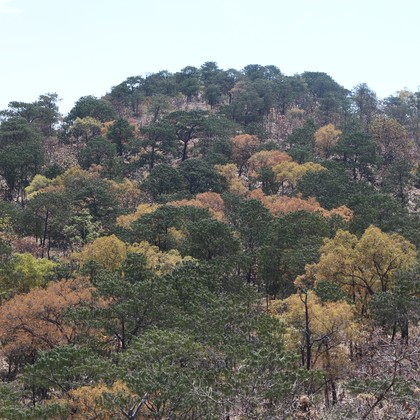
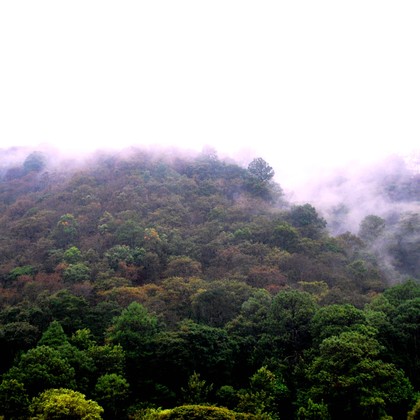
Pine-oak, conifer and oak forest in the mountains, especially clearings and forest edges, also wooded ravines and riparian woodland; in winter also lowlands, orchards, parks and gardens. In Mexico it breeds mostly between 1500 and 3500 m. It forages on the ground for earthworms and insects and, especially outside the breeding season, eats many berries such as juniper and hawthorn.
Where the bird is most at home, classified by the vegetation units of Mexico and Central America.



Range and movements
Breeds from Alaska and Canada through the United States into the guide area: in the mountains of northern Baja California, in the Sierra de la Laguna in southern Baja California and along the Sierra Madre Occidental, the Sierra Madre Oriental and the Trans-Mexican Volcanic Belt to Oaxaca and western Veracruz. Birds from the north winter in northern and central Mexico, scarcer further south; rare to Guatemala.
- Resident
- dark = core range, pale = thinly spread
How and when to look
Found year-round in the montane forests and parks around Mexico City and in the Sierra Madre. In winter flocks gather in northern Mexico at fruiting junipers, madrones and ornamental shrubs.
Conservation status
Not threatened (LC). One of the most numerous birds of North America and well adapted to human-modified landscapes. The population in the Sierra de la Laguna is small and depends on the pine-oak forest of that range.
Scientific name
Turdus migratorius | Linnaeus, 1766
Linnaeus described the species in 1766 and placed it straight away in the genus where it still stands. The genus Turdus was introduced in 1758 by Linnaeus. Turdus is the ordinary Latin word for 'thrush'. migratorius is Latin for 'migratory, wandering', from migrare 'to migrate', after the movements of the northern birds. The specimen the first description was based on came from North America.