All species › Pigeons and doves › Doves and pigeons › Band-tailed Pigeon
Position in the tree Birds Aves › Birds with a flexible palate Neognathae › All other modern birds Neoaves › Doves, turacos and allies Columbaves › Doves and sandgrouse Columbimorphae
Band-tailed Pigeon | Patagioenas fasciata
Bandstaartduif | Paloma de collar
The Band-tailed Pigeon is the large grey pigeon of the montane forests of the guide area, from Baja California and the Sierra Madre in Mexico to the highlands of Costa Rica and western Panama. Flocks roam in search of acorns and fruit and fly fast and high over the ridges. A white crescent on the hindneck and a yellow bill make it easy to recognise.

Voice
A low, owl-like cooing in two syllables, whoo-whooo or wuk-wooo, repeated at a slow pace. On take-off there is a loud clatter of wings.
Recording: Manuel Grosselet — CC BY-NC-SA 4.0 · converted to mono · xeno-canto
Identification
33–40 cm. A large, bulky pigeon with a fairly long tail. The head and breast are purplish pink to vinaceous, the belly becoming paler grey to whitish towards the rear. On the hindneck is a narrow white crescent, below which is a patch of bronze-green glossed feathers. The back and wings are grey, the flight feathers darker. The tail has a dark band across the middle and a broad, pale grey terminal band, which stands out in flight. The bill is yellow with a dark tip, the legs are yellow, the eye red to orange with a red eye-ring. The female is duller, with less pink on the head and breast and a weaker collar; young birds lack the white crescent. Birds in Costa Rica and Panama (P. f. crissalis) are darker and greyer than those in Mexico.
Confusion species
Red-billed Pigeon Patagioenas flavirostris has a darker vinaceous head and breast, a grey belly, a pale bill with a red base and no white collar or pale tail band, and lives lower down. Rock Pigeon Columba livia has black wing bars, often a white rump and a dark bill and lives around buildings. Plumbeous Pigeon P. plumbea, in eastern Panama, is smaller and darker and lacks the white collar.
Habitat
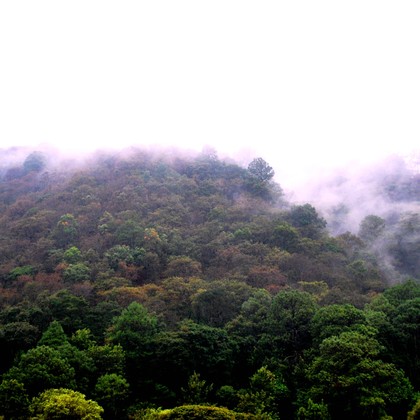
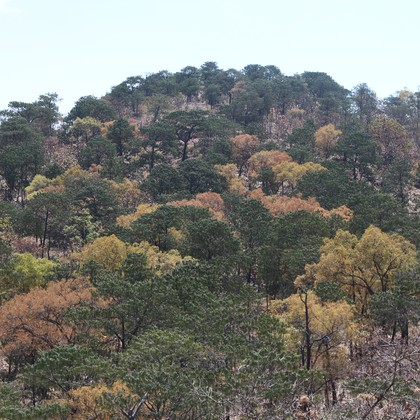
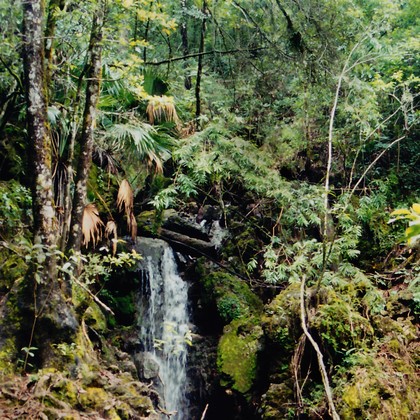
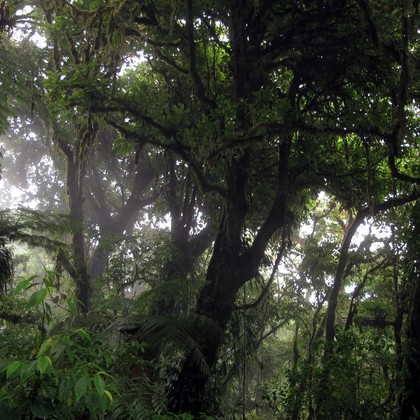
Pine-oak forest, oak forest, cloud forest and high-altitude conifer forest, forest edges and clearings in the mountains, roughly between 1000 and 3500 m, in Costa Rica and Panama mainly above 1500 m. Also visits orchards, shade coffee and gardens in the highlands. Roams in flocks and follows the supply of acorns, berries, fruit and seeds; in lean months it sometimes moves lower down. The nest is a loose platform of twigs in a tree.
Where the bird is most at home, classified by the vegetation units of Mexico and Central America.


Range and movements
In Mexico in the mountains of northern Baja California and, as a separate subspecies (P. f. vioscae), in the Sierra de la Laguna in southern Baja California Sur. Further along the Sierra Madre Occidental and the Sierra Madre Oriental, across the Trans-Mexican Volcanic Belt and in the Sierra Madre del Sur to the highlands of Oaxaca and Chiapas. In the highlands of Guatemala, El Salvador, Honduras and northern and central Nicaragua. In the mountains of Costa Rica and western Panama east to Veraguas (P. f. crissalis). Absent from Belize. Outside the guide area in the western United States and south-western Canada; the birds of the Andes are often treated as a separate species, P. albilinea.
- Resident
- dark = core range, pale = thinly spread
How and when to look
In the highlands of Costa Rica along the Cerro de la Muerte and at San Gerardo de Dota, and in Chiriquí around Boquete and Volcán Barú. In Mexico in pine-oak forest of the Sierra Madre, where flocks fly over the ridges in the morning and drop into oaks.
Conservation status
Not threatened. Locally common in the guide area, but scarcer where montane forest is cleared or hunting is heavy. Because it wanders, numbers can vary greatly from place to place and year to year.
Scientific name
Patagioenas fasciata | (Say, 1822)
Say described the species in 1822 as Columba fasciata; because it was later moved to another genus, the author and year stand in brackets. The genus Patagioenas was introduced in 1853 by Reichenbach. Patagioenas is Greek, from patageō 'to clatter' and oinas 'pigeon', after the clattering wings on take-off. fasciata is Latin for 'banded', after the pale band across the tail. The specimen the first description was based on came from Plum Creek near Castle Rock, Colorado.