All species › Owls › Owls › Bare-shanked Screech Owl
Position in the tree Birds Aves › Birds with a flexible palate Neognathae › All other modern birds Neoaves › Landbirds Telluraves › Raptors, owls, kingfishers and woodpeckers Afroaves › Hawks and owls Hieraves
Bare-shanked Screech Owl | Megascops clarkii
Kaalpootschreeuwuil | Autillo serrano
The Bare-shanked Screech Owl is a medium-sized screech owl of the montane forests of Costa Rica and Panama, with a small extension into northwestern Colombia. It is named after the unfeathered lower legs, a feature that is rarely seen in the field. It is resident in cloud forest and oak forest and lives hidden among moss and epiphytes.

Voice
A short series of three to five low, hollow notes, boo, boo-boo-boo, the last notes often following each other more quickly; repeated at short intervals. The female calls higher. Heard mainly shortly after sunset and before dawn.
Recording: Teet Sirotkin — CC BY-NC-SA 4.0 · converted to mono · xeno-canto
Identification
23–25 cm, with short, rounded ear tufts and yellow eyes. The plumage is warm cinnamon-brown to rufous, with a plain rufous facial disc without a distinct dark rim. The upperparts are brown with fine black spots and a row of pale spots across the scapulars. The underparts are pale cinnamon with large, diamond-shaped white spots edged by thin dark lines. The lower part of the legs is bare and greyish pink. Male and female are alike.
Confusion species
Tropical Screech Owl Megascops choliba is greyer, has a facial disc with a distinct black rim and dark streaks on the underparts, and lives lower, in semi-open country. Middle American Screech Owl Megascops guatemalae has finely vermiculated plumage without large white spots and lives mainly in the lowlands and foothills. Crested Owl Lophostrix cristata is much larger and has long white ear tufts.
Habitat
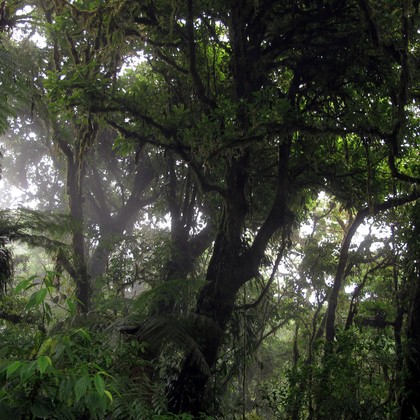
Cloud forest, montane rainforest and oak forest in the mountains, with abundant moss and epiphytes, also forest edges, clearings with scattered trees and shade coffee at the forest edge. It occurs from about 900 to 3000 metres, most between 1200 and 2500 metres. It nests in tree cavities. It hunts from a low branch for large insects, spiders, frogs and small rodents.
Where the bird is most at home, classified by the vegetation units of Mexico and Central America.



Range and movements
Resident in the mountains of Costa Rica, in the Cordillera de Tilarán, the Cordillera Central and the Cordillera de Talamanca, and of western Panama in Chiriquí, Bocas del Toro and the Ngäbe-Buglé region, east to Veraguas. A separate population lives in eastern Panama in the mountains of Darién, including Cerro Pirre and Cerro Tacarcuna. Outside the guide area only in extreme northwestern Colombia.
- Resident
- dark = core range, pale = thinly spread
How and when to look
Most often reported in the mountains around Monteverde and in the montane forests of the Cordillera de Talamanca, such as around San Gerardo de Dota, and in Panama around Boquete and Volcán Barú. After sunset the low call is often heard from a forest edge. A bird sometimes perches low at an open forest edge or along a road.
Conservation status
Not threatened. The range is small, but the species is locally fairly common in suitable montane forest and tolerates forest edges and small-scale farmland.
Scientific name
Megascops clarkii | (Kelso & Kelso, 1935)
Kelso & Kelso described the species in 1935 as Otus clarkii; because it was later moved to another genus, the author and year stand in brackets. The genus Megascops was introduced in 1848 by Kaup. Megascops combines the Greek megas 'great' with Scops, the old genus name of the scops owls. clarkii honours Revd Harry M. Clark (fl. 1917), a US minister who encouraged the describer Leon Kelso in ornithology. The specimen the first description was based on came from Calobre, Veraguas, Panama.