All species › Owls › Owls › Whiskered Screech Owl
Position in the tree Birds Aves › Birds with a flexible palate Neognathae › All other modern birds Neoaves › Landbirds Telluraves › Raptors, owls, kingfishers and woodpeckers Afroaves › Hawks and owls Hieraves
Whiskered Screech Owl | Megascops trichopsis
Gevlekte schreeuwuil | Tecolote rítmico
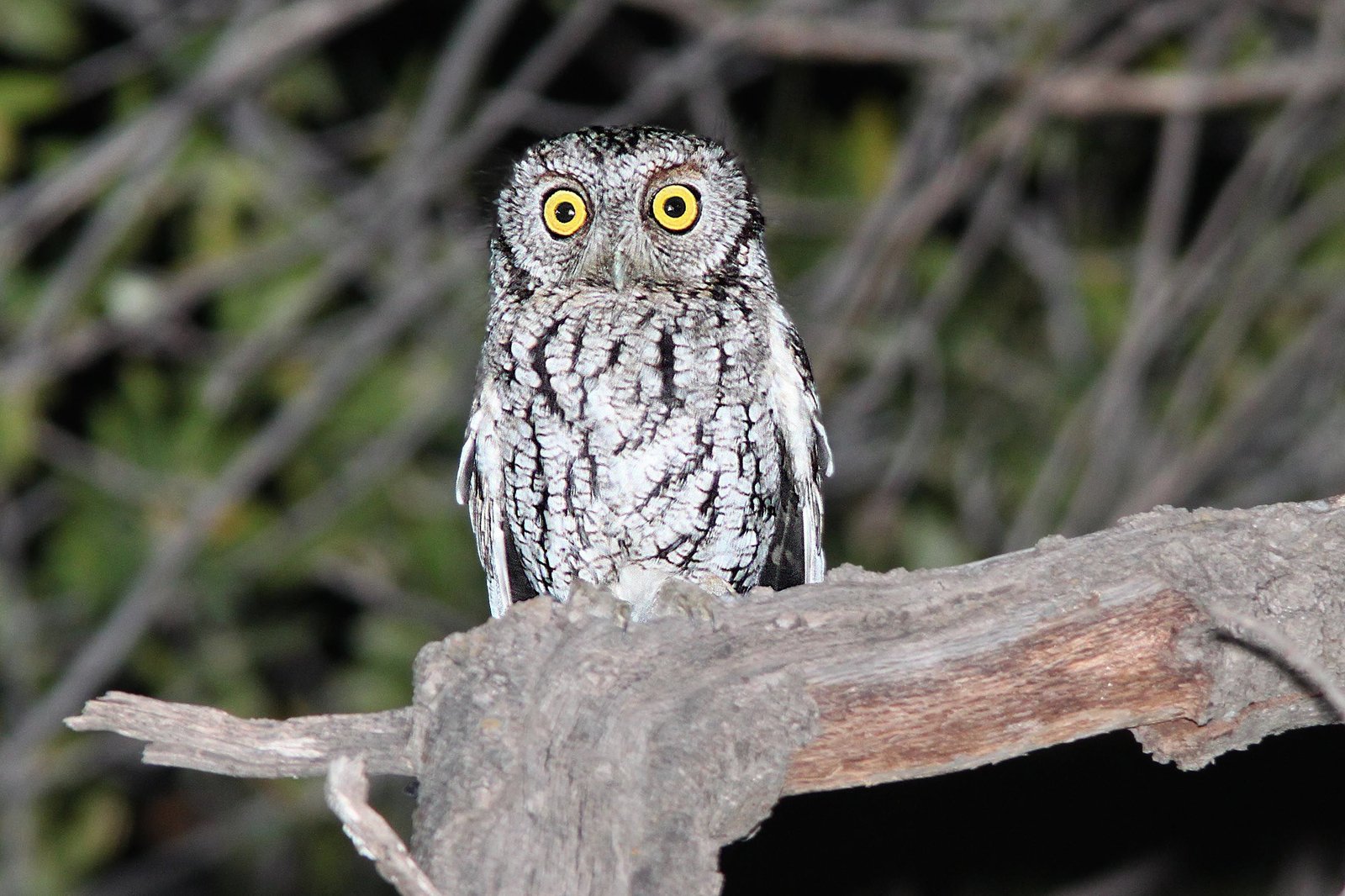
The Whiskered Screech Owl is a small screech owl of oak and pine-oak woodland in the mountains, from southeastern Arizona to northern Nicaragua. It is resident and can be heard year-round in the same territory. Its call, a series of notes in an irregular, Morse-code rhythm, sets it apart from the other screech owls in the same area.
Voice
A series of five to eight short, high boo notes in an irregular rhythm, with shorter and longer pauses, like Morse code: boo-boo-boo, boo-boo, boo. Also an even series of notes at a steady pace, and duets of male and female during courtship. Heard year-round, most from March to June.
Recording: GABRIEL LEITE — CC BY-NC-SA 4.0 · converted to mono · xeno-canto
Identification
16–19 cm, small, with short ear tufts, yellow eyes and a greyish-green to yellowish bill. Most birds are grey; in the south of the range rufous birds also occur. The facial disc is grey with a dark rim and long bristles at the base of the bill. The underparts have coarse black streaks with broad cross-bars and large, irregular black spots. The toes are relatively small. Male and female are alike.
Confusion species
Western Screech Owl Megascops kennicottii is larger, with a dark bill, larger feet and finer markings on the underparts; its song is an accelerating series of notes. Bearded Screech Owl Megascops barbarus is smaller, with a shorter tail and a short, fast trill as its song, and lives in the mountains of Chiapas and Guatemala. Flammulated Owl Psiloscops flammeolus has dark eyes and rufous scapular spots.
Habitat
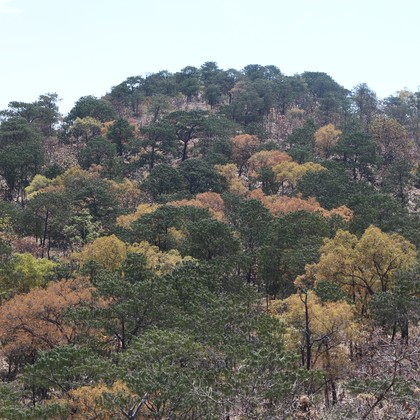
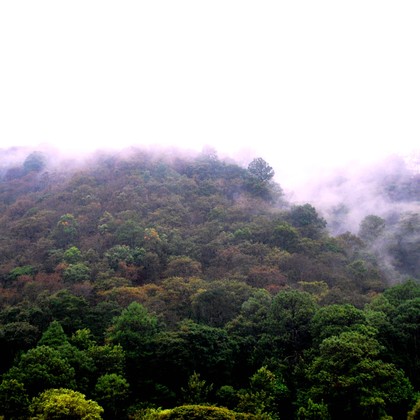
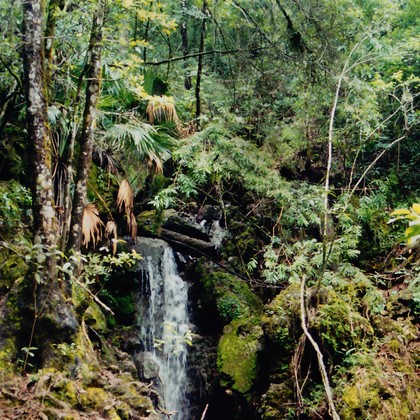
Oak and pine-oak woodland, especially in mountain canyons, often with sycamores and junipers along stream valleys, mostly between about 750 and 2500 metres. In the south also more humid forest at the edge of cloud forest and in shade coffee. It nests in woodpecker holes and natural cavities in oaks and sycamores. At night it hunts from a branch for large insects such as beetles, grasshoppers and moths, and for spiders and centipedes.
Where the bird is most at home, classified by the vegetation units of Mexico and Central America.


Range and movements
Resident in the mountains of Mexico, along the Sierra Madre Occidental from Sonora and Chihuahua through Sinaloa and Durango to Nayarit and Jalisco, along the Sierra Madre Oriental from Coahuila and Nuevo León southward, and on through Michoacán, Guerrero and Oaxaca to Chiapas. Also in the highlands of Guatemala, El Salvador and Honduras into northern Nicaragua, where the southern limit of the range lies. Outside the guide area only in southeastern Arizona and extreme southwestern New Mexico.
- Resident
- Summer visitor (c. Apr–Sep)
- Winter visitor (c. Oct–Mar)
- Passage (Mar–Apr, Oct–Nov)
- dark = core range, pale = thinly spread
How and when to look
Most easily heard in oak woodland in the mountains above Álamos in Sonora, in the Sierra de Picachos in Nuevo León and in the mountains of Durango and Sinaloa along the road to Mazatlán. After dark it often calls from a branch in the lower half of an oak and can be seen fairly well with a light.
Conservation status
Not threatened. The species is locally common in suitable montane woodland. Logging of oak woodland and the loss of old trees with cavities are local threats.
Scientific name
Megascops trichopsis | (Wagler, 1832)
Wagler described the species in 1832 as Scops trichopsis; because it was later moved to another genus, the author and year stand in brackets. The genus Megascops was introduced in 1848 by Kaup. Megascops combines the Greek megas 'great' with Scops, the old genus name of the scops owls. trichopsis is Greek, from thrix, trikhos 'hair' and opsis 'face, appearance', after the long facial bristles. The specimen the first description was based on came from Mexico (not specified).