All species › Passerines › Shrike-babblers, Erpornis and vireos › Black-capped Vireo
Position in the tree Birds Aves › Birds with a flexible palate Neognathae › All other modern birds Neoaves › Landbirds Telluraves › Falcons, parrots and passerines Australaves › Falcons and passerines Eufalconimorphae › Parrots and passerines Psittacopasserae
Black-capped Vireo | Vireo atricapilla
Zwartkapvireo | Vireo gorra negra
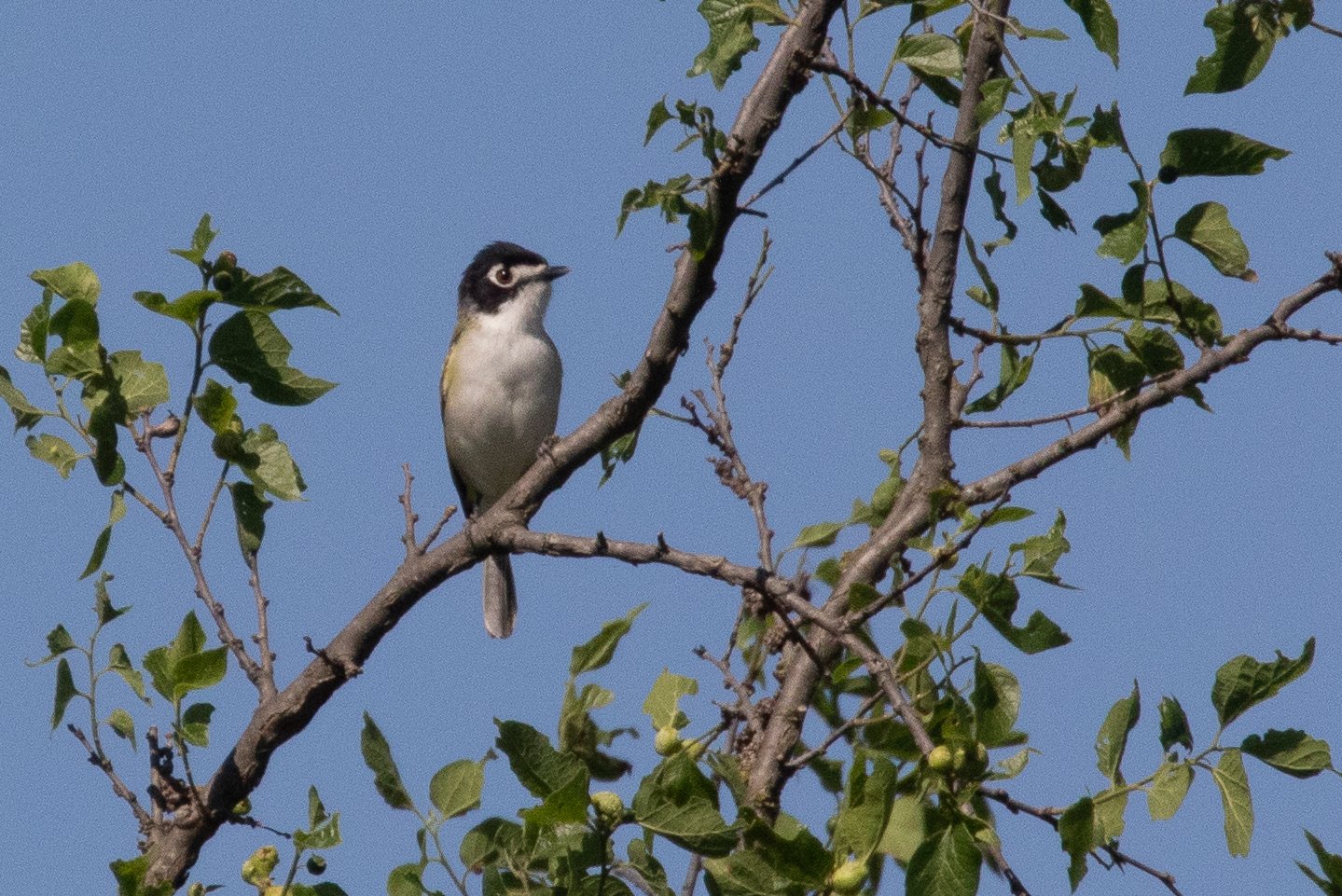
The Black-capped Vireo is a small vireo; the male has a glossy black head and bold white spectacles. It breeds in low oak scrub in north-eastern Mexico and winters on the Pacific slope of western Mexico. The species is sensitive to changes in its breeding habitat.
Voice
The song is a continuous, hurried series of varied, scratchy and clear phrases, repeated tirelessly. The call is a rasping chatter.
Recording: Sue Riffe — CC BY-NC-SA 4.0 · converted to mono · xeno-canto
Identification
11–12 cm. The male has a black head with broad white spectacles (lores and eye-ring). In the female the head is slate-grey, in young birds greyish-brown. Eye red in adults. Upperparts olive-green, two yellowish wing bars. Underparts white with olive-yellow flanks.
Confusion species
No other vireo in the guide area has a black head with white spectacles. White-eyed Vireo Vireo griseus has yellow spectacles, a grey nape and a white eye. Bell's Vireo Vireo bellii has faint spectacles and no dark head.
Habitat
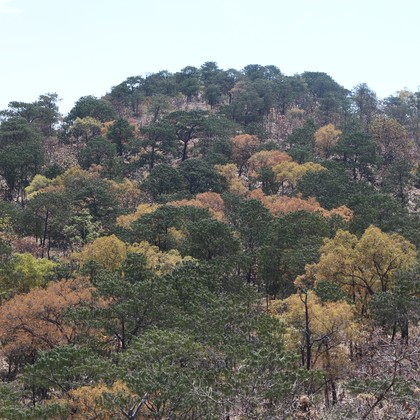
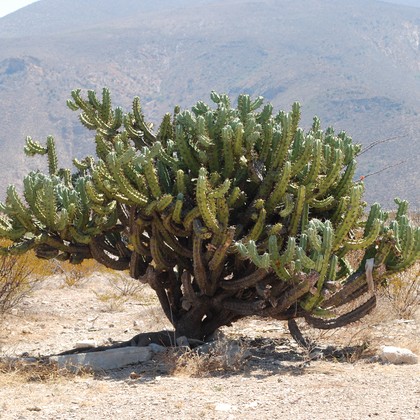
Breeds in low, patchy oak scrub and mixed shrubland on hills and slopes, with open spaces between the shrubs. Winters in dry forest, thorn scrub and shrubby ravines. Forages for insects in the foliage of shrubs.
Where the bird is most at home, classified by the vegetation units of Mexico and Central America.


Range and movements
Breeds in north-eastern Mexico, mainly in Coahuila, and in small numbers in neighbouring states. Winters on the Pacific slope of western Mexico, from Sinaloa south to about Guerrero. Outside the guide area it breeds in central and southern Texas and in Oklahoma.
- Summer visitor (c. Apr–Sep)
- Winter visitor (c. Oct–Mar)
- Passage (Mar–Apr, Oct–Nov)
- dark = core range, pale = thinly spread
How and when to look
In the breeding season the male sings almost continuously from the shrubs, which makes it easier to find. In winter it is inconspicuous and hard to locate.
Conservation status
Near Threatened. The breeding range is small and is declining through overgrazing, the loss of open scrub and brood parasitism by cowbirds; in the United States the species has recovered thanks to conservation measures.
Scientific name
Vireo atricapilla | Woodhouse, 1852
Woodhouse described the species in 1852 and placed it straight away in the genus where it still stands. The genus Vireo was introduced in 1808 by Vieillot. Vireo was used by Latin authors for a small, green, migratory bird, probably the Eurasian golden oriole, though the European greenfinch has also been suggested. atricapilla is Latin, from ater 'black' and capillus 'hair of the head', after the male's black head. The specimen the first description was based on came from Devils River near Sonora, Texas (USA).