All species › Passerines › Mockingbirds and thrashers › Black Catbird
Position in the tree Birds Aves › Birds with a flexible palate Neognathae › All other modern birds Neoaves › Landbirds Telluraves › Falcons, parrots and passerines Australaves › Falcons and passerines Eufalconimorphae › Parrots and passerines Psittacopasserae
Black Catbird | Melanoptila glabrirostris
Zwarte katvogel | Maullador negro
The Black Catbird is a medium-sized, all-black mimid with a blue-purple gloss. It lives in coastal scrub and low forest of the Yucatán Peninsula and its offshore islands, and occurs nowhere else. Its song and mewing call resemble those of Grey Catbird.

Voice
A varied series of squeaky, scratchy and whistled phrases, softer and more musical than the song of Grey Catbird, often from a high, open perch. Calls a nasal, mewing nyeh and a dry chak.
Recording: Manuel Grosselet — CC BY-NC-SA 4.0 · converted to mono · xeno-canto
Identification
19–21 cm. Entirely black with a blue to purple gloss, especially on head, back and wings. Eye reddish brown. Bill thin, straight and black, lacking the heavy structure of a blackbird. Tail fairly long and rounded; often perches with the tail drooped or slightly cocked. The sexes are alike; juveniles are duller blackish brown with a dark eye.
Confusion species
Melodious Blackbird Dives dives is larger, with a heavier, pointed bill and a dark eye, and often walks on open ground. Male Great-tailed Grackles Quiscalus mexicanus are much larger, with a long keeled tail and a yellow eye. Bronzed Cowbird Molothrus aeneus is stocky, with a short conical bill, a red eye and an erectile neck ruff. Grey Catbird Dumetella carolinensis, which winters in the same area, is grey with a black cap and rufous undertail coverts.
Habitat
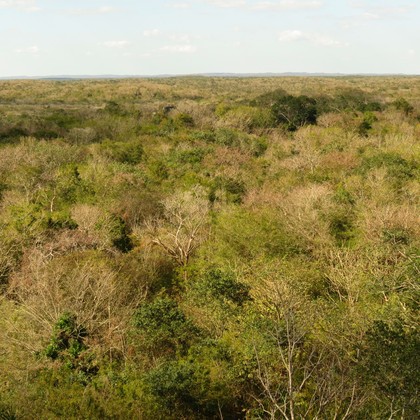
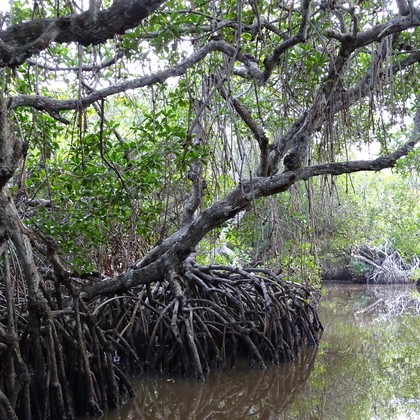
Coastal scrub and low semi-deciduous forest, mangrove edges, thickets behind beaches and on islets, also villages, hotel grounds and gardens with shrubs; mainly close to the sea, locally farther inland. It eats mainly fruit and berries, as well as insects.
Where the bird is most at home, classified by the vegetation units of Mexico and Central America.



Range and movements
Yucatán Peninsula (Yucatán, Quintana Roo and northern Campeche), including Cozumel, Isla Mujeres and other islands, northern Belize with its offshore cayes, and very locally northern Guatemala. It does not occur outside the guide area.
- Resident
- dark = core range, pale = thinly spread
How and when to look
On Cozumel and on Caye Caulker and Ambergris Caye in Belize it is easily seen in gardens and coastal scrub. In the breeding season it sings from a visible perch at the top of a shrub.
Conservation status
Not threatened (LC). The range is small and lies largely in the coastal strip, where tourist development is reducing the scrub sharply in places.
Scientific name
Melanoptila glabrirostris | Sclater, 1858
Sclater described the species in 1858 and placed it straight away in the genus where it still stands. He introduced the genus Melanoptila in that same work. Melanoptila is Greek, from melas 'black' and ptilon 'feather, plumage', after the all-black plumage. glabrirostris is Latin, from glaber 'smooth, bare' and rostrum 'bill', after the very small rictal bristles. The specimen the first description was based on came from near Omoa, Honduras.