All species › Passerines › Mockingbirds and thrashers › Grey Catbird
Position in the tree Birds Aves › Birds with a flexible palate Neognathae › All other modern birds Neoaves › Landbirds Telluraves › Falcons, parrots and passerines Australaves › Falcons and passerines Eufalconimorphae › Parrots and passerines Psittacopasserae
Grey Catbird | Dumetella carolinensis
Katvogel | Maullador gris
The Grey Catbird is a slender, slate-grey mimid with a black cap and rufous undertail coverts, named after its mewing call. It breeds in North America and in the guide area is a numerous winter visitor and passage migrant, especially on the Caribbean side of Mexico and Central America.

Voice
The call is a nasal, mewing meeew, like a cat, and a quick, dry chek-chek. The song, heard only occasionally in winter, is a long, rambling series of squeaky, scratchy and whistled notes with mimicry, without regular repetition.
Recording: Scott Olmstead — CC BY-NC-SA 4.0 · shortened to the first 60 s, mono · xeno-canto
Identification
21–24 cm. Plain slate grey, with a black cap from bill to hindcrown and rufous undertail coverts. Tail long, blackish and rounded, often flicked up or moved sideways. Eye and bill dark, bill fairly short and straight. The sexes are alike; first-winter birds hardly differ.
Confusion species
With its grey colour, black cap and rufous undertail, Grey Catbird is hard to confuse. Black Catbird Melanoptila glabrirostris of the Yucatán Peninsula is entirely glossy black. Grey Silky-flycatcher Ptiliogonys cinereus of the mountains has a crest, yellow-orange undertail and white patches in the tail.
Habitat
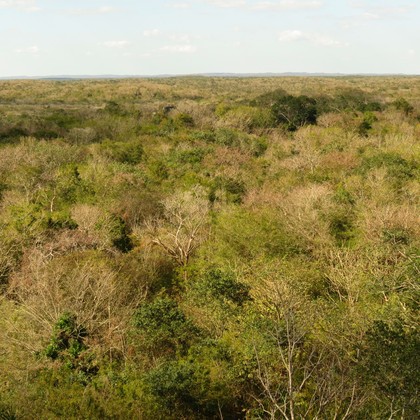
In winter dense thickets, overgrown secondary forest, forest edges, edges of mangrove and riparian woodland, hedgerows, shade coffee and gardens, mainly in the lowlands and foothills. In winter it eats much fruit and many berries, as well as insects.
Where the bird is most at home, classified by the vegetation units of Mexico and Central America.





Range and movements
Breeds in southern Canada and much of the United States east of the Rocky Mountains; resident on Bermuda. Winters in the south-eastern United States, the Caribbean and, in the guide area, from Tamaulipas along the Gulf coast across the Yucatán Peninsula and the Caribbean side of Central America to Panama, scarcer farther south; rare on the Pacific side.
- Winter visitor (c. Oct–Mar)
- dark = core range, pale = thinly spread
How and when to look
In winter on the Yucatán Peninsula and in Belize it is often plentiful in gardens and coastal scrub. The mewing call from a bush usually gives the bird away before its plumage does.
Conservation status
Not threatened (LC). Common and widespread. Many die in collisions with buildings during migration; in the wintering range it benefits from scrub and secondary forest.
Scientific name
Dumetella carolinensis | (Linnaeus, 1766)
Linnaeus described the species in 1766 as [Muscicapa] carolinensis; because it was later moved to another genus, the author and year stand in brackets. The genus Dumetella was introduced in 1837 by Wood. Dumetella is a diminutive of Latin dumetum 'thicket': 'little thicket bird', after its home in dense shrubbery. carolinensis means 'of Carolina', in North America, where the species was described. The specimen the first description was based on came from Virginia, USA.